
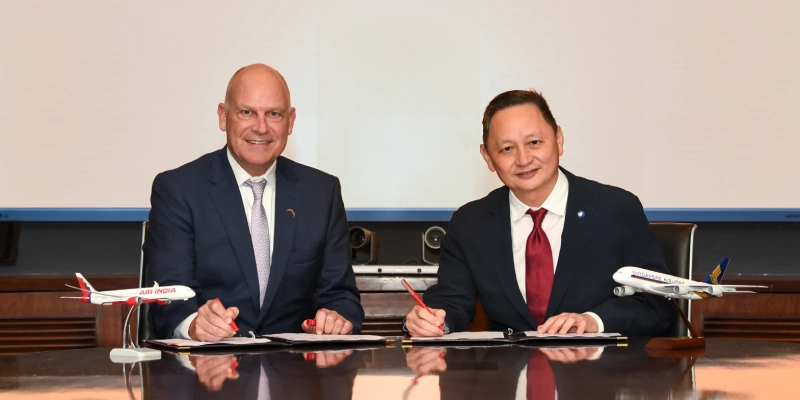
Air India and Singapore Airlines (SIA) have announced the signing of a framework commercial cooperation agreement, an instrument that lays the groundwork for a future joint strategic alliance, subject to regulatory approvals and the signing of definitive commercial agreements.
The agreement was signed in Mumbai by Campbell Wilson, Chief Executive Officer and Managing Director of Air India, and Goh Choon Phong, CEO of Singapore Airlines. Beyond the institutional gesture, the document formalizes a clear intent: to deepen commercial cooperation in order to strengthen connectivity between Singapore and India, one of the fastest-growing air corridors in Asia.
More Connectivity, More Commercial Integration
The central objective of the agreement is to expand and enhance both airlines’ product and service offerings. In practical terms, this would translate into smoother connections, a broader range of routes, and the ability for customers to book combined Air India and SIA flights within a single itinerary.
A key element will be closer coordination of flight schedules, a fundamental tool for improving the passenger experience on long-haul connections and maximizing the efficiency of both companies’ networks.
Although the agreement does not yet specify definitive dates or scope, the approach is progressive and conditional upon the approval of the relevant regulatory authorities—a critical aspect given the depth of commercial integration being sought.
→ Air India Seeks New CEO Amid Intense Scrutiny Over Operational and Safety Failures
Corporate Travelers and Loyalty Programs in Focus
The cooperation is not limited to the basic air transport product. Air India and SIA are also considering greater cross-participation in their corporate travel programs, a clear signal that the business segment is strategic for both airlines.
Simultaneously, enhancements to benefits for frequent flyers, beyond the current advantages of Star Alliance membership, will be explored. This would directly affect members of Maharaja Club (Air India) and KrisFlyer (Singapore Airlines).
Expansion Beyond India and Singapore
Another significant element is the intention to extend cooperation to key markets outside India and Singapore, wherever regulatory approvals allow. This approach aims to channel traffic through both airlines’ hubs, reinforcing their role in global connectivity and supporting the growth of both countries’ air markets.
This rationale aligns with the growing demand for international travel from India and with Singapore’s position as a strategic Southeast Asian hub.
An Already Solid Relationship: The Starting Point
The agreement does not start from scratch. Currently, Air India and Singapore Airlines share codes on 61 destinations across 20 countries and territories. This network is a direct result of the expansion of their codeshare agreement in October 2024, when 51 international and domestic destinations were added to both networks.
Campbell Wilson emphasized that this agreement aligns with Air India’s strategy of expanding its global presence, both through the addition of new aircraft and via stronger commercial partnerships, especially within Star Alliance. He further stressed that the approach will be “measured,” with the goal of creating sustainable, long-term value for customers and stakeholders.
For his part, Goh Choon Phong defined the agreement as a strategic and mutually beneficial collaboration, aimed at strengthening connectivity between the two countries, boosting the growth of air transport and tourism, and deepening commercial and personal ties between India and Singapore.
Although key details remain to be finalized, the framework agreement between Air India and Singapore Airlines represents a structured step towards deeper commercial integration.
Related Topics
LATAM Airlines Strengthens Regional Leadership with Five Honors at the 2026 World Travel Awards

Copa Airlines Restores Operations Following Seismic Activity in Panama and Expands Commercial Flexibility Policies

Arajet Resumes Direct Flights Between Punta Cana and Guayaquil

LATAM Airlines Announces Nonstop Flights Between Santiago de Chile and Caracas Starting in January


Un apasionado por la aviación, Fundador y CEO de Aviación al Día.