
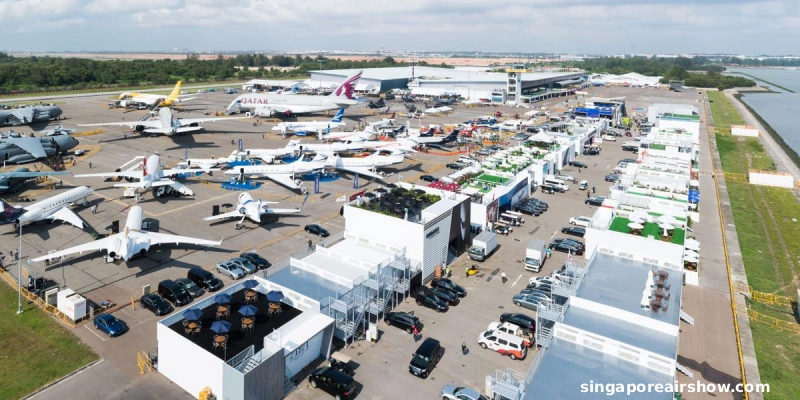
Boeing will arrive at the Singapore Airshow 2026 with a clear message strategically aligned with market reality: Southeast Asia will be a major engine of global aviation growth over the next two decades, and the company aims to position itself at the center of that expansion by combining commercial fleets, defense, services, and autonomous solutions.
The American manufacturer’s participation will not be limited to a static display. Its integrated approach encompasses market projections, technological demonstrations, autonomous products, and executive leadership in the event’s key forums.
A Market Growing 7% Annually, Demanding Nearly 5,000 New Aircraft
According to forecasts presented by Boeing, passenger air traffic in Southeast Asia will grow at an annual rate of 7%, one of the highest in the world. To absorb this demand, airlines in the region will require 4,885 new commercial aircraft by 2044.
This fleet growth brings with it a structural challenge that goes beyond aircraft manufacturing: human capital. Boeing estimates that 243,000 new aviation professionals will be needed in the region over the next 20 years, including more than 62,000 new pilots, as well as technicians and maintenance personnel to support the operation of an increasingly complex and technologically advanced fleet.
→ Boeing delivered 600 commercial aircraft in 2025: its highest number since 2018
“This region continues to be one of the fastest-growing aviation markets in the world,” said Penny Burtt, President of Boeing Southeast Asia, emphasizing the airshow’s role as a platform to strengthen ties with airlines, governments, suppliers, and universities.
Autonomy and Urban Air Mobility: Wisk Makes its Asian Debut
One of the most innovative focuses at Boeing’s stand will be autonomous air mobility. For the first time at the Singapore Airshow, the cockpit of Wisk’s air taxi will be displayed, following the successful first flight of the Gen 6 aircraft in December 2025.
Visitors will be able to experience the vision of urban air mobility through virtual reality, interacting with the cockpit of a fully electric, autonomous vehicle—a clear signal of Boeing’s long-term direction for congested urban environments.
777X: Betting on Comfort and Cabin Architecture
In the commercial aviation segment, Boeing will showcase a full-scale interior mock-up of the 777X, highlighting a wider cabin and an optimized interior architecture. The presence of the 777X at the airshow reinforces its positioning as the manufacturer’s long-range flagship, particularly relevant for Southeast Asian airlines with expanding intercontinental networks.
Defense and Unmanned Systems: A Comprehensive Portfolio
The defense area will also have significant weight. Key aircraft from Boeing’s military portfolio will be presented in the static display:
- KC-46 Pegasus
- P-8 Poseidon
- AH-64 Apache
- F-15 Eagle
- CH-47 Chinook
This is complemented by the participation of Insitu Pacific, a Boeing subsidiary, which, as part of the Team Defence Australia delegation, will highlight the ScanEagle and Integrator unmanned systems, along with their sensor and payload capabilities. The combination of manned and unmanned platforms reinforces Boeing’s strategy in defense, surveillance, and operational autonomy.
Boeing in the Strategic Debate: Sustainability, AI, and Supply Chain
Beyond products, Boeing will seek to influence the industry’s agenda through a strong executive presence in panels and conferences:
Sustainability and Innovation:
- Todd Citron, Chief Technology Officer, will participate in the “Innovating Sustainability” forum.
- Kim Camrass, Sustainability Leader for Asia Pacific, will address the path to Net Zero in aviation.
Industry and Supply Chain:
- William Ampofo, Senior Vice President of Parts & Distribution and Supply Chain for Boeing Global Services, will analyze the future of aeronautical production and supply.
Artificial Intelligence and Diversity:
- Todd Citron will also participate in a panel dedicated to AI in aviation.
- Penny Burtt will take part in a discussion on inclusive innovation and developing a diverse future industry.
For Southeast Asia, the challenge will not only be to grow, but to do so safely, sustainably, and with sufficient talent. Boeing makes it clear that it wants to be a central part of that equation. Now, the market will have the final say.
Related Topics
Embraer Reports Record Third-Quarter Performance With 66 Aircraft Delivered
Embraer Nears Key Regional Jet Order from Japan Airlines
BermudAir Becomes Second Global Operator of Embraer E-Freighter

ANA Expands Regional Fleet with Additional Order for Eight Embraer E190-E2s


Plataforma Informativa de Aviación Comercial con 13 años de trayectoria.