
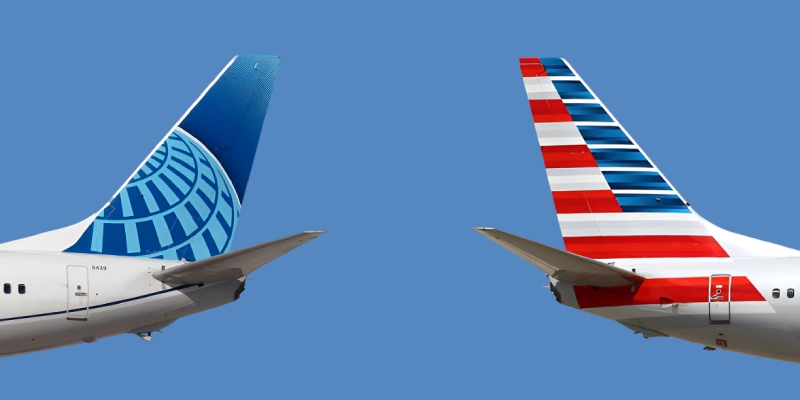
Chicago’s O’Hare International Airport, one of the world’s most valuable commercial aviation hubs, has become the stage for an open competition between United Airlines and American Airlines. What began as an uneven post-pandemic recovery has evolved into a structural dispute over gates, schedules, connectivity, premium products, and market share—with long-term implications for both carriers and the U.S. corporate travel ecosystem.
Far from a price war, the battle in Chicago reveals a truth increasingly clear in the industry: physical and operational access to the airport defines the winner.
From Post-Pandemic Recovery to Direct Confrontation
After COVID-19, United moved faster to restore and later expand its operations at O’Hare, while American remained below its 2019 levels for a longer period. That initial gap has now turned into a tangible difference in scale and control.
American, which claims a historic presence in Chicago dating back to its first scheduled flight in 1926, considers O’Hare its third-largest hub. United, on the other hand, is playing at home: its corporate headquarters is in Chicago, and the airport is a cornerstone of its domestic and international network.
In late December, American announced its largest spring schedule ever at O’Hare, featuring:
- Nearly 100 additional flights on peak days
- Over 75 destinations served
- More than 500 daily flights, a 30% increase over the previous year
- Extended seasonal transatlantic service to Paris and Dublin
→ United Airlines Redefines Meal Service in Economy Class: Customers Can Preorder Before Their Flight
United Counters from a Dominant Position
United not only responded but did so from a structurally stronger position. For the summer, the airline plans to operate nearly 650 daily flights to about 200 destinations from O’Hare, supported by a larger gate footprint and a broader connection network.
The company says it has hired thousands of local employees and plans to add thousands more before 2027—a sign of its long-term commitment. Operational results back this narrative:
- Just 1% of flights canceled at O’Hare in 2025, its lowest rate ever at the airport.
- A nearly 20 percentage-point lead in local passenger share over American.
For United CEO Scott Kirby, O’Hare is now “solidly profitable,” a statement he uses to question the sustainability of his rival’s growth.
Gates and Schedules: Real Battleground
Analysts agree that the Chicago face-off illustrates a structural shift in airline competition. It’s not fares that define the hierarchy, but access to gates and schedule quality, especially for corporate travelers.
In most major U.S. hubs, the map is set:
- Delta dominates Atlanta
- United controls Houston
- American leads Dallas/Fort Worth
Chicago is an exception. It’s one of the few airports where two legacy carriers still compete at scale, and that competition happens in real time. When American announced new routes, United responded in less than 24 hours, in some cases adding frequencies in the same markets.
An Expanding Airport… and a Disputed One
According to Michael McMurray, Commissioner of the Chicago Department of Aviation, the rivalry reflects the city’s strength. With eight runways and an $8.5 billion terminal expansion plan that will add new gates over the next decade, the airport can absorb growth without falling into chronic congestion.
Data supports this view. An analysis by Professor Joseph Schwieterman (DePaul University) shows O’Hare was the fastest-growing major U.S. hub last year in:
- Passenger numbers
- Flight departures
- Gate utilization
Chicago as a Strategic Premium Market
Chicago’s central location allows efficient connections between the East and West Coasts, while also serving as a key gateway to Europe and Asia. This is bolstered by a strong corporate base, which drives demand for:
- Premium cabins
- VIP lounges
- Reliable operations
Both airlines are fine-tuning their offerings:
- United is expanding premium seats and lounges and deploying high-speed Starlink Wi-Fi.
- American says it now offers premium seats on all departures from O’Hare after fleet upgrades and has made the Boeing 787-9 the core aircraft on the Chicago–London route, one of the most important corporate markets.
American also reported that loyalty program enrollments in Chicago grew nearly 20% in the third quarter of 2025—more than double its network’s average growth rate.
Gate Arithmetic: A Clear Advantage for United
According to Cirium data, United operates about 50% of all scheduled flights at O’Hare, compared to roughly one-third for American. That gap widened at the end of 2025 when:
- United gained five gates
- American lost four, following a city-led reassignment that the airline unsuccessfully tried to reverse in court.
American considers the loss temporary. To mitigate the impact, it purchased two gates from Spirit Airlines for $30 million, which it says recovers about half of the lost capacity.
For now, the battle at O’Hare is far from over. And in modern commercial aviation, few disputes are as revealing as this one.
Related Topics
LATAM Airlines Strengthens Regional Leadership with Five Honors at the 2026 World Travel Awards

Copa Airlines Restores Operations Following Seismic Activity in Panama and Expands Commercial Flexibility Policies

Arajet Resumes Direct Flights Between Punta Cana and Guayaquil

LATAM Airlines Announces Nonstop Flights Between Santiago de Chile and Caracas Starting in January


Plataforma Informativa de Aviación Comercial con 13 años de trayectoria.