
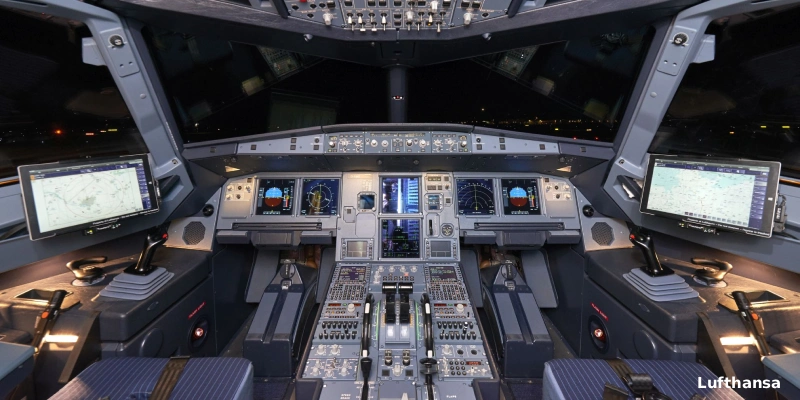
Lufthansa Airlines has introduced “IATA Turbulence Aware” technology, a system based on real-time data that improves in-flight turbulence management through the collection and exchange of anonymized atmospheric information. With this integration, the company not only optimizes its own operations but also actively contributes to improving the quality of data available to airlines globally. Within the group, Swiss International Air Lines and Edelweiss Air are also participating in the initiative.
How does “IATA Turbulence Aware” work?
The system relies on a clear principle: collective intelligence based on distributed sensors. Thousands of aircraft worldwide are equipped with sensors capable of continuously measuring turbulence intensity during flight.
- Each measurement is transmitted anonymously to a central database.
- The result is a global atmospheric information network updated in real time.
- In the cockpit, pilots can visualize this data directly on their navigation maps.
The information is represented by color-coded symbols indicating:
- Turbulence location.
- Altitude.
- Time of recording.
- Measured intensity.
This system complements traditional weather forecasts and allows for more precise flight planning, adjusted to actual conditions rather than just projections.
→ Lufthansa Modernizes 38 Airbus A320s with New Cabins, Increased Luggage Capacity, and USB Ports
Operational Impact: Safety, Planning, and Passenger Experience
According to Francesco Sciortino, Hub Manager Frankfurt: “With ‘IATA Turbulence Aware,’ we are setting new standards for safety and comfort in aviation. This technology allows us to offer our passengers a smoother and more pleasant flight experience, while making a significant contribution to global aviation safety”.
Beyond improvements in strategic route planning, the availability of real-time data has a direct impact on daily operations:
- Pilots can anticipate turbulence episodes with greater precision.
- Cabin crew can be warned in advance.
- In-flight service can be planned or interrupted at the appropriate time.
- Safety for both passengers and crew is reinforced.
In practical terms, this reduces exposure to unforeseen situations and allows for more proactive management of operational risk.
Contribution to Global Meteorology
Lufthansa’s participation in “IATA Turbulence Aware” is not limited to its internal scope. Every measurement recorded by a company aircraft is sent not only to the system’s database but also to the German Meteorological Service.
This data transfer contributes to:
- Calibrating weather prediction models.
- Improving the accuracy of long-term forecasts.
- Strengthening the quality of data used by the global aviation industry.
With the implementation of “IATA Turbulence Aware,” Lufthansa reaffirms its focus on technological innovation, operational safety, and a premium travel experience.
Related Topics
LATAM Airlines Strengthens Regional Leadership with Five Honors at the 2026 World Travel Awards

Copa Airlines Restores Operations Following Seismic Activity in Panama and Expands Commercial Flexibility Policies

Arajet Resumes Direct Flights Between Punta Cana and Guayaquil

LATAM Airlines Announces Nonstop Flights Between Santiago de Chile and Caracas Starting in January


Un apasionado por la aviación, Fundador y CEO de Aviación al Día.