
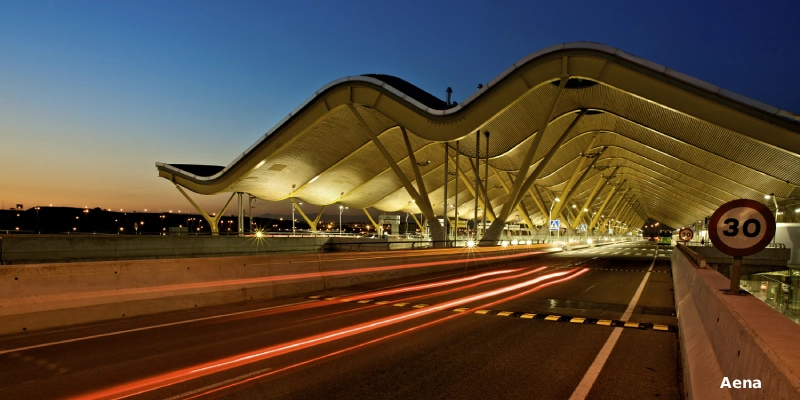
The T4 Terminal at Adolfo Suárez Madrid-Barajas Airport marks twenty years as one of the most influential airport infrastructures in Europe. Since the inaugural takeoff of Iberia flight IB2640 to Barcelona at 5:30 AM on February 5, 2006, T4 has not only expanded the airport’s capacity but also transformed its strategic role, operations, and international profile.
Officially inaugurated on February 4, 2006, in an event attended by over 1,000 guests—including authorities and executives from Aena, airlines, and participating companies—T4 was born as a structural solution to a clear problem: sustained growth in passenger traffic and Barajas’ lack of capacity to absorb it.
Context: Barajas Plan and the Need for Growth
The T4 cannot be understood without the Barajas Plan, an ambitious program launched by Aena in the 1990s to modernize and expand Spain’s primary airport.
Phase One: Establishing the Operational Foundations In the late 90s, the first stage was executed, which included:
- A new control tower
- The commissioning of what was then called the third runway (18R-36L)
- Expansions to the piers of terminals T1 and T3
Phase Two: Doubling the Airport’s Capacity The decisive phase began in the early 2000s. The goal was clear and measurable: to double the airport’s capacity from 35 to 70 million annual passengers and increase operational capacity to 120 movements per hour.
Within this framework, the following were built:
- Terminal T4 and the T4S satellite building
- Two new takeoff and landing runways
- New aircraft parking aprons
- Parking lots, access roads, and a service tunnel under the runways
- Undergrounding of the M-111 highway
This was accompanied by a significant technological leap for the era.
→ Madrid-Barajas Airport Closes 2025 with Record Figures
Pioneering Technology at the Service of Operations
T4 incorporated systems that marked a turning point in Spanish airport infrastructure:
- The Automatic People Mover: The first automated driverless train implemented in Spain.
- Automated Baggage Handling System: Featuring 120 kilometers of conveyor belts, also a national first.
- Airport Management Center: The airport’s “brain,” managing real-time operations supported by 5,000 security cameras.
These elements not only increased capacity but also improved operational reliability and the passenger experience.
T4: Architecture, Functionality, and User Experience
A Single Terminal Area of 800,000 m² T4 and its T4S satellite, with a combined surface area of nearly 800,000 square meters, were conceived as a single terminal area:
- Main Building (T4): Check-in, security checkpoints, baggage claim, and boarding for domestic and Schengen flights.
- Satellite Building (T4S): Dedicated to international hub operations.
Iconic Design with Operational Logic The project, signed by Antonio Lamela and Richard Rogers, opted for architecture where aesthetics reinforce functionality. Natural light, spatial clarity, flexibility, and the warmth of materials define a terminal designed for passenger comfort and long-term efficiency.
The influx of natural light is one of its most recognizable features:
- Over 550 skylights in T4
- 250 skylights in T4S
The characteristic color gradient, moving from blue to red, is more than just a visual resource: it acts as an intuitive guide for passengers on their way to the boarding gates.
Capacity and Constant Evolution
Since its opening, T4 has had the capacity to handle up to 10,400 passengers during peak hours. Over these 20 years, its systems and infrastructure have been continuously expanded and digitized, maintaining quality standards befitting a major international hub.
Commercial Expansion and New Services Adaptation was not only operational. Commercial and service areas have also evolved significantly. In T4 and T4S, commercial space grew from 19,000 m² to over 25,000 m², featuring:
- More than 80 shops and dining establishments
- New duty-free concepts
- Unique offerings such as the Real Madrid bars or Dabiz Muñoz’s Hungry Club
Additionally, services oriented toward connecting passengers were added:
- Air Rooms in T4
- GettSleep Lounge in T4S
All of this reinforces Barajas’ positioning as an international hub.
Impact on Airport Figures
The effects of T4 were quickly reflected in the data.
- 2005 (Pre-T4): 42.1 million passengers
- 2007 (One year later): 52.1 million, exceeding 50 million for the first time
- 2025: Historical record with over 68.1 million passengers
This growth contrasts sharply with the 2,900 passengers recorded in 1933 when Barajas began its commercial activity.
Intermodality, Airport Cities, and Sustainability
In these two decades, Madrid-Barajas has reached key milestones:
- Arrival of the Metro and Cercanías (commuter rail) to T4
- Inauguration of a new bus terminal in 2022
- Promotion of Airport Cities, with logistical, aeronautical, hotel, and office developments, including the future Aena headquarters
Regarding sustainability and innovation:
- Construction of the world’s largest airport-based solar photovoltaic park
- Implementation of remote driving for passenger boarding bridges, a world-pioneering project
International Recognition
T4 is also one of the most awarded terminals in the world. Its accolades include:
- RIBA Stirling Prize 2006
- RIBA European Awards 2006
- International Architecture Award 2007 (Chicago Athenaeum)
- Best New Airport 2006 (Wallpaper)
- Best New Building 2006 (Madrid City Council)
Since its opening, the airport has accumulated more than 50 awards, including Skytrax’s Best Airport in Southern Europe and ACI’s Best Airport in Europe in its category.
Looking to the Future: New Investments and More Capacity
With the airport again approaching its capacity limit, Aena has planned investments of nearly 4 billion euros to ensure Madrid-Barajas remains competitive against other major international hubs.
The actions focus on two axes:
- Extension of T4 and T4S terminals, along with new parking aprons, reinforcing hub operations.
- Construction of a new processing building in front of terminals T1, T2, and T3, alongside the remodeling of these facilities.
As summarized by Javier Marín San Andrés, Executive Vice President of Aena and CEO of Aena International, T4 has allowed Barajas to serve nearly 980 million passengers in 20 years and is now preparing for “the coming decades” with room for growth and a clear commitment to sustainability.
Twenty years later, T4 is not just a terminal. It is the axis upon which Madrid-Barajas consolidated itself as the great aerial gateway between Europe and Latin America and one of the airports with the highest growth potential on the continent.
Related Topics
LATAM Airlines Strengthens Regional Leadership with Five Honors at the 2026 World Travel Awards

Copa Airlines Restores Operations Following Seismic Activity in Panama and Expands Commercial Flexibility Policies

Arajet Resumes Direct Flights Between Punta Cana and Guayaquil

LATAM Airlines Announces Nonstop Flights Between Santiago de Chile and Caracas Starting in January


Un apasionado por la aviación, Fundador y CEO de Aviación al Día.