
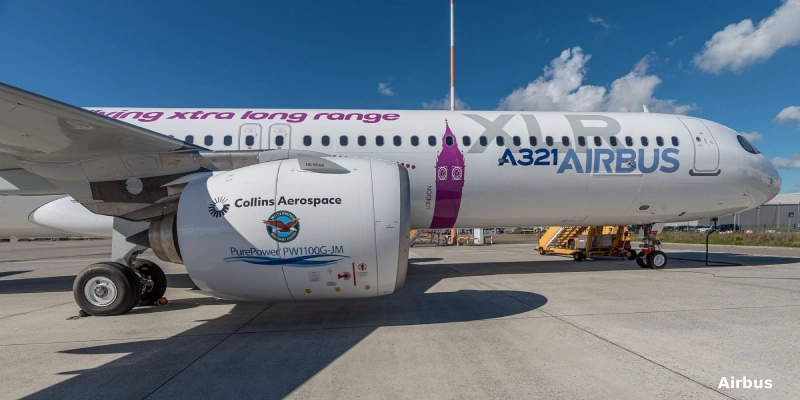
Airbus is spearheading the ECLIF-X flight test campaign, a pioneering research initiative designed to quantify and mitigate non-CO2 aviation emissions, with a specific focus on condensation trails (contrails) and their capacity to trap heat in the atmosphere. Through a strategic collaboration with the German Aerospace Center (DLR) and Pratt & Whitney, the project seeks to transform future engine design and fuel standards.
What is ECLIF-X and Why is it Vital for the Industry?
The Emissions and Climate Impact of Alternative Fuels (ECLIF-X) project represents a fundamental pillar in the industry’s commitment to reducing its total environmental footprint. Although carbon dioxide (CO2) is usually the primary focus, non-CO2 emissions, such as contrails, play a critical role in global warming.
These white lines that appear behind aircraft are ice clouds formed when hot, humid engine exhaust meets the freezing air at high altitudes. Under certain atmospheric conditions, these trails can trap heat, contributing significantly to the greenhouse effect.
“Sticky Seed” Problem: Soot and Sulfur
The formation of ice crystals in contrails depends on the presence of microscopic particles in the exhaust that act as “seeds” for water vapor to condense and freeze. The ECLIF-X project identifies two primary origins for these particles:
- Aromatics: Compounds present in the fuel that are the main precursors to soot particles.
- Sulfur: Even in trace amounts, it generates sulfuric acid that can coat soot or create volatile particles that attract water vapor.
→ Atlas Air Becomes Largest Airbus A350F Customer with Order for 20 Aircraft
To combat this, the test aircraft—an Airbus A321XLR—utilizes the Pratt & Whitney PW1100G-JM engine equipped with a TALON-X rich-burn combustion chamber, specifically designed to reduce soot emissions from the gas turbine.
Aerial Choreography: “Emitter” and the “Tracker”
The campaign, running between 2025 and 2027, employs a direct in-flight measurement methodology using two aircraft operating in a carefully choreographed formation:
- The Emitter (Airbus A321XLR): The testbed aircraft (MSN11058) flies using three types of fuel with different sulfur levels to observe their impact on emissions.
- The Tracker (DLR Falcon 20E): Acting as a flying laboratory, this aircraft positions itself directly in the exhaust plume of the A321XLR, at distances between 50 and 300 meters, to collect precise data on ice crystals and emissions.
Fuels Under Analysis
To obtain comprehensive data, the team is testing three variants of Jet A-1 fuel:
- Conventional Jet A-1: The baseline reference with approximately 200 ppm of sulfur.
- High-Sulfur Jet A-1: A special batch of 650 ppm to amplify and clearly observe its impact.
- Ultra-Low Sulfur and Aromatics Jet A-1: A hydrotreated fuel with less than 1 ppm of sulfur to evaluate the maximum potential benefit.
Toward Fuel Standards and Intelligent Operations
The results of ECLIF-X, which will continue to be processed over the next two years, will allow for the exact quantification of how much ice crystal formation can be reduced by altering fuel composition.
Beyond hardware and fuel, this research opens the door to new operational practices, such as contrail-avoidance navigation. This would allow airlines to adjust their flight paths in real-time to avoid atmospheric zones prone to the formation of persistent contrails. With this effort, Airbus and its partners seek not only to improve climate modeling but also to define design decisions for the next generation of aircraft.
Related Topics

Boeing Faces Delays in Stabilizing 737 MAX Production

Korean Air and Boeing Finalize Historic Order for 103 Aircraft Valued at $36.2 Billion

Boeing Nears 150-Jet 737 MAX Deal with Turkish Airlines After Resolving Engine Maintenance Dispute

Boeing and American Airlines Successfully Complete First 737 MAX Landing Gear Exchange


Un apasionado por la aviación, Fundador y CEO de Aviación al Día.