
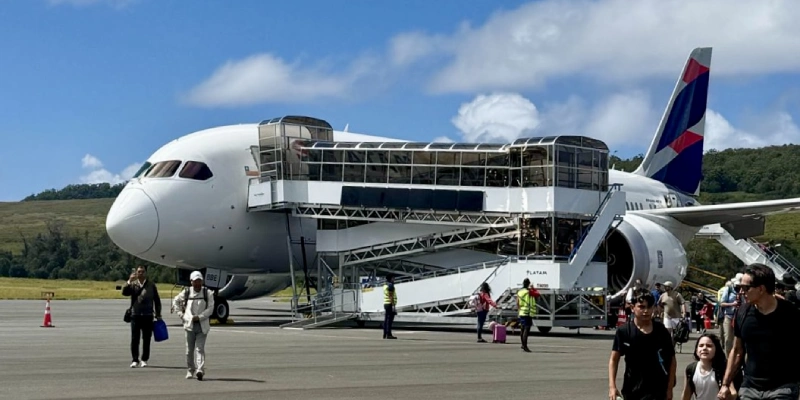
LATAM Airlines Group has marked a historic milestone in regional aviation by transforming its operations at Rapa Nui’s Mataveri International Airport into a combustion-free, zero-emissions system. This initiative positions the island’s terminal as the first in Latin America to feature a ramp service operated entirely by electric ground support equipment (eGSE), reinforcing the airline’s commitment to sustainability in vulnerable ecosystems.
Modernizing the Ground Fleet in Rapa Nui
The implementation of this system represents a radical shift in platform logistics. The company has introduced 6 new 100% electric units that replace the entirety of the airline’s ground support machinery on the island.
Key integrated equipment includes:
- Electric baggage tractors and tow tugs.
- Electric mobile boarding bridges.
This advancement not only enables the direct elimination of exhaust gases during aircraft turnaround and servicing but also contributes significantly to mitigating noise pollution within the airport perimeter, enhancing operational standards in a territory of immense environmental and cultural value.
→ LATAM Airlines to Resume Direct Flights Between Santiago and Quito
A Logistic Challenge in the World’s Most Remote Territory
Executing this project represented a major technical challenge due to Rapa Nui’s geographical isolation. The equipment, manufactured in various countries across Europe, North America, and Asia, had to be initially shipped to the Port of Valparaíso before embarking on its transoceanic journey.
Since the island lacks a traditional deep-water docking port for cargo of these dimensions, the offloading operation was conducted under critical conditions:
- Open-ocean transfer: The equipment was moved from the primary vessel onto smaller barges.
- Shore transport: The barges transported the machinery to the coastline.
- Final mobilization: A specialized crane was utilized to offload the equipment and transfer it directly to the airport.
This process demonstrates that innovation and sustainable solutions are viable even in the most complex and remote geographical conditions in the world.
Strategic Vision: Heading Toward Net-Zero Emissions
This initiative in Rapa Nui is an integral part of the group’s sustainability strategy, which aims to reach net-zero emissions by 2050. To measure progress, the company has established intermediate milestones for 2030, focusing on a 6% reduction in emission intensity compared to 2019 levels.
This path toward decarbonization is supported by three fundamental pillars:
- Fleet Renewal: Projections indicate that 50% of the fleet will consist of next-generation aircraft, doubling current technological capacity.
- Operational Efficiency: Process optimization through the intensive use of data and Artificial Intelligence (AI).
- Sustainable Aviation Fuel (SAF): Expanding the use of SAF as a key tool for reducing the carbon footprint.
The electric transformation of the ramp in Rapa Nui is more than just a technological leap; it is a statement of principles regarding the future of aviation in the region. According to Eduardo Bustamante, LATAM’s Regional Airports Sub-Manager, operating with the highest standards in locations of enormous cultural value is a long-term requirement that is now being translated into concrete solutions for the industry’s decarbonization.
Related Topics

Thai Airways Cuts Flights and Faces Baggage Handling Collapse Following Severe Bangkok Flooding

Akasa Air in Talks With Boeing for Over 200 737 MAX Jets

Embraer Nears Key Regional Jet Order from Japan Airlines

AirAsia Co-Founder Defends Airline’s Liquidity Amid Fuel Surge and Rules Out State Bailout


Plataforma Informativa de Aviación Comercial con 13 años de trayectoria.