
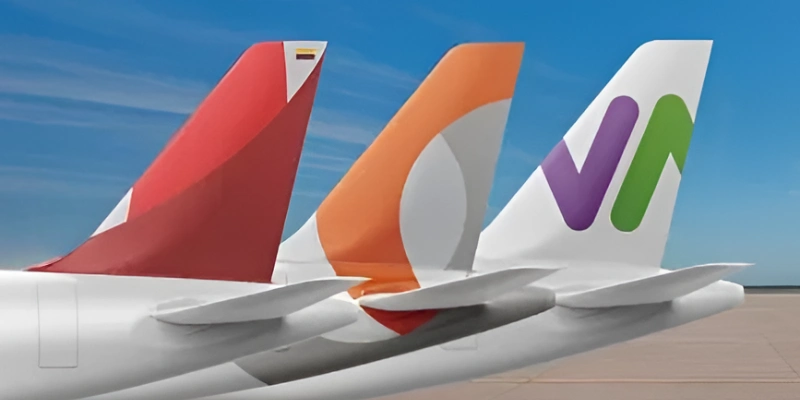
Abra Group Limited, the holding company encompassing Avianca, GOL, and Wamos Air, closed the 2025 fiscal year with a robust financial and operational performance. Following GOL’s successful exit from Chapter 11 and its subsequent consolidation into the group’s financial statements, the company reported double-digit revenue growth and key strategic progress in Latin American connectivity.
Financial Results: Growth and Margin Expansion
The year 2025 marked a turning point for Abra Group. Total pro forma operating revenues reached $9.7 billion, representing an 11.1% increase compared to the previous year. This growth was primarily driven by:
- Passenger Revenue: Increased by 7.9%, reflecting resilient demand across the region.
- Cargo and Other Services: This segment (which includes Wamos Air) generated $1.6 billion, showing robust growth of 31.3%.
In terms of profitability, the adjusted EBITDAR (Earnings Before Interest, Taxes, Depreciation, Amortization, and Restructuring/Rentals) rose to $2.7 billion. The EBITDAR margin stood at 27.4%, achieving an expansion of 321 basis points compared to 2024.
Strategic Milestones and Fleet Strengthening
One of the most significant events of the year was GOL Linhas Aereas Inteligentes’ emergence from its Chapter 11 restructuring process on June 6, 2025. As of that date, Abra became the controlling shareholder, consolidating its financial results.
Regional Expansion and New Alliances
The group announced an agreement in principle for a business combination with SKY Airline, the second-largest carrier in Chile and Peru in terms of Available Seat Kilometers (ASK). If finalized, this union would add 52 routes and 29 additional destinations to the holding company’s network.
→ Avianca Doubles Down on Venezuela: Airline to Operate Two Daily Flights Between Bogota and Caracas
Aircraft Modernization
To support its long-haul strategy and efficient growth, Abra Group strengthened its order book with the addition of:
- 50 Airbus A320neo aircraft for short and medium-haul routes.
- 7 Airbus A330neo aircraft, of which GOL will operate up to five and Avianca the remaining two.
- These aircraft are configured with 290 seats.
Operational Performance and Efficiency Metrics
During 2025, the group transported 71 million passengers, a 5.2% year-on-year increase, while total capacity grew by 11.6%.
Key Performance Indicators (KPIs)
- Load Factor: Remained healthy at 81.3%.
- Passenger Revenue per Available Seat Kilometer (PRASK): Stood at 6.8 cents.
- Passenger Cost per Available Seat Kilometer (Passenger CASK): Costs (excluding fuel) remained under control at 4.2 cents.
Regarding On-Time Performance (OTP), GOL led the group with 87.4%, while Avianca recorded 81.7%. Both airlines demonstrated exceptional schedule reliability, exceeding 98%.
Loyalty and Customer Experience
The loyalty platform, comprising LifeMiles and Smiles, reached 46 million members by year-end, a 20.9% growth. These programs are critical revenue drivers, as elite-tier members spend approximately twice as much and fly at least 13 times more than non-enrolled customers.
Additionally, the group continued to enhance the premium experience with the opening of new VIP lounges at Bogota’s El Dorado International Airport and upgrades to Avianca’s Business Class across its entire network.
Balance Sheet and Liquidity
As of December 31, 2025, Abra Group demonstrated a solid financial position:
- Total Liquidity: $2.5 billion, a 20.1% increase compared to the combined $2.0 billion in 2024.
- Net Debt: Reduced by 16.6%, closing at $8.8 billion.
- Net Leverage: Dropped to 3.3x, reflecting strict financial discipline and solid operating cash flow generation.
With a fleet of 325 aircraft and more than 145 destinations, Abra Group enters 2026 focused on capturing greater synergies—which have totaled $183.1 million since 2023—and advancing its strategy for sustainability and operational efficiency throughout the region.
Related Topics

American Airlines to Build Network’s Largest Admirals Club at Charlotte

British Airways Launches Multi-Million-Pound Heathrow Airport Lounge Transformation

Venezuela Opens Temporary Domestic Arrivals Terminal at Maiquetia Airport

Caracas and Margarita Airports Have Potential to Attract Private Investment but Require Legal Certainty, Says ACI-LAC


Un apasionado por la aviación, Fundador y CEO de Aviación al Día.