
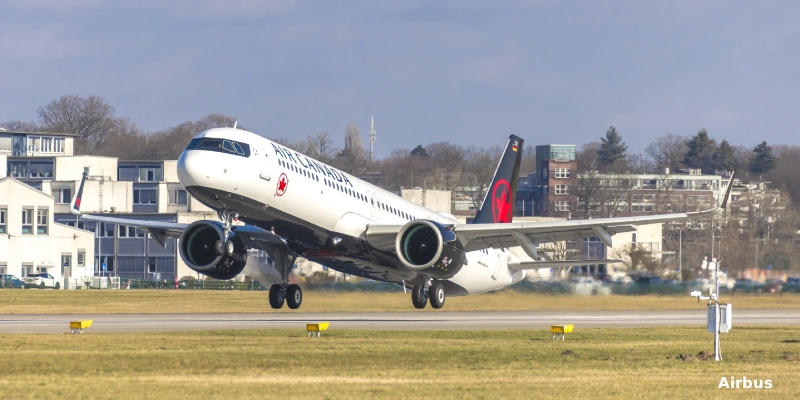
Air Canada has taken delivery of its first Airbus A321XLR, the ultra-long-range narrowbody aircraft that will enable the airline to efficiently connect secondary markets with transatlantic destinations, optimizing both profitability and the passenger experience.
A Strategic Bridge Between Short and Long-Haul
The delivery of this aircraft—the first of an order of 30, completed under a lease agreement with SMBC Aviation Capital—makes the carrier the first A321XLR operator in Canada. This move is fundamental to the company’s fleet renewal strategy, as it closes the operational gap between its short-haul services and long-haul operations.
The deployment of this model will provide the necessary flexibility to serve secondary markets with non-stop connectivity, improving operational efficiency on both new and existing routes.
Premium Flight Experience and Airspace Technology
Air Canada’s new A321XLR is powered by Pratt & Whitney GTF engines and features a two-class cabin designed to maximize comfort on transcontinental and transatlantic missions.
Cabin Configuration and Comfort
- Air Canada Signature Class: Equipped with 14 lie-flat seats in a 1-1 configuration, ensuring every passenger has direct aisle access.
- Economy Class: Features 168 seats, bringing the aircraft’s total capacity to 182 seats.
Passengers will enjoy the Airspace interior design, which incorporates the latest in-flight entertainment systems with Bluetooth audio and full connectivity at every seat. Additionally, the XL overhead bins increase storage space by 60%, while an advanced mood lighting system works to mitigate the effects of jetlag during long-haul flights.
Efficiency and Ultra-Long-Range Capabilities
The Airbus A321XLR is the natural evolution of the A320neo family, designed to meet market demand for increased range and payload.
- Extended Range: The aircraft offers an unprecedented range of up to 4,700 nautical miles.
- Sustainability: It records 30% lower fuel consumption per seat compared to previous-generation competitors, while also significantly reducing nitrogen oxide (NOx) emissions and noise.
- Key Routes: These capabilities will allow Air Canada to operate direct flights from Montreal and Toronto to European destinations such as Berlin, Toulouse, and Edinburgh.
Regarding environmental performance, the A321XLR can currently operate with up to 50% Sustainable Aviation Fuel (SAF). Airbus aims for all its aircraft to be 100% SAF compatible by the year 2030.
Through this acquisition, Air Canada continues to strengthen its relationship with the European manufacturer; it currently operates a fleet of 136 Airbus aircraft and has outstanding orders for another 61 units, including the A350 model.
Related Topics

FAA Clears Path for Boeing 737 MAX 10 Certification After Dismissing Flight Software Safety Risks
Ethiopian Airlines Orders Ten Boeing Freighters: Eight 777-8Fs and Two 777Fs to Boost Global Logistics Network

US Transportation Secretary Rules Out Safety Risks From Boeing 737 MAX Software Glitch
FAA Delays Boeing 737 MAX 10 Certification Following Software Issue


Un apasionado por la aviación, Fundador y CEO de Aviación al Día.