
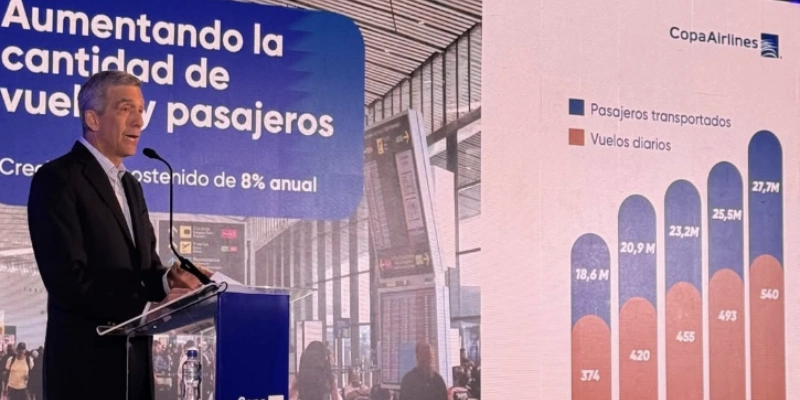
Copa Airlines has presented its strategic projections for 2026, reaffirming its regional leadership through fleet expansion, the implementation of cutting-edge satellite technology, and an ambitious job creation plan. The Panamanian carrier aims to consolidate the Hub of the Americas as the most efficient and competitive connection center on the continent.
Fleet and Route Network Expansion: Heading Towards 420 Daily Flights
By the end of 2026, Copa Airlines estimates it will operate a fleet of 121 aircraft. This growth is supported by the scheduled delivery of 43 Boeing 737 MAX aircraft remaining from its current fleet plan through 2029. Additionally, the company anticipated that it will soon announce a new order of Boeing aircraft to further deepen its regional expansion.
With this operational capacity, the airline projects reaching 420 daily flights from Panama City, currently connecting 88 destinations across 32 countries. Over the last 18 months, the network has been bolstered by new strategic points:
- New Destinations: San Diego, Raleigh-Durham (USA), Tulum (Mexico), Florianopolis (Brazil), Puerto Plata (Dominican Republic), and Tucuman (Argentina).
- Reactivated Routes: Salvador de Bahia, Salta, and Santiago de los Caballeros.
- Presence in Venezuela: Consolidation of operations in Caracas, Barquisimeto, Valencia, and Maracaibo.
This operational robustness will allow the company to transport an estimated 20.9 million passengers in 2026.
Technological Innovation: Starlink Comes Onboard
In a milestone for regional aviation, Copa Airlines announced the integration of Starlink as its Wi-Fi connectivity provider. Through this alliance, it will become the first airline in Latin America to offer high-speed, low-latency internet via SpaceX’s low-earth orbit (LEO) satellite constellation.
The rollout of this service is expected to begin in July 2026, allowing passengers to engage in high-bandwidth activities such as streaming, online gaming, and real-time cloud-based work.
Hub of the Americas as an Engine for Jobs and Local Talent
The projected growth impacts more than just transport figures; it also significantly influences the Panamanian labor market. By 2026, the airline expects to generate 400 new direct jobs, totaling more than 1,000 annual hires when accounting for operational turnover.
Specialized Training in In-House Academies
To ensure a steady supply of qualified talent, the airline will enhance its training centers:
- Aviation Training Academy (ALAS): Projects graduating 65 Panamanian pilots in 2026 through scholarship programs and costs lower than the market average.
- Aeronautical Technicians Academy (ATA): Will train 50 specialized technicians at no cost to the students.
- Cabin Crew Academy: Estimates 415 new graduates by the end of that year.
Additionally, partnerships with the Don Bosco Technical Institute and the Specialized Superior Technical Institute (ITSE) will be maintained to strengthen the academic offering in aircraft maintenance.
Economic Impact and Tourism: The Evolution of the “Panama Stopover”
The airline remains a fundamental pillar of the Panamanian economy. It is estimated that in 2026, its activity will contribute approximately US$ 1.4 billion through tax payments, local suppliers, and payroll. According to data from Oxford Economics and the International Air Transport Association (IATA), aviation and tourism support 194,000 jobs in the country, representing 8% of the Gross Domestic Product (GDP).
Boosting Domestic Tourism
One of the most significant updates is the increased flexibility of the Panama Stopover program. Starting in 2026, the period passengers can remain in the country at no additional airfare cost will be extended from 7 to 15 days.
This program, which projects attracting 250,000 visitors in 2026, seeks to decentralize tourism by directing travelers to destinations such as David, Chiriqui. Currently, 25% of passengers arriving in David do so via connections through the Hub of the Americas. Consequently, the airline will increase its seat capacity on this route by 40%, operating up to four daily flights on weekends.
Copa Airlines’ strategic plan for 2026 reflects a decisive commitment to modernization and competitiveness. By combining a next-generation fleet, unprecedented digital connectivity in the region, and a robust human talent training system, the airline not only secures its corporate growth but ensures that Panama remains the undisputed logistical and tourism hub of the Americas.
Related Topics

Aeromexico Weighs New US Flights Following Lifting of Mexico City Airport Restrictions
Lufthansa Announces New Route Between Frankfurt and Columbus, Ohio

US Lifts Restrictions on Mexican Carriers Following Bilateral Air Transport Agreement Dispute

Resumption of Direct US–Lebanon Flights Faces Setbacks Following Technical ICAO Report


Un apasionado por la aviación, Fundador y CEO de Aviación al Día.