
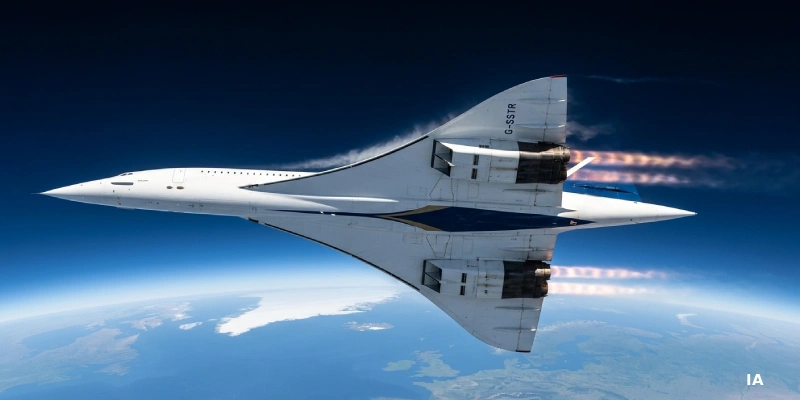
The Federal Aviation Administration (FAA) has introduced a key regulatory proposal to enable civil supersonic flights over the continental United States. This measure seeks to overturn the prohibition@ imposed in the 1970s and clear the way for a new generation of commercial aircraft capable of drastically reducing travel times for both passengers and cargo.
A New Regulatory Framework for Commercial Aviation
US Secretary of Transportation Sean P. Duffy announced a historic milestone led by the FAA. The agency has published a proposed rule establishing a noise-based certification standard for supersonic aircraft.
This initial effort will be complemented later this year by a second FAA regulatory proposal focused on defining allowable noise limits specifically during takeoff and landing phases. The agency’s objective is to have both regulations fully finalized by mid-2027, thereby providing manufacturers with the necessary technical guidance to solidify their designs and bring these innovations to market.
Breaking the Sound Barrier Without the Impact of the Sonic Boom
Unlike aircraft of the past, current technological developments promise to mitigate the acoustic effects that prompted the original restrictions in US airspace.
- Speed and efficiency: Supersonic aircraft operate at speeds of Mach 1 or higher, which equates to traveling at approximately 770 or more miles per hour. By comparison, conventional commercial airlines currently fly at speeds between 550 and 600 miles per hour.
- Mitigation technology: Thanks to advancements in aerospace engineering, materials science, and noise reduction, the goal is to eliminate the traditional sonic boom.
- “Mach cutoff” technique: One of the keys to making this transport viable is an operational method where aircraft design, atmospheric conditions, speed, and altitude interact concurrently to ensure the sonic boom refracts back into the atmosphere, significantly reducing the acoustic impact at ground level.
→ FAA Unveils Proposal to Streamline New Commercial Aircraft Certification
Collaboration and Global Strategic Momentum
The revitalization of this sector is formally grounded in Executive Order 14304, titled “Leading the World in Supersonic Flight.” This order directs the FAA to secure operational safety agreements with foreign aviation authorities to enable safe supersonic flights internationally.
For the development of these global noise standards, the FAA is working jointly with an ecosystem of strategic allies, including the International Civil Aviation Organization (ICAO), the National Aeronautics and Space Administration (NASA), academic institutions, and aerospace industry leaders.
Voices from the Administration and the Technology Sector
“Restoring overland supersonic flight is not just a matter of speed; it is about unleashing American innovation and ushering in a Golden Age of Travel,” stated Secretary Sean P. Duffy, further highlighting President Trump’s leadership in enabling this quantum leap in aviation technology.
For his part, FAA Administrator Bryan Bedford emphasized that current advancements will allow for the repeal of the 1970s ban that hung over US airspace, while minimizing the acoustic impact on communities adjacent to flight paths and airports.
Likewise, Michael Kratsios, Assistant to the President for Science and Technology and Director of the White House Office of Science and Technology Policy, emphasized the industrial impact of the measure:
“For too long, outdated rules held back our engineers and manufacturers. Under President Trump’s leadership, we are clearing the runway for supersonic flight, strengthening our industrial base, creating highly skilled jobs, and ensuring that the future of aviation is invented and built in America.”
The publication of these regulations marks the beginning of a profound transformation in passenger and cargo air transport, aiming for far more agile global connectivity. With the FAA’s target set for 2027 for final rule approval, the aerospace industry now has a clear regulatory horizon to safely and sustainably return supersonic speed to commercial skies.
Related Topics

Tocumen Airport and Copa Airlines Resume Operations Following Powerful Earthquake in Panama
Birmingham Airport Plans £2 Billion Investment to Reach 30 Million Passengers in New Master Plan
Missile Strikes Damage Saudia Aircraft at Riyadh Airport, Triggering Mass Flight Cancellations

American Airlines to Build Network’s Largest Admirals Club at Charlotte


Plataforma Informativa de Aviación Comercial con 13 años de trayectoria.