
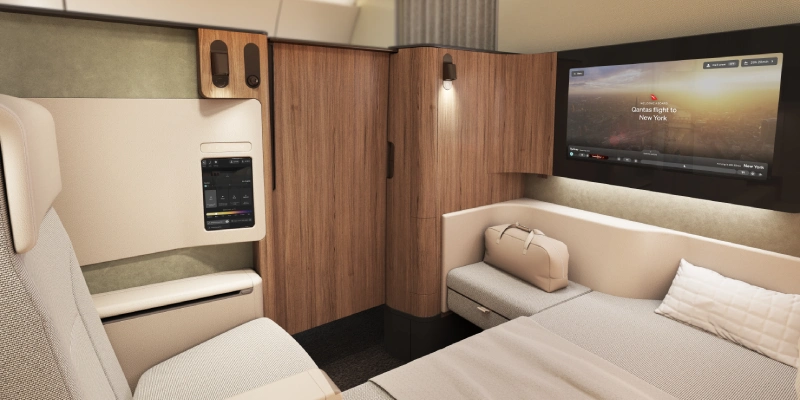
Qantas has unveiled the evolution of its interior cabin design for “Project Sunrise,” the ambitious plan that will launch the world’s first nonstop commercial flights between Sydney and London starting in October 2027. For this milestone, the carrier will operate Airbus A350-1000 Ultra Long Range (ULR) aircraft configured with just 238 seats. This layout represents the lowest seating density for this aircraft model globally, ensuring greater personal space for every passenger on ultra-long-haul routes.
Innovation and Science-Based Passenger Well-Being
The development of the A350-1000ULR cabin has been structured so that seating, lighting, inflight catering, and rest areas function as a unified ecosystem. This design is the result of a ten-year collaboration focused on ergonomic and medical research alongside the Charles Perkins Centre at the University of Sydney, in addition to joint work with Caon Design Office and various technology partners. The primary objective is to mitigate the physical toll of ultra-long-haul travel, helping passengers rest properly and arrive at their destination in optimal condition.
Detailed Passenger Cabin Configuration
The aircraft’s layout is engineered to maximize space and comfort across all available travel classes:
First Class: Exclusivity and Customized Ergonomics
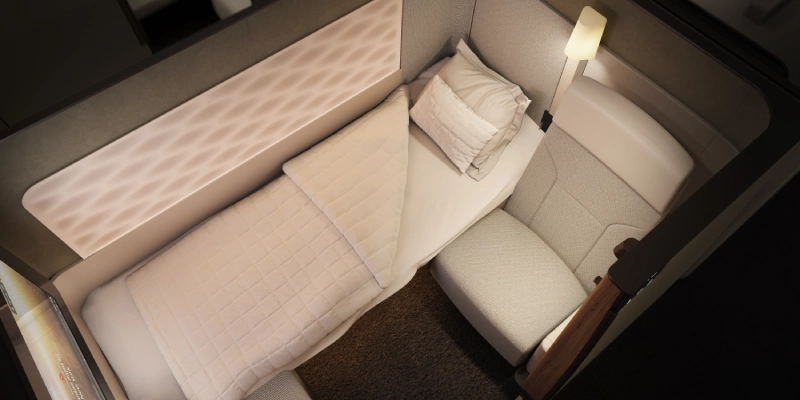
- The fleet will feature six fully enclosed First Class suites arranged in a 1-1-1 row configuration.
- Each suite is equipped with an 80-inch flat bed, a separate reclining armchair, and an adaptable workspace or dining area for one or two people.
- It also includes a full-length wardrobe along with multiple personal storage compartments.
- The mattresses incorporate a multi-layer memory foam system designed after months of pressure-mapping tests.
- Lighting can be individually programmed to safeguard the traveler’s circadian rhythm.
- A digital outer panel allows for discrete communication between passengers and the cabin crew.
→ Qantas and American Airlines Secure Provisional Authorization in Australia for Transpacific Alliance
Business Class: Privacy and Flexible Scheduling
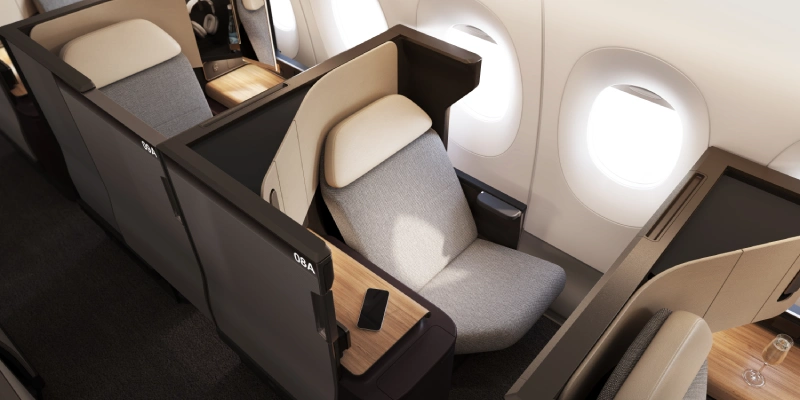
- There will be 52 Business Class suites in a 1-2-1 seating configuration.
- For the first time in Qantas history, these suites will feature a sliding door to maximize privacy.
- Alternating center seats will come equipped with an adjustable divider.
- Each space offers an 80-inch flat bed, a spacious dining table, a dedicated workspace, and enhanced storage options.
- Meal service will be flexibly scheduled using scientifically optimized time windows to sync with the body’s biological clock.
- The cabin ambiance will be managed via luminescent lighting that dims gradually to induce sleep.
Premium Economy and the New Economy Plus Class
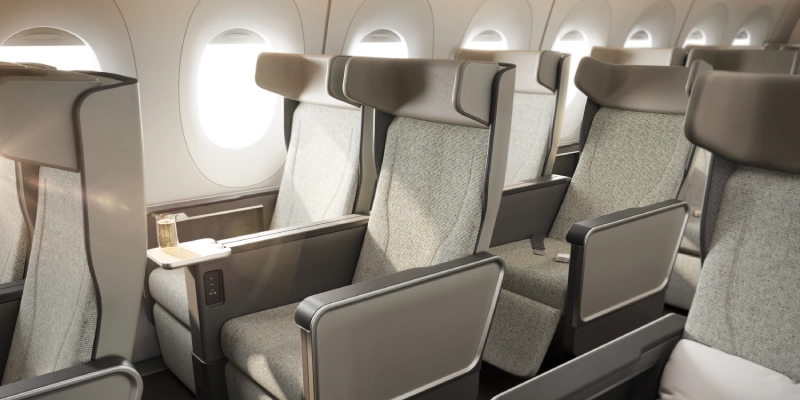
- The Premium Economy section will consist of 40 seats in a 2-4-2 configuration, completely redesigned from scratch for long-haul travel. These seats will include an ergonomic leg and calf support system, headrests with 8-inch privacy wings, and the widest pitch in the fleet.
- The standard Economy cabin will feature 140 seats in a 3-3-3 layout, offering a greater overall seat pitch than any current Qantas aircraft. Seats will feature breathable woven wool upholstery in “Pilbara Red” to optimize thermal control.
- The airline is introducing Qantas Economy Plus, featuring 42 seats located at the front of the economy cabin. These will provide a 34-inch seat pitch, priority boarding, and preferential overhead bin access.
- More than 70% of the aircraft’s total seats will feature a pitch of 33 inches or more.
- Platinum One and Platinum Frequent Flyers will receive complimentary access to Economy Plus upon booking, while Gold frequent flyers can request it 24 hours prior to departure.
Across all cabin classes, passengers will have the option to pre-select their menus prior to takeoff.
Well-Being Spaces and Next-Generation Inflight Entertainment
Wellbeing Zone
Qantas will become the first global airline to implement a purpose-built Wellbeing Zone, which will be located between the Premium Economy and Economy sections. Conceived by Caon Design Office, this space will integrate sculpted wall panels, fixed handles for stretching, continuous hydration stations, premium refreshments, and an on-screen program featuring body movement guides.
Inflight Connectivity and Entertainment
The Inflight Entertainment (IFE) system will mark the airline’s most significant technological upgrade in more than a decade. Key features include an interactive trip planner synchronized with the cabin lighting, visually indicating meal and rest times. Furthermore, the system will be available in 15 languages, remember viewing preferences, and include a “watch together” feature to share content as a group with up to three other passengers. High-speed Wi-Fi and Bluetooth pairing will be available throughout the entire aircraft.
Next Steps for Implementation
Vanessa Hudson, Qantas Group CEO, remarked that “Project Sunrise” represents an unprecedented opportunity to transform the flight experience based on the real biological needs of the human body. Meanwhile, David Caon, founder of Caon Design Office, pointed out that the design focus was always centered on ensuring that passengers disembark fully rested.
Additional cabin testing is currently underway before flights officially take off in 2027. Following the launch of the Sydney–London route, Qantas has confirmed that the Sydney–New York route will be the next international service added to the “Project Sunrise” network, with the official rollout schedule expected to be announced next year.
Related Topics
FAA Mandates Inspections on Nearly 2,000 Boeing 737 NGs Over Horizontal Stabilizer Oscillations

GE Aerospace Ramps Up GEnx Deliveries, Outpacing Boeing 787 Handover Rate
FAA Certifies Boeing 737-10: Largest Member of MAX Family Is Cleared for Deliveries

Boeing Unveils Dataliner: Next-Gen AI-Powered Aircraft Data Platform


Un apasionado por la aviación, Fundador y CEO de Aviación al Día.