
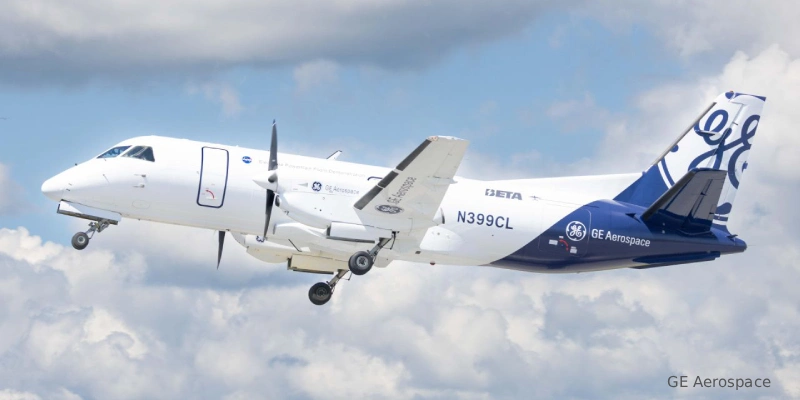
In a decisive breakthrough for commercial aviation decarbonization and efficiency, GE Aerospace has achieved a historic milestone by operating a megawatt-class hybrid-electric propulsion system above 30,000 feet altitude. The test flight was conducted aboard a modified Saab 340B aircraft, marking the first time an electric powerplant of this capacity has operated under the altitudes and conditions required for scheduled commercial service.
The aircraft made its public debut at the prestigious Farnborough Airshow in the United Kingdom following a transatlantic ferry flight from the United States. Throughout the journey, the aircraft demonstrated the operational maturity of the technology by employing the hybrid-electric system on every leg of the crossing.
Technical Architecture of the Testbed: Saab 340B and Integrated Powerplant
The platform utilized for this flight-test program is a Saab 340B regional turboprop. The system configuration integrates a megawatt-class hybrid-electric powerplant housed within an adapted nacelle at the No. 2 engine position (starboard wing). To maintain safety margins and operational redundancy, the aircraft retains its baseline GE CT7 turboprop engine in the No. 1 position (port wing).
Key Components and System Integration
- Motors/Generators and Inverters: Fully developed in-house by GE Aerospace, alongside the digital power control and battery management systems.
- Gearboxes: Designed and supplied by Avio Aero.
- Energy Storage (Batteries): Provided by BAE Systems.
- Propulsion and Thermal Management: High-performance Dowty propellers and heat exchangers with torque sensors supplied by Unison.
- Systems Integration: Developed by Beta Technologies (a company specializing in electric vertical takeoff and landing, or eVTOL, aircraft).
This program is executed under the umbrella of NASA’s Electrified Powertrain Flight Demonstration (EPFD) project, in strategic collaboration with Boeing and Beta Technologies.
From Ground Testing to Transatlantic Flight
Prior testing of the integrated system took place in 2022 at NASA’s Electric Aircraft Testbed facility at the Neil Armstrong Test Facility in Ohio, where operating conditions were simulated up to 45,000 feet.
The flight-test program commenced on May 3 of this year. On May 20, the team reached the critical milestone: operating the hybrid-electric system at maximum power in both motored mode (injecting torque into the propeller) and generator mode above 30,000 feet.
“The first time we powered up the hybrid system on the aircraft, it ran exactly as planned. We managed to operate the system above 30,000 feet, both generating and boosting at full power. We used the hybrid system to reach an altitude higher than the Saab 340B’s nominal ceiling or what it can reach on its own with CT7 power, maintaining it for two hours.”
— Christine Andrews, Hybrid-Electric Propulsion Leader at GE Aerospace.
The robustness demonstrated by the system enabled the transatlantic ferry flight, departing from Beta Technologies’ flight-test base in Plattsburgh, New York. The itinerary included technical stops in Goose Bay (Canada), Nuuk (Greenland), Keflavik (Iceland), and Wick (Scotland), concluding in Bournemouth (England) prior to its showcase at Farnborough.
Institutional Backing and Operational Relevance
During his address at Farnborough, NASA Administrator Jared Isaacman emphasized the value of public-private partnerships in accelerating cutting-edge technologies:
“When NASA first began exploring this technology nearly 15 years ago, many questioned whether it could ever be practical at scale. We spent years solving the most complex technical challenges: electrical components, batteries, weight, thermal management, and power systems. Today, alongside GE Aerospace, we are taking these systems out of the lab and into practical applications.”
— Jared Isaacman, NASA Administrator.
Technology Scalability: Synergy with the CFM RISE Program
The operational experience gained from the EPFD project not only benefits regional platforms but will directly feed into the development of the Open Fan engine within the Revolutionary Innovation for Sustainable Engines (RISE) program, led by CFM International (a 50/50 joint venture between GE Aerospace and Safran).
Arjan Hegeman, Vice President of Future Flight Engineering at GE Aerospace, explained the significance of operating high voltages and power levels at cruise altitudes:
- Equivalent Power: The aircraft flew with the power equivalent of three GE CT7 engines instead of the standard two.
- Scalable Simplification: Demonstrating stable operation of massive voltages and ultra-high power in low-density air at high altitudes simplifies downscaling or tailoring for future applications.
- Narrowbody Application: Understanding the power electronics and operational envelope at commercial cruise altitudes establishes the foundation for introducing hybrid architectures into next-generation single-aisle aircraft families.
Next Steps
Having comfortably exceeded the minimum technical goal of continuous operation at 30,000 feet, GE Aerospace will return the aircraft to its facilities to complete additional flight envelope expansion tests and participate in scheduled industry events through the remainder of the year before determining the testbed’s final disposition.
The success of the transatlantic journey and the expansion of the Saab 340B’s service ceiling reaffirm that megawatt-class hybrid-electric propulsion has evolved from a theoretical concept into a viable operational architecture for the future of commercial aviation.
Related Topics
LATAM Airlines Brazil Takes Delivery of Its First Embraer E195-E2

Embraer Reports Record Third-Quarter Performance With 66 Aircraft Delivered
Embraer Nears Key Regional Jet Order from Japan Airlines
BermudAir Becomes Second Global Operator of Embraer E-Freighter


Un apasionado por la aviación, Fundador y CEO de Aviación al Día.