
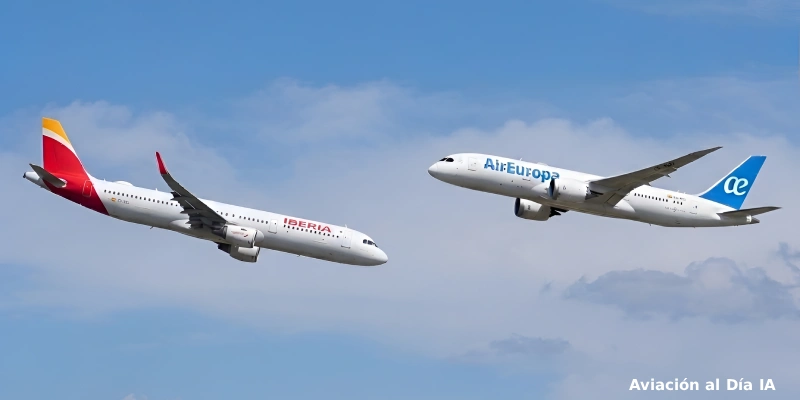
Spain’s Civil Aviation Accident and Incident Investigation Commission (CIAIAC) has launched an investigation into a serious incident in which an Iberia Airbus A321XLR and an Air Europa Boeing 787-9 found themselves on a direct collision course while cruising along the same airway and at the same altitude over the Atlantic Ocean. The incident forced both flight crews to execute coordinated evasive maneuvers to avoid a mid-air collision.
Incident Details in Canary Islands Airspace
According to preliminary information provided by the CIAIAC, the event occurred during the night of July 10 in the oceanic airspace corresponding to the Canary Islands Upper Information Region (UIR). The conflict point was located on airway N857, approximately 70 nautical miles off the coast of the Western Sahara territory, specifically between the ETIBA and BIPET aerial reporting points.
The aircraft involved in the loss of separation event have been fully identified by the investigative authority:
- Iberia Airbus A321XLR: Registration EC-OLE, which was flying on a northeasterly heading.
- Air Europa Boeing 787-9: Registration EC-NBM, which was proceeding in the opposite direction (southbound).
At the time of the encounter, both commercial jetliners were at a cruise altitude of 36,000 feet (FL360).
→ TWA 800 and MH17: Two Flights That Fell on July 17
Altitude Regulation and Vertical Separation Analysis
According to official documentation from Enaire, Spain’s air navigation service provider, combined with collision risk analyses from the European Organisation for the Safety of Air Navigation (Eurocontrol), airway N857 is a bidirectional route.
Technical Flight Level Allocation
To ensure separation on bidirectional routes, regulations establish standard flight level allocation criteria based on the aircraft’s heading:
- Aircraft operating on assigned southbound headings—such as the Air Europa Boeing 787—normally occupy even flight levels (FL360).
- Traffic proceeding on northbound headings must operate at odd flight levels to maintain a minimum vertical safety separation of 1,000 feet.
The CIAIAC confirmed that both commercial airliners were on conflicting headings at the same altitude within this airway, although the investigative commission has not yet detailed the origin of the operational or air traffic control failure that led to the converging trajectories.
Activation of Evasion Systems and Status of Souls on Board
The imminent collision was successfully averted thanks to the correct operation and response of the onboard traffic collision avoidance systems (TCAS). The automated systems issued immediate Resolution Advisories (RAs) to the flight decks.
Following the system alerts, the crew of the Iberia Airbus A321XLR executed a 500-foot descent, while the pilots at the controls of the Air Europa Boeing 787 performed a 400-foot climb, immediately restoring a safe margin of vertical separation.
Despite the abruptness and critical nature of the evasive maneuvers during the cruise phase, no structural damage to the aircraft was reported. The incident concluded with no injuries among the 454 passengers and 18 crew members across both combined flight operations.
Next Steps in the Investigation
The CIAIAC will continue analyzing data extracted from the flight data recorders (FDR), cockpit voice recorders (CVR), and air traffic control reports from the oceanic sector. The ongoing technical investigation aims to determine the precise chain of human, technical, or navigational procedural factors that caused the loss of horizontal and vertical separation on a high-density route.
Related Topics

Avianca Flight from Medellin to New York Diverts to Miami Due to Severe Turbulence; At Least Eight Hospitalized
Southwest Airlines Evaluates Widebody Aircraft, Eyes Boeing 787

Air France to Expand US Network with New Direct Flights to Nashville and San Diego for Summer 2027

Icelandair Adds Madrid and St. Louis to Route Network for Summer 2027, Expands Southwest Partnership


Plataforma Informativa de Aviación Comercial con 13 años de trayectoria.