
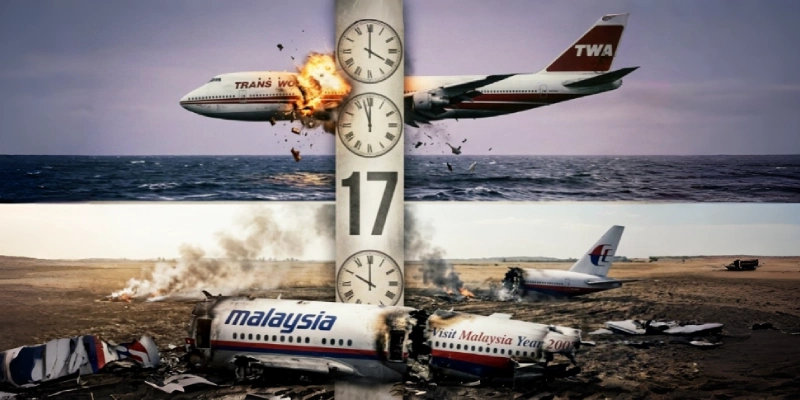
There are dates that commercial aviation would prefer to erase from the calendar. July 17 is one of them. In 1996, a Trans World Airways (TWA) Boeing 747-100 disintegrated in mid-air off the coast of New York with 230 people on board. Eighteen years later, on July 17, 2014, Malaysia Airlines Flight MH17 was shot down over eastern Ukraine with 298 people on board. In both cases, talk of a missile surfaced within the opening hours. In one case, the missile never existed. In the other, it did.
TWA 800: Sixteen Months to Dismantle a Missile That Nobody Fired
The Takeoff
On Wednesday, July 17, 1996, Trans World Airways Flight 800 took off from John F. Kennedy International Airport bound for Charles de Gaulle Airport in Paris, delayed by one hour.
The delay was caused by two factors. First, the aircraft had arrived in New York from Athens, and during the transatlantic crossing, right engine anomalies had caused concern among the crew. Boeing mechanics worked diligently but against the clock—every minute of delay was measured in dollars—and the engine was repaired almost on schedule. The second cause emerged later: among the luggage was a suspicious bag whose owner had failed to board. It took time to verify that it was a false alarm. Inside, there was only clothing.
The aircraft was a Boeing 747-100: weighing 334 metric tons, with a capacity for 425 passengers, a speed of 958 kilometers per hour, a service ceiling of over 13,000 meters, and a price tag of $170 million. It was one of 1,082 aircraft across the entire 747 line in operation that year. This particular TWA airframe was 25 years old but belonged to a family considered among the most reliable in the world: in the mid-1990s, the accident rate for the 747 was 1.64 per million departures, the lowest in the entire airline industry.
At 21:35, Captain Steven Snyder initiated the takeoff, assisted by First Officer Ralph Kevorkian. On board were 230 people: 169 Americans, 42 French, 11 Italians, two Norwegians, one British, one Chinese, one Spaniard, one Portuguese, and one German. Among the passengers were saxophonist Wayne Shorter, ABC sports executive producer Jack O’Hara, country guitarist Marcel Dadi, German fashion photographer Rico Puhlmann, and French national ice hockey player Michel Breistoff, who was returning to his country to be married.
Five Minutes and Ten Seconds
The Boeing took off normally and began climbing to intercept its route over the Atlantic. At 21:40, the Boston controller lost radio contact with the aircraft, which nevertheless continued to appear on the screens of a dozen radars monitoring the area.
The explosion occurred at 21:45, off Fire Island, 112 kilometers from New York. As the aircraft fell, at least one other explosion occurred. Seconds later, the 747 plunged into the sea.
Twenty-three rescue and oversight agencies—including the Navy, the Coast Guard, the Red Cross, the New York Police Department, and the FBI—immediately began scouring the maritime sector. From the very beginning, they knew they would find no survivors. The task was different: recover the bodies and retrieve as much of the aircraft as possible to reconstruct what had happened.
Missile Everyone Saw
Initial eyewitness accounts confirmed that the explosion had occurred in mid-air and not upon impact with the sea. Sven Faret, a local private pilot, told UPI that he was flying at 2,500 meters when he looked up, saw landing lights, and then a massive circle of flames; an instant later, only debris and orange flames over the water. Colonel William Stratemeier of the New York Air National Guard was conducting test maneuvers aboard a C-130 about 16 kilometers from the scene: he reported seeing two huge orange fireballs that looked like comets plunging into the water.
Based on these testimonies, and before investigators could even begin working with the wreckage, the theory of an onboard bomb became a fact in the public eye. Suspects emerged quickly: Islamic Jihad, Hezbollah, Hamas, and the Iranian secret services for the external hypothesis; any of the more than 800 far-right groups opposed to the federal government operating in the United States for the internal one. An FBI source leaked to The Washington Post that anyone capable of bombing the Oklahoma City federal building could also evade airport security and plant a bomb on a plane.
But other witnesses pushed the investigation in a different direction. The New York Times published the statement of Joseph Wilkins, a resident of Fire Island: he had seen a light ascending at high speed, then an explosion, and the plane falling into the sea. What Wilkins described was, point by point, the trajectory of a missile.
The alternative could not be ruled out, especially after veteran journalist and former JFK press secretary Pierre Salinger produced documentation regarding Navy missile tests off the coast of New York and posed an uncomfortable question: what if they made a catastrophic mistake?
The “friendly fire” hypothesis put the Armed Forces on the defensive. In the weekly USA Today, journalist M.J. Zuckerman developed three alternatives, and all three were denied almost immediately:
- The USS Normandy: A Navy vessel was located in zone W-105, off the southeastern coast of Long Island, used for live-fire exercises. The Navy denied it immediately.
- The Air National Guard: It was accused of conducting exercises in the area and firing a missile. “We don’t have a single missile; we don’t even have ammunition in our armories because we don’t use it,” replied Major Paul Fanning, responsible for New York operations.
- The Smithpoint Depot: An anonymous tip spoke of a missile fired from a secret ammunition depot near the crash site. Local Police Chief Robert Anderson responded that the location is a beach resort, not a depot, and that if there were a missile depot in the area, he would know about it.
All of this was happening while investigators were just beginning to work with the recovered wreckage and had not yet reached any conclusions.
Sound at Minute 11:30
A week after the crash, rescue teams had recovered fewer than one hundred bodies and about 70% of the aircraft wreckage. On July 20, the USS Pirouette detected the electronic signal from the black boxes; it took another two days of searching for divers to retrieve them at a depth of about thirty meters. While one group analyzed the recordings, another reconstructed the Boeing in a hangar in Calverton.
Far from the public debate, where bombing psychosis reigned, technicians did not rule out any hypothesis. Their initial list had nine entries:
- A mechanical failure in the fuel pump system.
- A mechanical failure involving static electricity.
- A mechanical failure in the engine wiring.
- A failure in equipment within the center wing fuel tank.
- A small explosive charge placed in the center wing fuel tank.
- A high-yield bomb brought onto the aircraft by a terrorist or sent with checked luggage.
- A missile that directly struck the aircraft.
- A missile that may have exploded near the aircraft.
- A “high-velocity” particle originating from a meteor fragment or “space junk.”
Against all hopes, the black boxes clarified nothing. They sustained “moderate damage,” but the data was intact: the four channels of the cockpit voice recorder captured a brief, mysterious sound at minute 11:30 of the flight, just before the tape stopped working. For specialists at the National Transportation Safety Board (NTSB), it was evident that this sound pointed to the cause of the crash, but they could not determine its origin. FBI Agent Kallstrom summarized it with brutal honesty: the noise could have been caused by a bomb exploding, by something striking the aircraft from the outside, or by a major structural failure of the aircraft itself. In other words, the investigation remained at square one.
Return of Salinger
Nearly nine months passed without news until, in March 1997, Pierre Salinger returned to the fray. In a report published by the French magazine Paris Match, he insisted that the plane had exploded due to the impact of a missile launched from the sea, possibly by a U.S. submarine participating in a “super-secret counterterrorism exercise.” He claimed to have interviewed 154 witnesses who said they saw one or two missiles in the air.
The photographs accompanying the report caused a stir. Extracted from a video of the JFK Airport radar control, they showed the Boeing crossing paths before the explosion with a supposed Navy drone target, while a line on the radar moved toward the aircraft.
At a press conference in Paris, alongside former presidential advisor Mike Sommer and former pilot Richard Russell, the team doubled down. Sommer claimed that two minutes before the blast, another missile—a Tomahawk—had passed through the same airspace; Russell displayed more photographic material and asserted that the airport tape showed an object tracking toward the aircraft, conclusive proof—in his view—that it had been shot down. Salinger closed with a provocative question: why doesn’t the CIA release the images captured by its satellites that night?
The response came from NTSB Chairman James Hall: his investigators had studied all the recordings and had found nothing indicating a missile.
Even so, the “Salinger episode” reinstated the disaster on the media agenda and forced the FBI to declare that the missile hypothesis was not entirely ruled out and was being given equal weight alongside the mechanical failure and bombing theories.
The Tape
During the first week of November 1997, the head of the FBI’s Counterterrorism Division sent a letter to the victims’ families and called a press conference. On November 21, at three o’clock in the afternoon, James Kallstrom stood before journalists, lawyers, and relatives holding a videotape. Every lead had been covered, he said; every possible avenue of investigation explored. Before playing the video, he warned that this was not an attempt at showmanship. The clarification was warranted: the documentary featured music and television production techniques that could leave a bad impression.
The centerpiece was a computer reconstruction. CIA experts had input into the program the reports of the 244 witnesses who claimed to have seen ascending lights before the explosion—the very testimonies that had fueled the missile theory.
The analysis was based on what was known with certainty: the aircraft’s altitude, speed, and heading, as recorded by 12 radars along different points of the East Coast. To this was added data from the infrared sensor of a high-precision U.S. satellite that had captured the second explosion. The result was four animated shots:
| Shot | Altitude | What it shows |
|---|---|---|
| 1 | — | The TWA aircraft seconds before the explosion |
| 2 | 5,100 m | The exact moment of the explosion and the beginning of the breakup |
| 3 | 4,128 m | The second explosion, with the aircraft already broken apart |
| 4 | 1,590 m | An explosion as the left wing detached from the fuselage |
The figure of 5,100 meters was itself a revelation: there had never been mention of that altitude, as it was assumed the explosion had occurred at around 4,100 meters.
As the images progressed, a voiceover explained the key to the entire case. Those who believed they saw a missile were actually seeing the different stages of the aircraft’s breakup. After the initial explosion, which detached the cockpit and the forward fuselage, the aft section—engulfed in flames and relieved of the nose weight—pitched up and climbed. That was the ascending light. That was the missile.
When Kallstrom turned the lights back on, the room remained silent.
Only one unknown remained: the nature of the failure. The answer came a week later, from the mouth of James Hall: with a minimal margin of doubt, the explosion of the Boeing 747-100 was caused by an accumulation of fuel vapors in the aircraft’s center wing tank.
Sixteen months and four days after the tragedy, and at a cost exceeding $40 million, the mystery was solved. There never was a missile.
MH17: Missile That Did Exist
Eighteen years later, on July 17, 2014, Malaysia Airlines Flight MH17, operating the route between Amsterdam and Kuala Lumpur, was shot down over eastern Ukraine by a surface-to-air missile in an area then controlled by pro-Russian militias.
All 283 passengers and 15 crew members on board perished. Among the 298 victims were 80 minors, originating from a dozen countries: 196 Dutch citizens—the largest group—43 Malaysians, and 38 Australians, alongside nationals from the United Kingdom, Germany, Belgium, the Philippines, Canada, New Zealand, and Indonesia.
While the TWA 800 case required sixteen months to reach a technical conclusion, MH17 has spent twelve years in a different process: not establishing what brought the plane down, but establishing who is accountable for it.
Chain of Rulings
May 12, 2025. The Council of the International Civil Aviation Organization (ICAO) concluded that Russia violated the international prohibition against using weapons against civil aircraft in flight. It ordered Russia to enter into talks with the states that brought complaints before the European Court of Human Rights and ICAO itself—the Netherlands and Australia—with the aim of offering them “full reparations” for the downing of the flight.
July 9, 2026. The European Court of Human Rights (ECHR) ruled that Russia is responsible for the downing of the aircraft and the deaths of the nearly 300 people on board. According to the same ruling, Moscow is equally responsible for the additional suffering inflicted on the victims’ relatives. The court is now in a position to determine the consequences of the violations and the compensation to be paid.
July 17, 2026. On the twelfth anniversary of the catastrophe, the European Union again demanded that Russia accept its responsibility. The demand was issued in a statement on behalf of the 27 member states signed by the EU High Representative for Foreign Affairs, Kaja Kallas, who highlighted both legal precedents.
Kallas described the ECHR ruling and the ICAO Council’s decision as “important steps towards truth, justice, and accountability for all the victims of Flight MH17, their families, and loved ones,” and reiterated the call for the Russian Federation to accept its responsibility for this tragedy and cooperate fully in efforts to deliver justice.
Similarities
Sharing a calendar date is a coincidence devoid of analytical value. What makes these two cases comparable is something else.
Both involved mid-air disintegrations, with no survivors, on long-haul intercontinental routes: New York–Paris and Amsterdam–Kuala Lumpur. Two fully loaded widebody aircraft, either in the cruise or climb phase, carrying passengers of multiple nationalities: nine nationalities on board TWA 800, a dozen on MH17. In both cases, the tragedy ceased to be a domestic matter the very instant of impact.
In both cases, the word “missile” surfaced before the evidence did. In 1996, it was introduced by a Fire Island resident who saw an ascending light, and amplified by a highly prestigious journalist with genuine documentation regarding naval exercises. In 2014, the missile hypothesis also circulated from day one. The difference does not lie in the speed with which the theory appeared, but in what happened when it was subjected to verification.
And therein lies the inverted symmetry, which is the true point of contact between the two cases.
In TWA 800, the missile was the popular explanation and the mechanical failure was the uncomfortable one. The investigation—sixteen months, over $40 million, twelve radars, an infrared satellite, 244 computer-processed testimonies—ultimately proved that the witnesses had seen something real but had misinterpreted it: the burning aft section climbing after the initial explosion. The missile dissolved. What remained was a center wing fuel tank filled with vapors.
In MH17, the exact opposite occurred: the missile was not a misinterpretation of a physical phenomenon, but a fact, and what the investigation had to establish was not the cause, but the liability.
In both cases, the institutional process outlasted public interest. TWA 800 required sixteen months and four days to close. MH17 has been ongoing for twelve years, and compensations have yet to be finalized. The difference is one of scale: when the cause is a fuel system failure, the problem is resolved by technical investigators. When the cause is a weapon fired by a state, the issue moves to international courts, to ICAO, to diplomacy, and the clock is no longer measured in months.
And in both cases, the crux was the same: the gap between what is seen and what can be proven. The 244 Long Island witnesses did not lie. They saw an ascending light. What they could not know—what could only be discovered by cross-referencing twelve radars with a satellite sensor and a computer reconstruction—was what that light actually was. Serious accident investigation almost always consists of that operation: not dismissing the witness, but explaining them.
In 1996, that operation proved the missile did not exist.
In 2014, there was no need to prove it. The missile was right there.
Related Topics
Fresh Attack on Riyadh Airport Leaves Multiple Casualties, Halts Flight Operations

Tocumen Airport and Copa Airlines Resume Operations Following Powerful Earthquake in Panama

Birmingham Airport Plans £2 Billion Investment to Reach 30 Million Passengers in New Master Plan
Missile Strikes Damage Saudia Aircraft at Riyadh Airport, Triggering Mass Flight Cancellations


Un apasionado por la aviación, Fundador y CEO de Aviación al Día.