
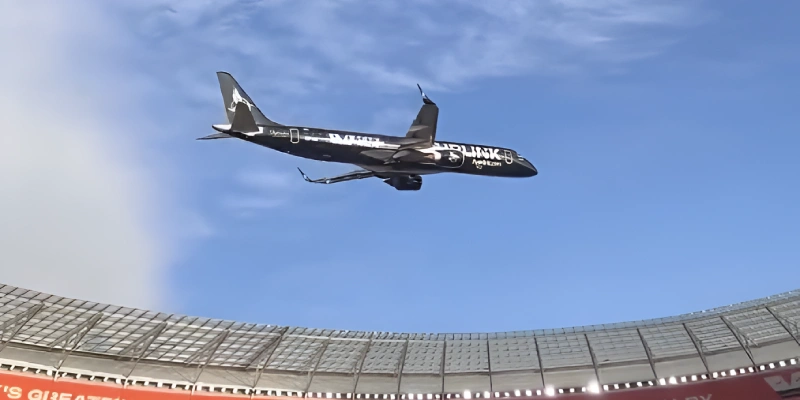
A striking aerial display has divided opinion across the aviation industry and the general public. In the buildup to the rugby match between the South African and New Zealand national teams, two Airlink Embraer E190 aircraft executed a low-altitude formation flight over the DHL Stadium in Cape Town, timed to coincide with a pyrotechnic flare display inside the venue.
According to flight-tracking platform Flightradar24, the lead aircraft cleared the top of the stadium structure by less than 50 feet (15 meters).
computational analysis and flight data raised immediate questions regarding operational risk and the potential for a catastrophic incident when maneuvering two commercial airliners over a maximum-capacity venue. However, the flight also drew praise for the technical precision required, with many locals welcoming the flypast as a display of national pride.
Airlink Statement and Safety Standards
Responding to allegations of recklessness, Airlink released official statements defending the operation under the banner: “Planning. Precision. Performance.”
The carrier detailed the safety measures implemented for the event:
- Highly Qualified Crew: Each participating aircraft was crewed by three senior captains, fulfilling the roles of Commander, First Officer, and Technical/Safety Officer.
- Approved Operational Envelope: The flyover adhered strictly to safety altitude and airspeed limits that had been previously rehearsed and authorized for the demonstration flight.
- Regulatory Coordination: The maneuver was executed with explicit sign-off from civil aviation authorities.
A Historic Precedent in South African Aviation
Low-altitude stadium flypasts have a rich history in South African aviation. The most iconic precedent occurred at the 1995 Rugby World Cup final in Johannesburg, when a South African Airways Boeing 747 performed a low pass over Ellis Park prior to South Africa’s victory against New Zealand.
That historic event, later dramatized in the Hollywood film Invictus, served as a moment of profound national unity under then-President Nelson Mandela.
Despite concerns raised by critics regarding risk management over densely populated areas, Airlink maintains that the operation complied fully with all applicable regulatory protocols for display flypasts. The airline continues to stand by the technical rigor and high level of preparation demonstrated by its flight crews.
Related Topics
British Airways Expands Network for Summer 2027: Touches Down in Tanzania and Boosts Latin American Capacity by 25%

Copa Airlines Restores Second Daily Flight to Caracas, Venezuela

Avianca Strengthens Cross-Border Network: Launches Daily Flights Between Bogotá and Maracaibo, Venezuela

LATAM to Expand International Connectivity With New Direct Route Between Santiago de Chile and Salvador de Bahia


Plataforma Informativa de Aviación Comercial con 13 años de trayectoria.