
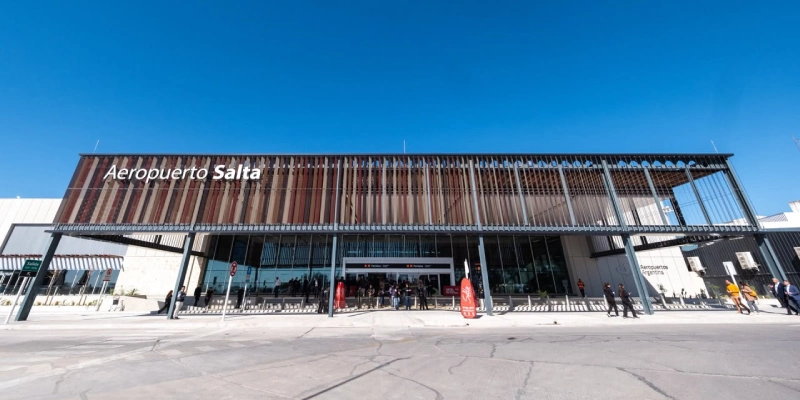
The new terminal at Salta International Airport has been officially inaugurated and will begin operations on August 27, positioning itself as one of the country’s most modern airport infrastructures. The facilities brought online during this first phase will increase operational capacity by 65%, meeting the sustained growth of national and international passenger traffic across the province.
The comprehensive modernization project represents a total investment of $110 million, executed in successive construction phases by the concessionaire Aeropuertos Argentina in coordination with the National Airport System Regulatory Body (ORSNA).
First Phase Infrastructure, Capacity, and New Amenities
The commissioned phase introduces key upgrades aimed at enhancing passenger processing and terminal operational efficiency:
- Passenger Processing and Departure Area: A new main departure hall has been opened, featuring 32 new check-in counters and a 650 m² expansion of the domestic departures area, complemented by new operational spaces.
- Technical Infrastructure and Support: The plan included the construction of technical support facilities, including a new post office, an electrical substation, a technical pump building, reconfigured airside and landside access roads, and a renovated vehicular access gate.
- Retail and Dining Options:
- Public Area (Ground Level): Includes a new Open25 chain convenience store, luggage wrapping services operated by Tripstore, a new Tostado food outlet (opening in September), and ATMs from Banco Nacion and Banco Macro.
- Domestic Airside Area: The opening of ShopGallery retail stores and local cafe and dining space Charter Coffee.
→ Costa Rica: Juan Santamaría Airport Breaks Ground on Central America’s First On-Site Terminal Hotel
Air Traffic Growth and Salta’s Connectivity
The expansion addresses sustained demand for air transport in the region. Between January and July of this year, Salta International Airport recorded total traffic of 830,859 passengers (767,968 on domestic flights and 62,891 on international routes), marking a 2.35% increase compared to the same period in 2025.
Currently, six airlines operate scheduled flights out of the airport:
- Aerolineas Argentinas
- JetSmart
- Flybondi
- LATAM
- Copa Airlines
- Paranair
These carriers connect the province to domestic destinations—including Buenos Aires, Cordoba, Mendoza, and Neuquen—as well as international hubs in Asuncion, Panama City, and Lima.
The official ribbon-cutting ceremony was attended by the Governor of Salta, Gustavo Saenz; the CEO of Aeropuertos Argentina, Daniel Ketchibachian; the President of ORSNA, Noelia Ruiz; alongside executive leadership from the local aviation and tourism sectors.
“We are proud to inaugurate such an important facility today. We know that a terminal of this standard will not only allow the people of Salta to travel better, with greater comfort and services, but it also unlocks operational growth that will help energize tourism and the economy across the province and the broader region. We are committed to ensuring that air connectivity acts as a catalyst for national development, and projects like the one we are unveiling today are proof of that.”
— Daniel Ketchibachian, CEO of Aeropuertos Argentina.
Next Phase and Comprehensive Capital Plan
Following the complete operational transition from the legacy terminal to the new infrastructure, phase two of the project will commence immediately.
Upon final completion, the airport complex will encompass a total footprint of 16,160 m² (adding 6,960 m² over the original facility). The second phase will comprise:
- The expansion of the international departures sector.
- The redevelopment of the arrivals immigration processing area.
- The construction of a new VIP lounge within the domestic departure gate area.
This capital project forms part of the broader airport infrastructure program spearheaded by Aeropuertos Argentina in coordination with ORSNA and the National Secretariat of Transport, which has deployed over $1 billion over the last 5 years. During this period, key capital developments have been completed, including the North Apron at Jorge Newbery Airfield (Aeroparque), the Ezeiza Master Plan, the new San Juan terminal, runway upgrades at Rio Cuarto and Rio Gallegos, and terminal expansions at Formosa and Rio Grande.
Related Topics
Delta Postpones Launch of Direct Atlanta–Riyadh Flights to March 2027

Avianca Flight from Medellin to New York Diverts to Miami Due to Severe Turbulence; At Least Eight Hospitalized
Southwest Airlines Evaluates Widebody Aircraft, Eyes Boeing 787

Air France to Expand US Network with New Direct Flights to Nashville and San Diego for Summer 2027


Un apasionado por la aviación, Fundador y CEO de Aviación al Día.