
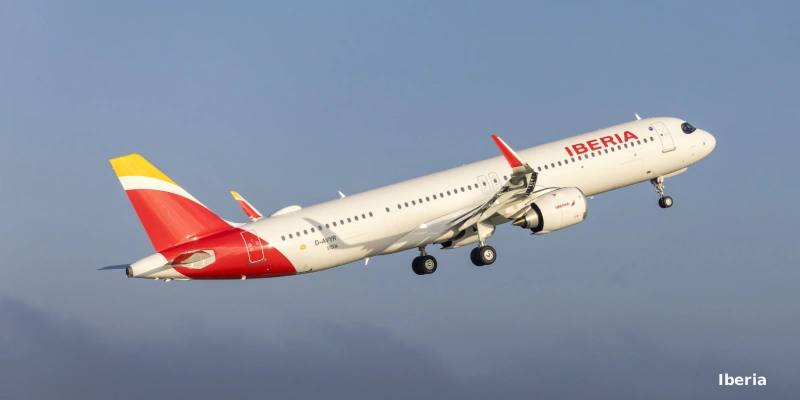
Iberia will operate an exclusive flight designed to intercept the path of totality of the upcoming solar eclipse on August 12 at an altitude of 33,000 feet. Combining a scientific mission in collaboration with the Shelios Project and a live broadcast via high-speed satellite internet, the operation stands out as an operational and technological milestone for European commercial aviation.
Scientific Mission and Real-Time Satellite Transmission
The Spanish flag carrier will deploy its new high-speed Wi-Fi connectivity service powered by Starlink technology, a system it is progressively rolling out across its commercial fleet. This infrastructure will enable a live stream of the entire astronomical event across the company’s social media channels, offering a global audience unprecedented imagery captured above the cloud deck.
In the research domain, the flight will serve as a platform for a scientific mission led by astronomer Miquel Serra-Ricart, scientific director of Light Bridges and researcher at the Instituto de Astrofisica de Canarias. The delegation of researchers from the Shelios Project will conduct critical measurements directly from cruise altitude.
“Observing from cruise altitude will allow us to have a clear view of the solar corona, free from cloud cover and other atmospheric phenomena that can hamper observations from the ground,” Serra-Ricart explained.
Additionally, high-altitude observation conditions will enable precise studies of the Sun’s immediate surroundings, facilitating direct viewing of the apparent positions of planets such as Venus and Mercury, as well as various stellar structures visible during the phase of total darkness.
→ Iberia Expands Adriatic Coast Network with Inaugural Direct Vows to Tivat
Flight IB1473: Operational Details
Operational planning incorporates high symbolic and technical value, meticulously coordinated to maximize duration within the umbral shadow:
- Flight Number: IB1473, a direct tribute to the birth year of astronomer Nicolaus Copernicus.
- Aircraft: Airbus A321XLR, one of the most advanced long-range narrowbody aircraft in Iberia’s fleet.
- Origin and Departure: Departing from Adolfo Suarez Madrid-Barajas Airport (MAD) at 18:45 local time.
- Observation Zone: The flight path has been specifically calculated to optimize viewing conditions over the province of Palencia, Spain.
- Flight Crew: The operation will be commanded by Captain Javier Lopera Alcala alongside pilot Javier Meana Fernandez, the latter holding specialized training in Astrophysics.
Historical Significance of the Phenomenon
The August 12 event marks the first total solar eclipse visible from the Iberian Peninsula since 1912. Its operational and astronomical characteristics mirror the historic eclipse recorded on August 30, 1905, making this flight a particularly significant occasion.
A total solar eclipse occurs when the Sun, Moon, and Earth align in such a way that the Moon completely blocks the solar disk from specific vantage points on Earth. This phenomenon is made possible by a geometric coincidence: although the Sun’s diameter is approximately 400 times larger than that of the Moon, it sits roughly 400 times farther away from Earth.
“We are delighted to collaborate on an initiative that brings together aviation, science, and innovation. This flight will leverage the advantages of observing from cruise altitude to contribute to the study of an exceptional astronomical phenomenon,” stated Diego Fernandez, Iberia’s Director of Strategy, Transformation, and Sustainability.
The airline’s institutional involvement falls under its strategic plan for technological innovation and social impact, validating the capability of its long-range single-aisle aircraft as airborne scientific observation platforms.
Related Topics

American Airlines to Build Network’s Largest Admirals Club at Charlotte

US Department of Transportation Closes Airline Data Privacy Review Without Penalties

Southwest Unveils Record-Breaking Summer 2027 Schedule With Major Expansion in Austin, Nashville, and San Diego

Alaska Airlines Challenges Delta in Seattle, Taking its Offensive to Long-Haul Routes


Plataforma Informativa de Aviación Comercial con 13 años de trayectoria.