
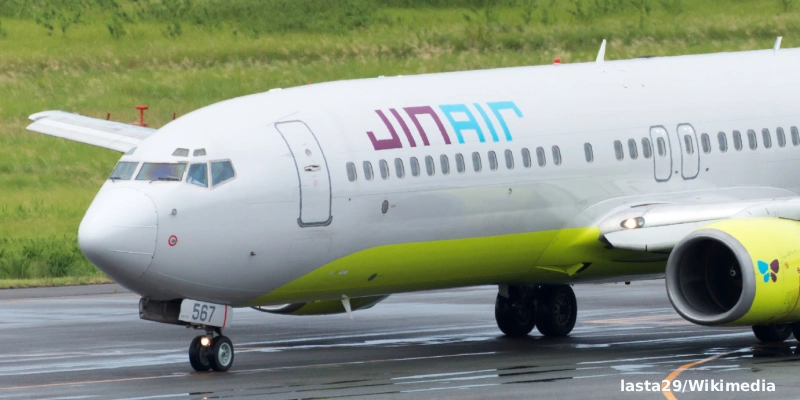
South Korean commercial aviation is undergoing a historic restructuring. The boards of directors of Jin Air, Air Busan, and Air Seoul have formally approved a proposal to merge the three low-cost carriers (LCCs) under the single Jin Air brand. The final integration is scheduled for completion in March 2027, creating a single operating entity that will redefine short- and medium-haul competition across the Asia-Pacific region.
Alignment with the Korean Air-Asiana Mega-Merger
This consolidation directly mirrors the broader restructuring of the South Korean airline sector: the merger between the country’s two legacy network carriers, Korean Air—parent company of Jin Air—and Asiana Airlines—parent company of Air Busan and Air Seoul. While Korean Air and Asiana are expected to complete their integration by late 2026, their budget subsidiaries will progress in parallel to finalize their merger months later.
Following execution of the transaction, the Air Busan and Air Seoul brands will be phased out. The aircraft fleets, workforce, and operational assets of both carriers will be fully absorbed into Jin Air.
Transaction Valuation and Financial Terms
Under the financial terms agreed upon by the three boards, Jin Air will assume all assets, liabilities, personnel, and legal status of Air Busan and Air Seoul. The fixed stock exchange ratio for the operation is as follows:
- 1 Jin Air share for 0.29 Air Busan shares
- 1 Jin Air share for 0.75 Air Seoul shares
Regulatory Approval and Operational Certification
Despite board approvals, the transaction remains subject to key regulatory milestones:
- Regulatory Approval: South Korea’s competition and civil aviation authorities must grant final approval.
- Air Operator Certificate (AOC): The combined entity must apply for and secure a unified AOC to streamline the three carriers’ fleets and procedures under a single set of operations specifications (OpSpecs).
Airline officials emphasized that operational safety will remain the top priority throughout the transition, even as the merged carrier strengthens its strategic position to expand market share in Asia.
Pressure on the Asian LCC Model: Forced Consolidation
This strategic move by South Korean carriers comes amid intense competitive pressure within Asia’s low-cost sector. Since Cebu Pacific pioneered the concept in the Philippines in 1988 and AirAsia scaled the LCC model across the region from Malaysia in 2001, the sector has experienced unprecedented expansion in markets including Japan, Thailand, Indonesia, and India.
However, the current market environment faces major structural challenges:
- Market Saturation: A high volume of carriers aggressively competes on identical regional routes.
- Model Hybridization: Legacy network carriers have widely adopted unbundled pricing structures (“basic economy”), narrowing the competitive price gap.
- Rising Direct Operating Costs (DOC): Escalating fuel costs, airport user fees, and maintenance expenses continue to squeeze operating margins for non-consolidated LCCs.
Industry Impact
The expanded Jin Air will emerge as one of the largest low-cost operators in East and Southeast Asia. The combined entity is expected to optimize its route network, maximize human resources and infrastructure utilization, and achieve substantial operational synergies across fleet procurement and maintenance.
With a target completion date set for March 2027, industry stakeholders will closely monitor the pending regulatory clearances and the subsequent capacity restructuring across South Korea’s primary aviation hubs.
Related Topics
SKY Announces First Airbus A321XLR Route and Boosts Connectivity from Peru and Chile

LATAM Secures US$ 505 Million for Fleet Expansion and Integrates Its Largest Sustainability-Linked Financing

WestJet expands Latin America and Caribbean network for winter 2026/2027 season

Peru Conditionally Approves Abra Group’s Acquisition of Sky Airline


Plataforma Informativa de Aviación Comercial con 13 años de trayectoria.