
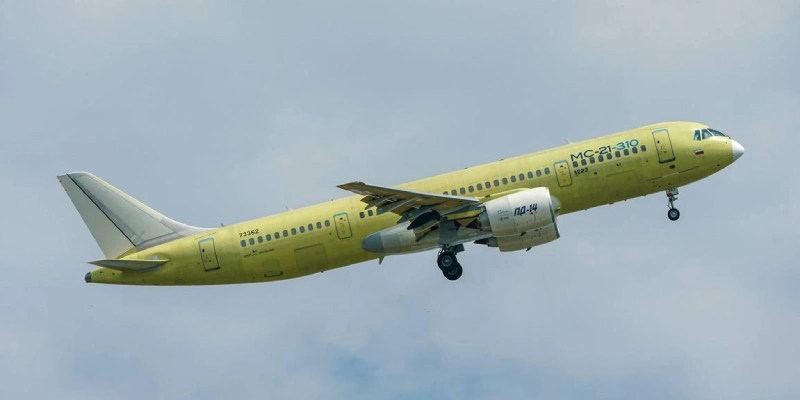
The Russian commercial aviation development program has reached a major operational milestone in its flight validation phase. During July 2026, two MC-21-310 prototype aircraft successfully completed an intensive flight-test cycle consisting of 17 sorties, logging a combined airtime of over 56 hours. The intensive campaign aimed to verify the overall serviceability of the avionics suite, the dynamic response of the powerplants, and the structural and aerodynamic behavior under high-complexity flight regimes.
Prototype Allocation and Flight-Test Focus
Systematic evaluations were strategically distributed between two dedicated flight-test airframes, identified by their registration tail numbers and Manufacturer’s Serial Numbers (MSN):
- Tail Number 73055 (MSN MC.0012): An airframe assigned to the comprehensive verification of the onboard avionics complex and fire protection systems.
- Tail Number 73057 (MSN MC.0013): A testbed platform dedicated to evaluating the automatic flight control system, nose-wheel steering and ground maneuvering, powerplants, and aerodynamic stability envelope limits.
The primary focus of the campaign centered on validating component performance under normal operating conditions, complemented by simulated in-flight system failures to certify aircraft redundancy and operational safety.
Avionics and Safety Systems Testing
On board Aircraft 73055 (MSN MC.0012), program specialists focused on auditing the precision and reliability of the avionics suite. Key systems evaluated included:
- Flight Management and Navigation System: Verification of trajectory calculation accuracy and guidance laws.
- Weather Radar System: Evaluation of storm-front detection, range performance, and meteorological characterization capabilities.
- Communications Suite: Verification of signal clarity and link integrity across multiple frequency bands.
- Traffic Alert and Collision Avoidance System (TCAS): Verification of proximity alerting and resolution advisory capabilities to maintain safe aircraft separation.
- Terrain Awareness and Warning System (TAWS): Ground proximity warning capabilities designed to prevent Controlled Flight Into Terrain (CFIT).
Additionally, operational testing of the fire detection and suppression systems was conducted on airframe MC.0012, with targeted testing on the Auxiliary Power Unit (APU) and cargo compartments.
Automatic Flight Control, Hydraulics, and Powerplants
Meanwhile, Aircraft 73057 (MSN MC.0013) was tasked with certifying the response of the automatic flight control system and primary flight control actuators. During ground-roll testing, engineers verified the operation of the nose landing gear steering system and confirmed braking efficiency under simulated hydraulic system failures.
In the air, unit MC.0013 conducted dynamic evaluations of the engines, the APU, and the fuel feed system under negative-g load maneuvers. Test pilots also successfully verified the alternate emergency landing gear extension procedure.
Flight Envelope Expansion and Flight Control Envelope Protections
A dedicated phase of the flight-test regimen focused on assessing the stability and controllability of the MC-21-310 at high angles of attack and sideslip angles. During these flight maneuvers, test pilots evaluated the engagement of flight control envelope limiters designed to prevent the airframe from exceeding structural and aerodynamic design limits in:
- Airspeed
- Load factor ($g$-limits)
- Mach number
The successful completion of this 17-flight testing campaign within a single month represents a substantial step forward in the certification pathway and technical maturity of the MC-21-310. Data gathered across these 56 flight hours will enable engineering teams to validate operational reliability and refine software algorithms and mechanical systems ahead of upcoming certification phases.
Related Topics
FAA Mandates Inspections on Nearly 2,000 Boeing 737 NGs Over Horizontal Stabilizer Oscillations
GE Aerospace Ramps Up GEnx Deliveries, Outpacing Boeing 787 Handover Rate
FAA Certifies Boeing 737-10: Largest Member of MAX Family Is Cleared for Deliveries

Boeing Unveils Dataliner: Next-Gen AI-Powered Aircraft Data Platform


Plataforma Informativa de Aviación Comercial con 13 años de trayectoria.