
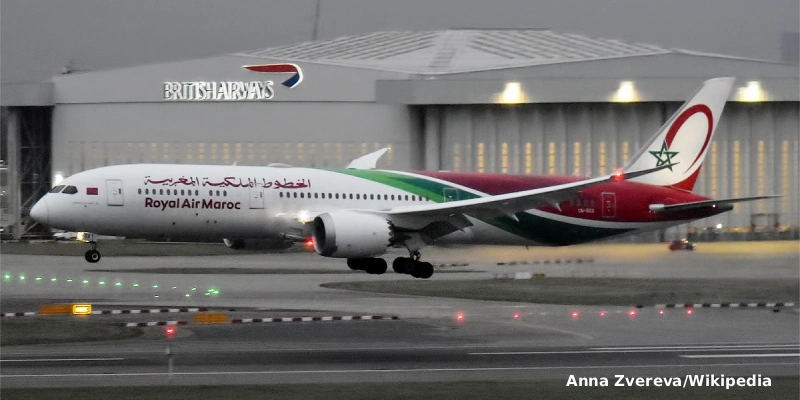
Royal Air Maroc (RAM) has signed a strategic agreement with Starlink to equip its entire commercial fleet with high-speed connectivity, becoming the first carrier in Africa to integrate this technology.
To date, in-flight connectivity across the region has been subject to structural limitations due to reliance on traditional geostationary orbit satellites and sparse ground infrastructure along various routes. By adopting Starlink’s network—built on low Earth orbit (LEO) satellites interconnected via optical laser links—RAM overcomes this technological bottleneck.
This infrastructure will provide passengers with:
- Seamless high-definition streaming services.
- Real-time remote work capabilities and continuous data exchange.
- Smooth browsing and social media access in remote regions or during transits over areas with zero ground coverage.
Fleet Rollout Plan and Operational Synergy
The master plan outlined by the Moroccan flag carrier entails a phased integration of the hardware across its aircraft, focusing primarily on Boeing models, which form the core of its commercial fleet.
Key Rollout Highlights:
- Accelerated Timeline: System installation will be completed by 2027, bringing the schedule forward by 12 months from the initial plan, which estimated the arrival of on-board Wi-Fi by 2028.
- Fleet Expansion: The deployment aligns strategically with the planned induction of nearly 100 new Boeing aircraft over the coming years, ensuring new deliveries enter revenue service fully operational with next-generation connectivity.
- Traffic Management and Congestion Avoidance: The plan includes technical network-shaping adjustments to manage signal density within flight corridors shared with other Starlink-equipped airlines.
Establishing a Global Commercial Aviation Standard
With this implementation, Royal Air Maroc joins a select group of major global carriers that have committed to SpaceX’s technology, including:
- Air France
- Emirates
- Qatar Airways
- British Airways
This joint adoption confirms that LEO satellite connectivity is transitioning from a premium differentiator to a baseline requirement in global air transport. Furthermore, it demonstrates the technical capability of the network to support simultaneous operations across multiple airlines along identical routing without compromising bandwidth stability.
Related Topics

Southwest Posts Record Q3 2026 Operating Revenue, Accelerates Commercial Transformation

United Airlines Unveils New Terminal B North Concourse at Houston Bush Intercontinental Airport

Aeromexico Weighs New US Flights Following Lifting of Mexico City Airport Restrictions
Lufthansa Announces New Route Between Frankfurt and Columbus, Ohio


Plataforma Informativa de Aviación Comercial con 13 años de trayectoria.