Air France Unveils Results of Large-Scale Trial Program to Mitigate Contrail Impact
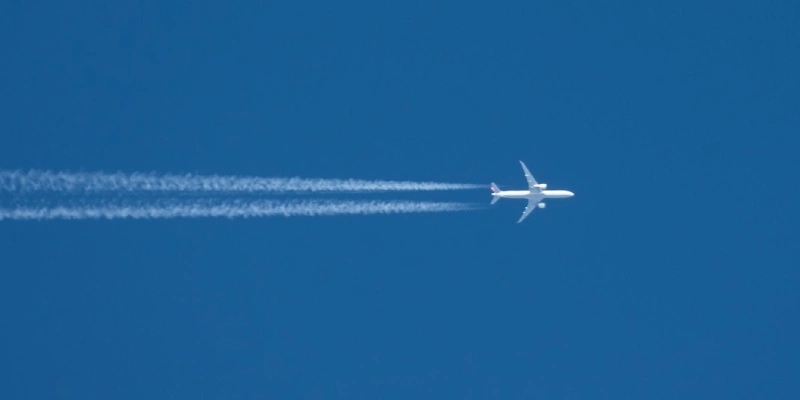




As part of its strategy to reduce the environmental footprint of its operations and tackle commercial aviation’s non-CO₂ effects, Air France has presented the findings of a comprehensive operational research campaign focused on contrails.
Contrails (condensation trails) are the visible white line-clouds that occasionally form behind aircraft cruising at high altitudes. They occur when water vapor emitted by jet engines condenses and freezes on fine particulates (such as soot) in cold, ice-supersaturated atmospheres. While most dissipate within minutes, specific atmospheric conditions can cause them to persist for hours, spreading out into human-induced cirrus clouds that exert a notable warming effect on the climate.
Operational Trials Across Nearly 4,300 Transatlantic Flights
Between February and April 2026, the carrier conducted a dedicated operational trial aimed at detecting and circumnavigating regions with a high probability of forming persistent contrails. The initiative encompassed approximately 4,300 commercial revenue flights operated over the North Atlantic, an airspace sector ideally suited for observing and analyzing these atmospheric phenomena.
The project was carried out in partnership with Estuaire and Klima, two French climate-tech startups acting as technical and operational partners in advancing environmental mitigation tools. Furthermore, these large-scale flight trials were embedded into CICONIA, a European project bringing together academic researchers, airlines, and Air Navigation Service Providers (ANSPs).
The trial program targeted two core operational objectives:
- Deepen the scientific understanding of atmospheric conditions generating contrails with the highest radiative forcing and warming potential.
- Assess the real-world operational feasibility of altering flight profiles and trajectories to minimize climate impact within the rigid constraints and schedule demands of long-haul air transport.
Methodology and Tactical Rerouting: The “Test-and-Learn” Approach
Leveraging high-resolution meteorological forecasts and predictive modeling, Air France operations teams screened and identified 245 flights presenting significant warming potential. Alternative flight paths—combining horizontal route shifts and Flight Level (FL) stepped re-clearances—were generated and evaluated for each flight. Ultimately, 130 flights were actively rerouted under real-time operating conditions.
One of the trial’s key takeaways underscores the concentrated nature of non-CO₂ effects: just 3% of the analyzed flights accounted for 25% of the total contrail-induced warming impact. This distribution validates the effectiveness of targeted contrail avoidance, focusing intervention specifically on high-consequence flights where corrective trajectory adjustments yield the greatest net benefit.
Climate Impact Reduction and Quantitative Results
Flight data demonstrated that targeted avoidance strategies can effectively prevent contrail formation or significantly curb their thermal forcing:
- Across the overall program scope: The diverted flights avoided a climate footprint equivalent to 22,000 metric tons of carbon dioxide (CO₂), delivering an 8% net reduction in contrail-related climate impact across the entire sample evaluated.
- On actively rerouted flights: Aircraft that modified their flight paths saw a 57% decrease in contrail-related climate impact, translating to a 36% overall net climate impact reduction for those specific sectors.
Role of Air Traffic Control
For contrail management to be scaled and standardized across daily airline operations, seamless coordination with air traffic management (ATM) authorities and Air Navigation Service Providers is critical, as any tactical flight plan revision or flight level adjustment remains subject to ATC clearance and sector capacity constraints.
Vincent Etchebehere, VP of Sustainability and New Mobility at Air France, noted: “This trial program marks an essential milestone in validating real-world operational solutions to mitigate contrail climate impact. The findings are highly encouraging and will be shared across ongoing European scientific research frameworks. By contributing our operational flight data and operational expertise, Air France aims to provide transparent, evidence-based support for scalable mitigation frameworks, while strictly adhering to commercial aviation’s operational realities.”
Laurent Lafontan, EVP of Flight Operations at Air France, highlighted the operational commitment: “Every team across our network, both on the ground and in the flight deck, is committed to shrinking our operational footprint. Contributing to this groundbreaking contrail research is a shared point of pride. Tackling these phenomena requires a granular grasp of the atmospheric triggers behind their persistence, and this trial proves that practical, actionable flight deck solutions can be delivered. We stand ready to advance this work alongside all industry and ATM stakeholders.”
The results logged by Air France, Estuaire, and Klima confirm the viability of cutting non-CO₂ warming via tactical trajectory adjustments. Air France will continue supplying flight telemetry and operational feedback to European scientific initiatives, maintaining close collaboration with air traffic control authorities to build an implementation framework fully aligned with international commercial airline operations.
Related Topics
United and American Airlines Eye Further Capacity Cuts Amid Spiking Jet Fuel Prices
Air France to Relocate Operations to JFK’s New Terminal One, Unveiling a 29,000-Square-Foot Flagship Lounge

Frontier Airlines Touches Down in South America with Three New Nonstop Routes Connecting Orlando and Colombia
La Compagnie to Connect New York and Dusseldorf Starting in 2027

Plataforma Informativa de Aviación Comercial con 13 años de trayectoria.