
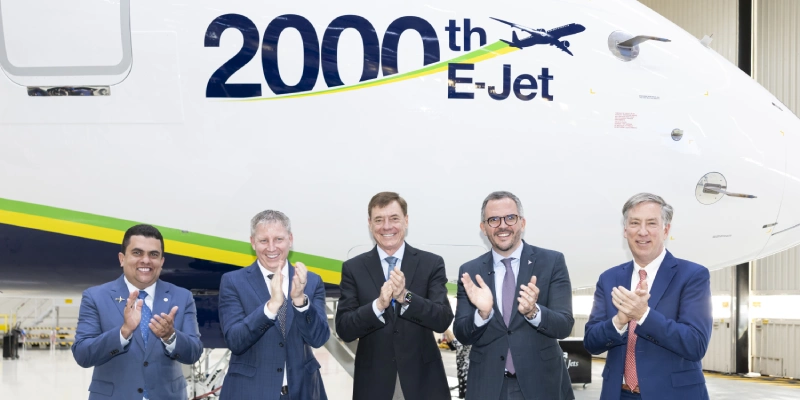
Brazilian aircraft manufacturer Embraer celebrated on Wednesday the delivery of its 2,000th E-Jet, a milestone highlighting the sustained success of one of the world’s three largest commercial aircraft families. The milestone aircraft was an E195-E2 delivered to Azul Linhas Aéreas.
Two Decades of Transformation in the Small Narrowbody Segment
Since entering service in 2004, the E-Jets family has transformed commercial aviation by combining passenger comfort, operational efficiency, and industry-leading reliability. Over the past 20 years, these aircraft have established a strong global footprint:
- Global Operators: More than 90 airlines across over 60 countries.
- Flight Hours: Approximately 48 million hours logged across the fleet.
- Passengers Carried: Over 2.85 billion people worldwide.
The program’s continued performance has enabled the Brazilian planemaker to expand beyond its traditional regional market, cementing a competitive position in the global small narrowbody segment.
Strategic Partnership and Regional Expansion with Azul Linhas Aéreas
The delivery of the 2,000th unit also marks a significant milestone for Azul Linhas Aéreas, representing the 50th E2 aircraft in its fleet. Since launching operations on December 15, 2008—with an E190 registered as PR-AZL—the carrier has operated more than 140 E-Jets family aircraft, serving as a key partner for regional connectivity in Brazil. In 2019, the airline became the launch customer for the E195-E2 upon taking delivery of the first unit produced.
Arjan Meijer, President and CEO of Embraer Commercial Aviation, emphasized the vital role the aircraft family plays in connecting communities, opening new markets, and driving sustainable growth opportunities for airlines globally.
Evolution of the E-Jets Family
The aircraft family encompasses two generations of technological development:
- First Generation: E170, E175, E190, and E195 models.
- Second Generation: E190-E2 and E195-E2 models.
This technical trajectory places the program among the highest-volume and most enduring developments in the history of international commercial aviation, positioning its operational footprint well into the future.
Related Topics

Boeing Posts Best Month of 2026 With 57 Aircraft Delivered in September
Southwest Airlines Evaluates Widebody Aircraft, Eyes Boeing 787
Avolon Orders 250 Aircraft from Airbus and Boeing

FAA Clears Path for Boeing 737 MAX 10 Certification After Dismissing Flight Software Safety Risks


Plataforma Informativa de Aviación Comercial con 13 años de trayectoria.