
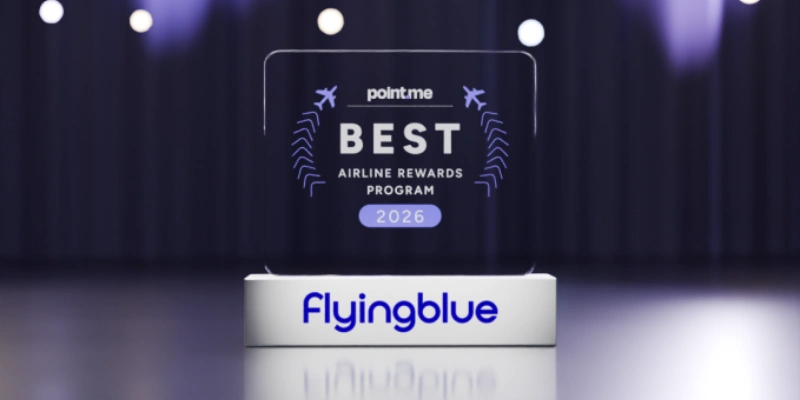
Air France-KLM’s Flying Blue loyalty program solidified its global lead in point.me’s 2026 rankings, underscoring the critical role seat availability and strategic partnerships play in frequent flyer retention within an increasingly restrictive industry landscape.
Clear Dominance in the 2026 Global Rankings
For the third straight year, Air France-KLM Flying Blue captured the top spot globally in the annual World’s Best Airline Rewards Programs report compiled by reward travel search engine point.me. The study assessed 33 of the world’s leading frequent flyer programs, evaluating a proprietary dataset of more than 250 million award fare searches.
Flying Blue led the pack on the strength of top-tier performance across three core pillars: award seat availability, partner airline opportunities, and ease of earning.
United MileagePlus claimed the second global spot, earning distinction for delivering the industry’s best redemption experience alongside top marks for customer service. Air Canada Aeroplan took third place, recognized as a well-rounded and versatile program while finishing as direct runner-up in award space availability, partner carrier coverage, and earn velocity.
Top 10 Global Frequent Flyer Programs
- Air France-KLM Flying Blue
- United MileagePlus
- Air Canada Aeroplan
- Alaska / Hawaiian Atmos Rewards
- American Airlines AAdvantage
- Qatar Airways Privilege Club
- JetBlue TrueBlue
- British Airways Club
- Virgin Atlantic Flying Club
- Cathay Pacific Asia Miles
Regional Leaders: Mapping Frequent Flyer Value
The point.me report also broke down program performance across global regions, highlighting regional strengths by market:
- Americas: United MileagePlus (#1) and Air Canada Aeroplan (#2).
- Europe: Air France-KLM Flying Blue (#1) and British Airways Club (#2).
- Asia & Oceania: Cathay Pacific Asia Miles (#1), followed by a tie between Japan Airlines Mileage Bank and Singapore Airlines KrisFlyer (#2).
- Middle East: Qatar Airways Privilege Club (#1) and Emirates Skywards (#2).
Methodology: Eight Criteria Evaluating Practical Utility
The study analyzed quantitative and qualitative carrier data through a cut-off date of August 1, 2026, structuring overall scores across eight core evaluation metrics:
- Ease of earning
- Redemption rates
- Partner airline redemption opportunities
- Overall redemption experience
- Award seat availability
- Booking hold capabilities
- Customer service
- Itinerary change and cancellation fee policies
Adam Morvitz, Chief Executive Officer of point.me, emphasized that ease of use remains the top priority for today’s passenger:
“Travelers want to use their points without having to become experts to do so. A great loyalty program isn’t one that offers an incredible deal once in a while; it is one where you can find a reasonably priced seat, book it easily, and change your plans if needed. That is what we measure, and the programs at the top of this list are delivering on that promise.”
Benjamin Lipsey, President of Flying Blue Miles and Senior Vice President of Loyalty, Digital, and Data at Air France-KLM, pointed out the program’s growing balance-sheet impact:
“Loyalty has become a strategic lever in global aviation, and for the third consecutive year, the data ranks Flying Blue at the top. The program extends the reach of Air France, KLM, and Transavia beyond the flight itself, engaging our members wherever they travel and spend. That connectivity represents one of the Group’s defining competitive advantages, and loyalty will remain central to our customer acquisition and retention strategy.”
Key Industry Trends: Co-Branded Cards and Fading Flexibility
The 2026 report pinpointed broader structural shifts across frequent flyer program policies, driven by balance-sheet monetization and tighter inventory segmentation:
1. The Leverage of Co-Branded Credit Cards
Airlines are increasingly cordoning off their most competitive award tiers and premium inventory exclusively for co-branded credit cardholders. Financial portfolios have turned into one of the airline industry’s most lucrative revenue streams; by comparison, American Express paid a reported $8.2 billion to Delta Air Lines in a single calendar year (per Delta.com disclosures).
Morvitz outlined the direct operational impact:
- United Airlines routes the bulk of its saver-tier Polaris business-class inventory toward cardholders and elite-status members.
- Delta Air Lines provides a straight 15% discount on award travel to select premium cardholders.
- JetBlue Airways offers a 10% to 15% rebate on points redemptions.
2. Shrinking Inventory Across Partner Carriers
Premium cabin award inventory made available for redemption across alliance and partner airlines continues to see sharp cutbacks, as network legacy carriers increasingly safeguard premium seats for their own frequent flyers.
3. Policy Flexibility as a Major Differentiator
Change and cancellation policies have emerged as a significant competitive divide among carriers: only three of the 33 programs evaluated in the report offer completely fee-free changes and cancellations on all award tickets. The remaining carriers assess cancellation and change fees of up to $150 or impose strict penalties and non-refundable terms on mileage redemptions.
The 2026 edition of the report highlights that as access to premium cabin awards becomes increasingly tied to financial products and stricter fare rules, Flying Blue, United MileagePlus, and Air Canada Aeroplan preserve their market leadership by maintaining an operational balance of accessible award space, comprehensive alliance integration, and everyday ease of use.
Related Topics

JetBlue Rules Out Debt Restructuring and Creditor Talks Following Bond Sell-Off

Alaska Airlines to Connect Anchorage and Tokyo Narita with Nonstop Boeing 737 MAX Flights
Avior Airlines to Resume Nonstop Flights Between Barcelona and Miami in Partnership with Eastern Airlines

Boeing Reports Wider Q3 Losses in Commercial Airplanes Weighed Down by Delivery Delays

Plataforma Informativa de Aviación Comercial con 13 años de trayectoria.