
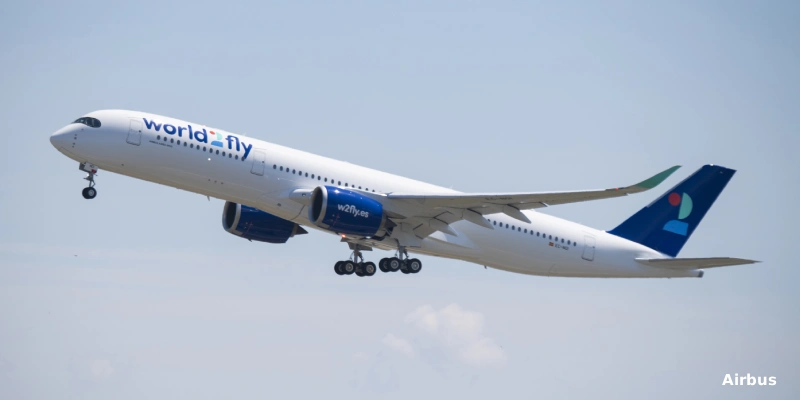
World2Fly commenced scheduled commercial operations in Argentina this Thursday with the launch of the first direct service between Madrid and Rosario.
The rollout of this route takes place under the Open Skies policy and airline deregulation implemented by Argentina’s federal government. This framework is anchored in the updated bilateral air services agreement signed between Argentina and the Kingdom of Spain, through which the carrier obtained scheduled international passenger and belly-cargo traffic rights.
To serve this transatlantic route, World2Fly has structured the following operational schedule:
- Frequencies: Twice-weekly flights, scheduled to operate on Tuesdays and Thursdays.
- Assigned fleet: Airbus A350-900 aircraft.
- Configuration: Single-class, high-density cabin accommodating 432 seats.
Under this layout, World2Fly’s Airbus A350-900 currently stands as the highest-capacity commercial passenger aircraft operating across Argentine airspace and territory.
→ Iberia Begins Countdown to Its Centenary: Unveils Commemorative Livery and Event Program
Argentina–Spain Market Competition and Traffic Growth
World2Fly’s arrival broadens the carrier landscape along one of the Southern Cone’s most heavily traveled intercontinental corridors. The Argentina–Spain market currently features operations from:
- Iberia
- Air Europa
- LEVEL
- Plus Ultra
- Aerolíneas Argentinas
- World2Fly
The new service joins an already well-established route network linking Buenos Aires’ Ezeiza International Airport to Madrid and Barcelona, as well as the nonstop link connecting Córdoba with the Spanish capital.
Market demand continues its upward trajectory: between January and August 2026, 1,034,574 passengers traveled on scheduled commercial flights between both nations. This represents a 7% year-over-year increase compared to the same period in 2025 and a 54% surge over 2023 levels.
Decentralization of International Connectivity
Bringing Rosario into the international route network reinforces point-to-point regional connectivity from Argentina’s interior without routing traffic through Buenos Aires:
- As of October 2026, the country registers 88 active international routes.
- Of that total, 28 point-to-point links directly connect provincial airports with foreign destinations.
- Between January and August this year, 1,902,571 passengers traveled abroad directly from regional terminals, marking a 29% growth over 2025 and a 133% increase compared to 2023.
Globally, Argentina’s federal Open Skies strategy now spans 65 international bilateral agreements, aimed at lifting capacity caps, expanding traffic rights, and streamlining market access for new commercial carriers.
The inauguration of the Madrid–Rosario city pair encapsulates the core pillars of Argentina’s evolving commercial aviation landscape: the induction of a new international operator, the opening of a brand-new long-haul intercontinental route, the expansion of direct connectivity for regional hubs, and the market entry of private ground-handling providers.
Related Topics

Southwest Unveils Record-Breaking Summer 2027 Schedule With Major Expansion in Austin, Nashville, and San Diego
Alaska Airlines Challenges Delta in Seattle, Taking its Offensive to Long-Haul Routes

JetBlue Expands Colombian Network With Nonstop Fort Lauderdale–Barranquilla Flights

US Seeks to Accelerate Aircraft Type Certification


Un apasionado por la aviación, Fundador y CEO de Aviación al Día.