
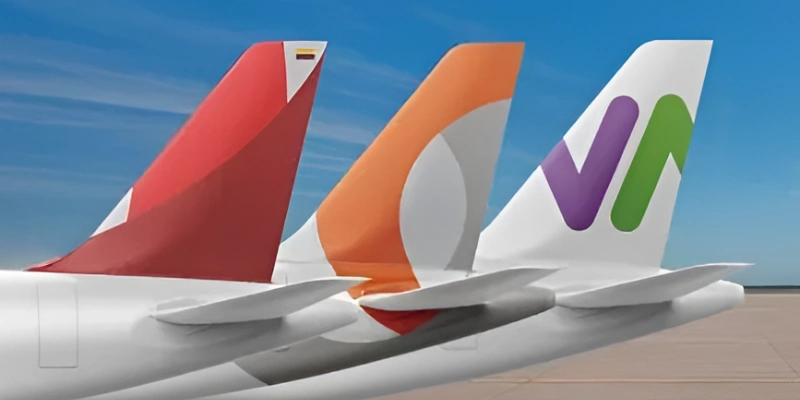
Abra Group, the Latin American airline holding company and parent of Avianca and Gol, reported total operating revenue of $3.1 billion in the third quarter of 2026, representing a 22.0% year-over-year (YoY) increase. This performance underscores the group’s financial resilience in the face of elevated fuel prices, bolstered by a 64% surge in premium revenue, a 93% commercial recovery rate, and the expansion of its long-haul international network.
Consolidated Financial Results: Commercial Traction and Margin Expansion
During the third quarter of 2026, Abra Group’s unaudited results reflected broad-based growth across all business units. Passenger revenue reached $2.6 billion (+22.9% YoY), supported by a resilient demand environment and strict fare discipline. Meanwhile, cargo and other revenues totaled $476 million (+17.1% YoY), driven by incremental cargo capacity.
A key catalyst for the period’s profitability was the consolidation of its high-value product: premium revenue grew 64% YoY, coming to represent 26% of total quarterly passenger revenue.
In terms of operating profitability, adjusted Earnings Before Interest, Taxes, Depreciation, Amortization, and Restructuring or Rent Costs (EBITDAR) reached $917 million, yielding an adjusted EBITDAR margin of 29.7%. Excluding non-recurring items, adjusted EBITDAR stood at $676 million, equivalent to a 21.9% margin.
“We delivered solid third-quarter results with continued revenue growth, disciplined execution, and strong performance across our passenger, cargo, and other businesses. The growth in our premium business and the expansion of our international footprint through new routes and strategic partnerships are contributing to a stronger, more diversified Abra platform,” stated Adrian Neuhauser, Chief Executive Officer of Abra Group.
Financial Performance by Airline: Avianca and Gol
The individual breakdown of the group’s two main operating carriers highlights complementary dynamics in response to fuel inflationary pressures:
- Avianca: Recorded total operating revenue of $1.8 billion (+21.3% YoY). Passenger revenue rose to $1.5 billion (+24.2%), boosted by a greater contribution from its Business Class cabin and solid yields, while cargo and other revenues generated $344 million (+10.1%). Adjusted EBITDAR was $398 million (-3.1%), with a margin of 21.7% (down 5.5 percentage points [p.p.]). Excluding non-recurring items, adjusted EBITDAR was $321 million (a 17.5% margin).
- Gol: Reached total operating revenue of $1.3 billion (+23.5% YoY). The passenger business contributed $1.1 billion (+21.7%), while the cargo and other segment jumped 41.3% to $131 million, supported by Gollog’s strategic partnerships. Adjusted EBITDAR soared 61.0% to $531 million, achieving a 42.2% margin (+9.9 p.p.). Excluding non-recurring items, adjusted EBITDAR was $367 million (a 29.1% margin).
Beginning this quarter, the group incorporated the impact of mileage redemptions into its unit revenue and unit cost metrics to improve comparability with industry reporting practices, restating prior-period data on a comparable basis.
Operational Metrics and Unit Cost Control
On the operational front, Abra Group carried 19.0 million passengers during the quarter (+2.5% YoY), while capacity—measured in Available Seat Kilometers (ASK)—grew moderately by 7.3% to 33.1 billion ASKs, focusing selectively on Europe, the Brazilian domestic market, and North America.
Consolidated average yield increased 16.6% YoY to 9.6 U.S. cents, and the load factor stood at 82.0%. This combination drove Passenger Revenue per Available Seat Kilometer (PRASK) up 14.6% YoY (and 13.1% sequentially) to 7.9 cents. Meanwhile, Cost per Available Seat Kilometer excluding fuel (CASK ex-fuel) declined 11.5% quarter-over-quarter to 4.9 cents, benefiting from a non-recurring effect and higher capacity; excluding that benefit, the metric remained modestly below the prior quarter.
Operational Breakdown: Avianca and Gol
- Traffic and Capacity: Avianca transported 9.8 million passengers (+0.5%) with a capacity of 19.4 billion ASKs (+6.2%), prioritizing longer-haul international routes (its average stage length increased by 2.7%). Gol carried 9.3 million passengers (+4.7%) with 13.7 billion ASKs (+8.8%), capitalizing on its focus on the domestic market.
- Yield and Load Factor: Avianca’s yield rose 18.8% to 9.4 cents, and Gol’s rose 14.1% to 10.0 cents. Load factors closed at 81.6% (-1.3 p.p.) for Avianca and 82.6% (-1.6 p.p.) for Gol, resulting in a PRASK of 7.6 cents (+16.9%) and 8.3 cents (+11.9%), respectively.
- Cost Efficiency: Reported CASK ex-fuel was 4.9 cents for Avianca (-0.5% sequentially) and 4.8 cents for Gol (-27.1% sequentially). Isolating non-recurring items, Avianca’s CASK ex-fuel moved from 4.8 to 5.0 cents, primarily due to the appreciation of local currencies, whereas Gol’s improved by 8.7% sequentially—dropping from 6.5 to 6.0 cents—thanks to higher capacity, lower maintenance costs, and efficiency initiatives.
Fuel Mitigation, Liquidity, and Capital Structure
To counter jet fuel price volatility and elevated costs, Abra executed a coordinated strategy that enabled a 93% commercial recovery, complemented by hedging 44% of fourth-quarter passenger fuel consumption and making tactical capacity adjustments. Along these lines, the group reduced frequencies on underperforming routes, trimming Avianca’s ASKs by 3% and Gol’s by 7% compared to the third-quarter schedule planned in February 2026.
As of September 30, 2026, the group’s balance sheet showed the following key indicators:
- Total Liquidity: $1.96 billion, equivalent to 18% of Last Twelve Months (LTM) revenue. This amount includes $1.3 billion in cash, cash equivalents, and short-term investments (a decrease of approximately $125 million compared to $1.4 billion at the end of Q2) and $659 million in other liquidity (Gol credit card receivables and availability under Avianca’s revolving credit facility, up from $636 million as of June 30, 2026).
- Debt and Leverage: Net debt stood at approximately $10.0 billion, maintaining stable net leverage of 3.7x quarter-over-quarter, even before new aircraft begin contributing to adjusted EBITDAR.
- Maintenance Financing: The group diversified its funding sources by securing financing backed by the Brazilian government for Avianca and Gol engine maintenance at GE Aerospace facilities in Brazil.
Route Network, Fleet, and International Deployment
At quarter-end, Abra Group’s combined network spanned more than 370 routes (including 11 new routes) to over 150 destinations (including 3 new destinations) across 28 countries, operated by a total fleet of 317 aircraft: 270 narrow-body jets, 29 wide-body jets, and 18 freighters.
Key strategic moves in international expansion and connectivity included:
- Etihad Partnership: Under the memorandum of understanding between Abra and Etihad, Avianca is operating the Barcelona–Abu Dhabi route for the Emirati carrier under a one-year wet-lease agreement.
- Gol Long-Haul: The Brazilian airline advanced its wide-body strategy with the launch of routes from Rio de Janeiro to Lisbon and New York, operated temporarily by Wamos while A330neo aircraft are being phased into the fleet.
- Avianca Regional Connectivity: The carrier deployed selective capacity from Bogotá to Maracaibo and Valencia in Venezuela.
Additionally, the group reinforced its social commitment through collaborations with over 30 organizations across 11 countries, transporting more than 330 humanitarian specialists and nearly 590 tons of emergency aid to communities affected by earthquakes in Venezuela and Colombia.
Backed by robust liquidity, 44% of its Q4 passenger fuel consumption hedged, and the upcoming addition of A330neo aircraft to support Gol’s long-haul expansion, Abra Group heads into the close of 2026 prioritizing cost discipline and the consolidation of its global alliances to sustain long-term profitability.
Related Topics

TAP Air Portugal to Connect Porto and Washington, D.C. Starting March 2027
Bankruptcy Judge Approves $10 Million Sale of Spirit Airlines Internal Data to Google
FAA Suspends New Router Installations Following Friday’s Nationwide Ground Stop

Five Injured on JetBlue Flight Between Ponce and Fort Lauderdale Following Severe Turbulence


Un apasionado por la aviación, Fundador y CEO de Aviación al Día.