
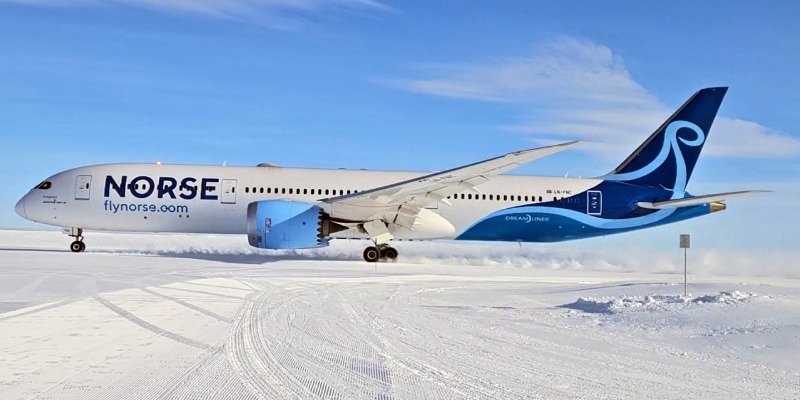
The Norwegian long-haul low-cost carrier Norse Atlantic halted operations on Thursday and announced that it will file for bankruptcy if it fails to secure urgent short-term financing. The company’s financial crisis reflects the severe operational and economic toll that the war with Iran is taking on the commercial aviation industry.
Financial Crisis, Stock Plunge, and Fleet Return
Norse Atlantic confirmed in an official statement that, unless a short-term financing solution is urgently secured, its Board of Directors intends to file for bankruptcy. As an immediate measure, the airline has already returned all of its aircraft to its bases in Norway, Sweden, and Great Britain, according to Chief Executive Officer Eivind Roald.
The company’s situation worsened this week in the financial markets after warning on Wednesday that its financial condition was “critical” and that it required fresh capital to cover its short-term liquidity and operational needs:
- Plunge and volatility: Wednesday’s announcement triggered an 85% drop in its share price. Although the stock rebounded by 9% at 10:02 a.m. on Thursday, the move reflected sessions of high volatility following its placement in the Oslo Stock Exchange’s recovery segment, designated for companies facing financial uncertainty.
- Loss of value: The accumulated crisis over the current year has wiped out 99% of Norse Atlantic’s market value.
- Suspension of commercial agreements: On Wednesday, Pakistan International Airlines (PIA) reported that Norse Atlantic abruptly suspended an agreement signed in October—under an Aircraft, Crew, Maintenance, and Insurance (ACMI) arrangement—through which PIA was to lease two aircraft, forcing the Pakistani carrier to cancel two flights.
Impact of the War with Iran on Fuel Prices
The global aviation industry is experiencing its worst crisis since the COVID-19 pandemic due to the conflict between the United States and Israel against Iran, which began in late February and has disrupted flight operations while driving up operating costs.
In Europe, jet fuel prices more than doubled in March due to supply disruptions linked to the conflict and have remained volatile at elevated levels throughout the year. While fuel typically accounts for roughly one-fifth of an airline’s costs, the impact on Norse Atlantic was critical due to two key factors:
- Lack of fuel hedging: The airline had not entered into financial hedging contracts to protect itself against jet fuel price fluctuations.
- Capacity reduction: The company was forced to operate with reduced capacity, a particularly challenging scenario for a low-cost carrier focused on fuel-intensive long-haul routes.
Norse’s situation adds to that of other European airlines facing financial distress, such as Latvian carrier airBaltic, which entered Chapter 11 bankruptcy proceedings in September to restructure and secure new financing.
Vulnerabilities of the Long-Haul Low-Cost Model
Founded in 2021 by entrepreneur Bjorn Tore Larsen following Norwegian Air’s exit from long-haul operations during the pandemic, Norse Atlantic sought to revive low-fare transatlantic flights by operating 12 Boeing 787 Dreamliner aircraft and employing much of Norwegian’s former staff.
However, industry analysts pointed out the structural limitations of its business model from the outset:
- Lack of a feeder network: By operating exclusively long-haul flights, the carrier lacked a regional feeder network to help fill its transatlantic routes.
- Delayed diversification: Faced with difficulties achieving profitability solely through scheduled flights, the airline later opted to diversify into charter services and aircraft leasing.
Commenting on the operational viability of the segment, James Halstead, managing partner at Aviation Strategy, explained that long-haul low-cost is a challenging model because fuel absorbs a large share of expenses, it is difficult to achieve a significant cost advantage over legacy network carriers, and demand is fickle, seasonal, and highly price-sensitive. Meanwhile, aviation analyst John Strickland warned that the grounding of flights makes the airline’s return to service increasingly unlikely and will undermine passenger confidence in making new bookings.
Next Steps and Search for Investors
Norse Atlantic, which launched a formal process in July to explore a potential sale or merger, stated that it continues to evaluate short-term financing alternatives and is holding discussions with investors regarding a possible acquisition that would include a capital injection. Nevertheless, the airline itself acknowledged that there is no guarantee a viable solution will be reached to avoid bankruptcy.
Related Topics
Xiamen Airlines Signs Agreement with Boeing to Purchase 50 737-8 Aircraft for $7.4 Billion

Investigation into Air India Boeing 787 Crash Enters Final Phase

Philippine Airlines Finalizes Order for up to 20 Boeing 787-10 Jets
Korean Air to Connect Seoul and Newark Starting May 2027


Plataforma Informativa de Aviación Comercial con 13 años de trayectoria.