easyJet and Rolls-Royce Successfully Run Aero Engine at Maximum Takeoff Power Using 100% Hydrogen
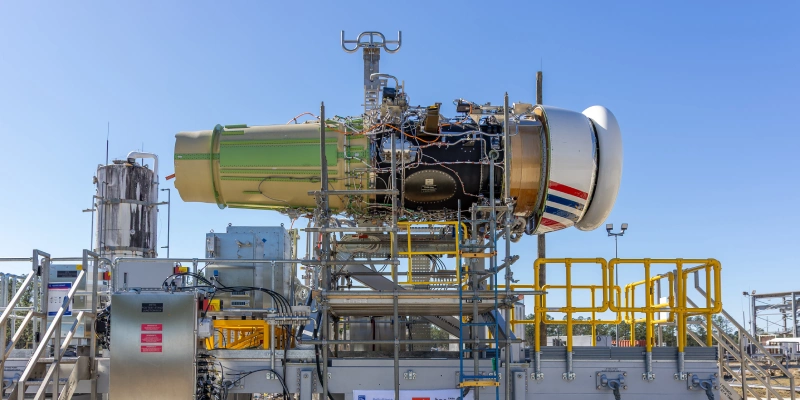




easyJet and Rolls-Royce have announced the successful completion of a critical phase in their hydrogen fuel testing, achieving maximum takeoff power on an aero engine using exclusively hydrogen. This breakthrough represents a fundamental step in the roadmap toward decarbonizing the aviation industry and validating new propulsion technologies.
A Historic Milestone at NASA’s Stennis Space Center
In what is considered an industry first, the companies conducted the tests using a modified Rolls-Royce Pearl 15 engine. The trials took place at the National Aeronautics and Space Administration (NASA) Stennis Space Center, located near Bay St. Louis, Mississippi.
This achievement is the result of a four-year collaborative program between Rolls-Royce, easyJet, and global partners. The primary objective has been to explore hydrogen as an aviation fuel and generate engineering insights for future propulsion applications.
Validation of the Full Flight Cycle
During this phase of the program, engineers demonstrated that a modern jet engine—with the scalability to power narrowbody aircraft—can operate safely using gaseous hydrogen. The tests covered a full simulated flight cycle, which included:
- Startup
- Takeoff
- Cruise
- Landing
→ easyJet Boosts Presence in Morocco with New Marrakech Base and Six Additional Routes
Technological Evolution and Strategic Collaboration
The success in the United States is the culmination of an incremental, technology-led approach. The path taken by the alliance includes several key milestones:
- Initial Testing (2022): Conducted at Boscombe Down, United Kingdom.
- Scalability: Development of component and system tests on testbeds across the UK and Europe.
- Safety Infrastructure: Development of a full-scale hydrogen test facility at Great Britain’s Health and Safety Executive (HSE).
- Final Integration: Incorporating the systems into a hydrogen-fueled demonstrator engine.
The partnership between Rolls-Royce and Tata Consultancy Services (TCS) has been instrumental in accelerating these goals, providing capacity and expertise in critical engineering workflows, systems, and software. For its part, the HSE managed the pressurized hydrogen infrastructure, ensuring that safety and performance requirements were rigorously met.
Implications for the Future of Aviation
The program focused not only on combustion but also on the impact of non-$CO_2$ emissions through exhaustive combustion analysis. The data obtained provides the clearest understanding to date regarding hydrogen behavior in a modern gas turbine.
“Demonstrating 100% hydrogen operation at scale is a significant milestone and marks a major step toward easyJet’s net-zero ambition,” stated David Morgan, Chief Operating Officer at easyJet.
Synergy with Other Technologies
The insights gained from this program, many of which are fuel-agnostic, will be applied to future Rolls-Royce developments, including the UltraFan program.
Hydrogen is expected to serve as a complementary solution to Sustainable Aviation Fuel (SAF) to support sector growth in the European and UK markets, as reinforced by the Enabling Hydrogen in the European Aviation Market report.
This advancement demonstrates that gas turbine technology will remain fundamental to the future of sustainable aviation. With the validation of control, fuel, and combustion systems, the industry is closer to translating climate ambition into viable technical execution for the real world.
Related Topics
FAA Mandates Inspections for Select Boeing 787s Over Potential Structural Defects

Boeing Delivers 53 Jets in July, Down 11 From June

FAA Orders Inspection of Hundreds of Boeing 737 MAX Aircraft Over Potential Fuselage Cracking

FAA Certifies Boeing 737-7

Plataforma Informativa de Aviación Comercial con 13 años de trayectoria.