Billion-Dollar Impact on U.S. Airlines Following Friday’s Ground Stop
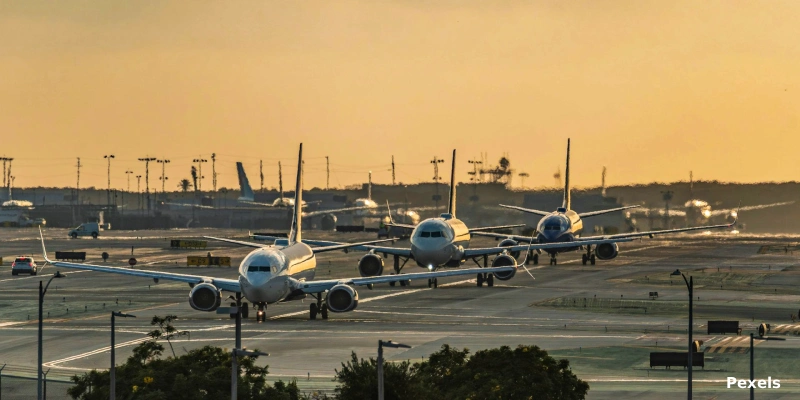




The recent nationwide ground stop in the United States threatens to generate over $1 billion in losses for airlines. This event deals a severe financial blow to an industry already grappling with high fuel costs and lowered earnings expectations, impacting nearly 18% of scheduled domestic operations.
Financial Fallout for Major Carriers
The November 13 disruption cost the U.S. economy “billions of dollars,” according to U.S. Transportation Secretary Sean Duffy.
An analysis conducted by Raymond James covering nine major U.S. and Canadian carriers details the estimated impact on earnings:
- American Airlines Group: Could post the steepest financial loss, estimated between $136 million and $354 million in potential earnings.
- Delta Air Lines: Losses are projected in the range of $94 million to $244 million.
- United Airlines Holdings: The estimated impact ranges from $88 million to $229 million.
→ United Airlines Opens New Concourse E at Washington Dulles International Airport
Operational Impact: Mass Cancellations Across the U.S.
According to data provided by Cirium, nearly 19,400 flights arriving in or departing from the United States were canceled or failed to operate between Friday and Monday morning.
Carrier-Specific Impact
- American: Recorded the highest number of affected flights among major U.S. airlines with 5,888 flights, representing approximately 23% of its schedule.
- JetBlue Airways: Was among the hardest hit operationally, with 1,119 flights canceled or unoperated, equivalent to nearly 33% of its schedule.
Blow to Financially Vulnerable Airlines
The operational impact could be particularly acute for financially strained carriers such as JetBlue and Frontier Group Holdings, which have weaker balance sheets and less headroom to absorb unexpected expenses.
For JetBlue, Raymond James estimated a financial hit of between $28 million and $73 million. While this represents a smaller monetary loss compared to its larger rivals, it could prove more consequential for a company currently struggling to return to profitability. The firm estimates that this operational disruption could reduce JetBlue’s fourth-quarter earnings per share by 7 to 18 cents.
Fourth-Quarter Outlook and Market Reaction
This Federal Aviation Administration (FAA) ground stop will weigh heavily on fourth-quarter earnings and cash flow, as airlines are forced to absorb direct costs stemming from canceled flights, aircraft diversions, and disrupted schedules, according to Bloomberg Intelligence analysts George Ferguson and Melissa Balzano. Despite this outlook, shares of most major U.S. airlines rose in early Monday trading, rebounding from previous losses.
As next steps, air carriers may seek to exclude the financial impact of these ground stops from their adjusted fourth-quarter results. Concurrently, management teams are expected to evaluate recovering some of these costs through business interruption insurance policies or by seeking direct compensation from the contractors involved.
Related Topics

LATAM Airlines Reports US$441 Million Q3 2026 Net Profit, Raises Full-Year Guidance

Qatar Airways Lands in Colombia and Venezuela: Inaugurates Triangular Route Linking Doha, Bogota, and Caracas

Latin America and the Caribbean Passenger Traffic Edges Up 0.8% in August

Copa Airlines Expands Connectivity in Venezuela with a Fifth Weekly Frequency to Barcelona

Plataforma Informativa de Aviación Comercial con 13 años de trayectoria.