Embraer Advances IGNITE-X Research to Reduce the Climate Impact of Contrails
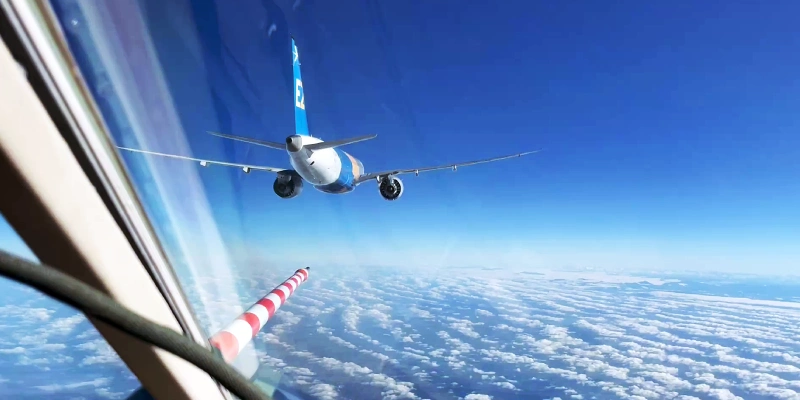




Embraer has joined the International Ground and Inflight Turbine Emission Experiment (IGNITE-X) research project, led by the German Aerospace Center (DLR), to evaluate how fuel composition affects contrail formation. This initiative is critical to understanding and mitigating the non-CO2 climate effects of aviation through the use of low-emission engine technologies and alternative fuels.
IGNITE-X Project and Emissions Analysis
The IGNITE-X research campaign brings together leading organizations from the aerospace, academic, and research sectors. Participants include DLR, Embraer, Pratt & Whitney (an RTX business), Aerodyne Research, and the Missouri University of Science and Technology.
The primary objective of this collaboration is to investigate how fuel composition—specifically its sulfur content—influences engine emissions, particulate matter formation, and contrail development. Contrails are ice-crystal clouds that form when aircraft exhaust gases interact with cold, humid air at cruising altitude, and they are widely recognized as a contributing factor to aviation’s non-CO2 climate impacts.
Through IGNITE-X, researchers aim to determine whether reducing sulfur in aviation fuels, combined with advanced low-emission engine technology, can significantly curb the formation of these contrails.
→ IndiGo in Talks to Acquire Up to 150 Regional Jets from Embraer to Boost Domestic Network
Embraer E195-E2 as a Technology Platform
At the center of this test campaign is the Embraer E195-E2, powered by Pratt & Whitney GTF PW1900G engines. The E195-E2 stands out as the most fuel-efficient and quietest small narrowbody aircraft in its segment.
Its key features include:
- Reductions of up to 30% in fuel burn and emissions compared to previous-generation aircraft.
- An advanced aerodynamic design and GTF engines, making it a highly relevant platform for evaluating long-term sustainability.
During the trials, the aircraft operates using both conventional jet fuel and a specially produced low-sulfur aviation fuel. This allows researchers to compare emissions and particle formation characteristics under real-world operating conditions.
Flight Test Methodology
As part of the flight test campaign, DLR’s Falcon 20E research aircraft trails the Embraer E195-E2 through dedicated test corridors over Germany. Its role is to measure exhaust emissions and contrail properties at varying distances behind the commercial airliner. Additionally, researchers are conducting extensive ground measurements to evaluate ultrafine particle emissions across the engines’ full operating envelope.
Industry Perspectives
Cleiton Silva, Vice President of Technology Development and Electronic Equipment at Embraer, highlighted the significance of the selected aircraft: “The E195-E2 was designed to deliver outstanding efficiency and lower emissions, making it an ideal platform to advance research toward the future of sustainable aviation.” Silva added that this collaboration reinforces Embraer’s commitment to science-based solutions.
Meanwhile, Markus Fischer, Divisional Board Member for Aeronautics at DLR, underscored the complexity of the testing: “We are measuring emissions directly inside the exhaust plume; this is extremely challenging both scientifically and operationally. The test procedure provides unique insights into the potential for reducing emissions.”
Findings from the IGNITE-X project are expected to yield high-value scientific data to better understand non-CO2 climate impacts in commercial aviation. This valuable insight will support the development of effective mitigation strategies and reflects the aviation industry’s growing commitment to collaborative research aimed at a more sustainable future for air transport.
Related Topics
Cathay Group Orders 14 Additional Airbus Jets
Lufthansa Group Takes Delivery of 700th Airbus Jets: An A350-1000 Marking 50 Years of Partnership and Debuting Starlink Inflight Connectivity
World Distance Record: Airbus A350-1000ULR Completes Historic 23,155-Kilometer Flight
Air France Takes Delivery of Its 60th Airbus A220

Plataforma Informativa de Aviación Comercial con 13 años de trayectoria.