
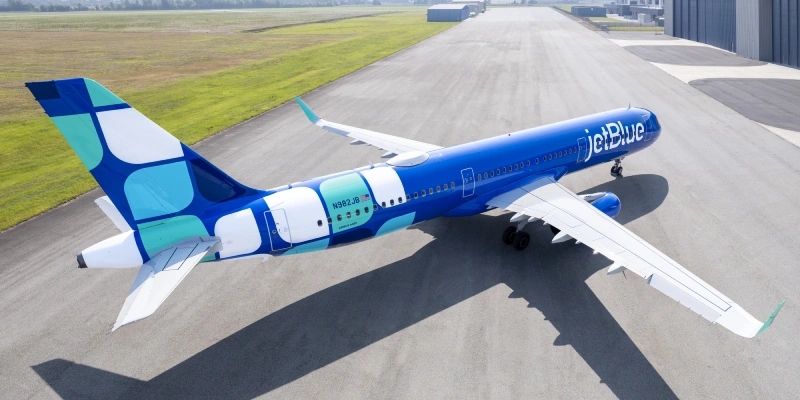
JetBlue announced on Thursday that it will be the world’s first airline to integrate Amazon’s Project Kuiper, a low Earth orbit satellite broadband network, in order to take the experience of its well-known Fly-Fi service to a new level of speed and reliability.
Since 2013, the company has stood out as the first—and still the only major U.S. airline—to offer free, high-speed Wi-Fi across its entire fleet.
What It Means for Passengers
JetBlue President Marty St. George emphasized that this agreement represents a decisive step in its commitment to leading the way in inflight connectivity: “Whether it’s binge-watching a series, staying in touch with family, or finishing a work project, we always strive to help our customers make the most of their time in the air in the most connected and productive way possible,” he stated.
The announcement is part of the JetForward strategy, focused on offering users the most valued benefits and services, highlighting simplicity, speed, and differentiated treatment.
From Amazon’s side, Panos Panay, Senior Vice President of Devices & Services, noted: “With Project Kuiper, we aim to deliver fast, reliable internet wherever customers are—whether at home or at 35,000 feet—and we’re excited to make that a reality together with JetBlue.”
→ JetBlue Threatens Legal Action Against Portugal Over Blocked Flights to Lisbon
How Project Kuiper Works
The system relies on thousands of interconnected low-orbit satellites linked by high-speed optical connections, creating a mesh network in space. This is supported by a ground-based infrastructure of antennas, fiber, and internet connection facilities ensuring global coverage.
To date, Amazon has deployed more than 100 satellites and continues to increase its production, processing, and launch rates with the goal of offering initial service.
Evolution of Fly-Fi
Currently, JetBlue uses geostationary orbit (GEO) satellite technology that provides gate-to-gate connectivity on all its flights. With the incorporation of Project Kuiper, its aircraft will gain higher speed and lower latency, allowing passengers to browse, stream, and work without interruption.
The airline is also exploring a multi-orbit connectivity model that combines the advantages of both GEO and low-orbit systems, which in the future could lead to an even more robust and stable service.
Implementation Timeline
JetBlue expects to begin installation of the Kuiper system in 2027, with a gradual rollout across its fleet. Details regarding the first routes and aircraft to feature the new technology will be announced as the project progresses.
Related Topics

Japan Airlines Selects Embraer E190-E2 to Renew J-AIR Regional Fleet

AirAsia in Talks with Malaysian Government Over Potential Financial Support Amid Economic Headwinds and Soaring Fuel Costs

LOT Polish Airlines Launches Direct Flights Between Warsaw and Bangkok

Lufthansa Group Boosts Connectivity to Japan, Reaching Up to 50 Weekly Flights in Summer 2027


Plataforma Informativa de Aviación Comercial con 13 años de trayectoria.