Philippine Airlines Receives Its First Airbus A350-1000
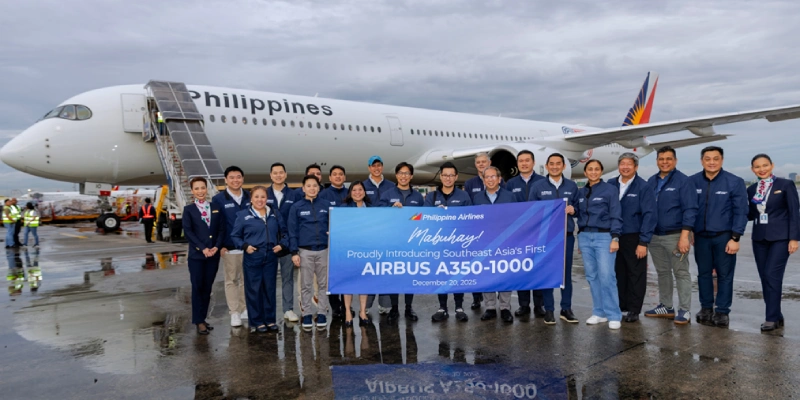




Philippine Airlines (PAL) reached a key milestone in its recent history with the arrival of its first Airbus A350-1000, a next-generation aircraft that reinforces the airline’s global growth strategy and raises the standard for long-haul operations in the region.
The aircraft landed in Manila at 4:43 p.m., making the company the first A350-1000 operator in Southeast Asia, an achievement that consolidates its positioning within the international market.
Official Delivery Following Ceremony in Toulouse
The incorporation of the new model occurred after a ceremony held in Toulouse, France, headquarters of Airbus. During the event, Lucio Tan III, President of PAL Holdings, Inc., led the delegation that formally received the aircraft.
The executive group included Kyle Tan, Advisor to the Board of Philippine Airlines; Richard Nuttall, President of the airline; and Atty. Carlos Luis Fernandez, Executive Vice President and Chief Operating Officer. This unit is part of a total order for nine A350-1000s, included within the company’s fleet expansion program.
→ Southwest and Philippine Airlines Announce New Partnership to Expand Transoceanic Connectivity
An Alliance of More Than Four Decades with Airbus
During the delivery, Tan highlighted the more than 40-year relationship between Philippine Airlines and Airbus, underlining the significance of incorporating what he defined as the world’s most modern wide-body aircraft.
“The arrival of the A350-1000 represents a significant step in our ongoing commitment to fleet modernization and network growth. It will be a source of Filipino pride and a transformation for our airline,” stated the President of PAL Holdings.
Cabin Configuration Designed for Transpacific Routes
The Airbus A350-1000 is primarily intended to operate the company’s transpacific routes. It features a three-class cabin, designed to offer greater comfort on intercontinental flights.
Total capacity reaches 382 passengers, distributed across 42 Business Class seats, 24 Premium Economy seats, and 316 in Economy, a configuration aimed at balancing operational efficiency and the onboard experience.
Greater Capacity and a Fleet Reaching 82 Aircraft
With this addition, the total fleet of Philippine Airlines rises to 82 aircraft, strengthening its presence in the long-range segment. The A350-1000 is powered by Rolls-Royce Trent XWB-97 engines, each with a thrust of up to 97,000 pounds, translating to higher levels of reliability and performance.
Advances in Efficiency and Sustainability
The new model also sets higher benchmarks in sustainable aviation. Compared to previous-generation aircraft, it offers up to a 25% reduction in fuel consumption and carbon dioxide emissions.
Furthermore, the A350-1000 is prepared to operate with Sustainable Aviation Fuel (SAF), aligning with the industry’s efforts to reduce the environmental impact of long-haul flights.
With this step, Philippine Airlines not only modernizes its fleet but also reaffirms its vision for the future in a context where efficiency, technology, and sustainability are key factors for commercial aviation.
Related Topics

Copa Airlines Restores Operations Following Seismic Activity in Panama and Expands Commercial Flexibility Policies

Arajet Resumes Direct Flights Between Punta Cana and Guayaquil

LATAM Airlines Announces Nonstop Flights Between Santiago de Chile and Caracas Starting in January

Satena to Launch Direct Flights Between Montería and Panama City in October

Un apasionado por la aviación, Fundador y CEO de Aviación al Día.