
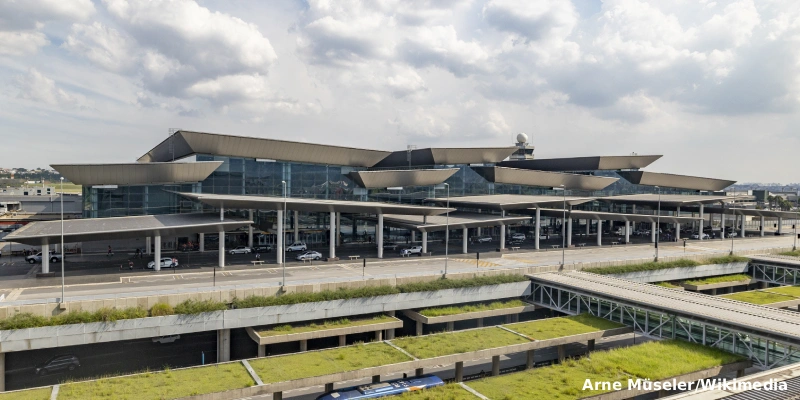
São Paulo-Guarulhos International Airport, Brazil’s largest, is preparing for an ambitious investment plan that will transform its infrastructure in the coming years. The announcement was made by the Minister of Ports and Airports, Silvio Costa Filho, who detailed the amounts, the origin of the resources, and the expected impact on Brazilian aviation.
An Investment Plan Combining Public and Private Capital
According to the report, investments in Guarulhos will reach R$ 2.5 billion by 2029. Of this total, approximately R$ 1.5 billion will come from private resources contributed by the concessionaire GRU Airport, while the remainder will correspond to public investment.
The minister explained that, by adding the projects planned for Guarulhos and Congonhas Airport, both located in the state of São Paulo, the total volume of investments exceeds R$ 8 billion, considering both state and private capital.
Detail of Resources Allocated to Guarulhos
In the specific case of Guarulhos, the disbursements amount to R$ 2.55 billion, focused mainly on the modernization and expansion of airport infrastructure. Of the total amount, R$ 1.98 billion will be distributed across different key areas of the airport complex.
The investments include the expansion of aprons and runways, with a budget of R$ 606.3 million, in addition to interventions in passenger terminals for R$ 546.6 million. The baggage system will receive R$ 365.6 million, while the cargo terminal will have R$ 147.9 million.
Resources were also allocated for the electrical system, with R$ 127.6 million, improvements to the road system and internal mobility for R$ 87.4 million, information technology with R$ 51.6 million, and parking facilities, which will have R$ 50.4 million.
Security and Terminal Modernization
The plan includes other actions aimed at reinforcing airport security, totaling R$ 365.4 million. This is in addition to the retrofit of passenger terminals, with an investment of R$ 206.9 million.
This amount is divided between civil works, which will receive R$ 91.8 million, equipment acquisition for R$ 77.6 million, and air conditioning systems, with R$ 37.6 million allocated for that purpose.
Operational Monitoring After Wind-Related Cancellations
During his remarks, Costa Filho pointed out that the ministry created a working group together with the National Civil Aviation Agency (Anac). The objective is to monitor the impacts caused by strong winds recorded in São Paulo over the last two days, a situation that led to the cancellation of more than 110 flights.
Sustained Growth of Air Traffic in Brazil
The minister stated that aviation is experiencing its “best moment.” He recalled that when President Luiz Inácio Lula da Silva assumed the government, Brazil registered 98 million passengers per year, a figure that is currently approaching 130 million.
According to his statements, the increase of more than 30 million travelers reflects the strengthening of both business and leisure tourism, with a direct impact on the national economy.
As of September 30, domestic aviation accumulated growth of over 10% for the year, while international traffic showed an increase of more than 12%, data that the minister deemed relevant for the sector.
Boost for the National Aeronautical Industry
Costa Filho also highlighted the recovery of Brazilian airlines and mentioned the recent purchase of 74 Embraer aircraft by Latam, an operation that reinforces the local industry. He indicated that he will soon hold a meeting with Gol with the aim of encouraging new acquisitions of aircraft manufactured in Brazil.
The minister compared the national situation with other markets: in the United States, 50% of the fleet corresponds to Boeing; in France, 49% uses Airbus aircraft. In Brazil, only 12% of the planes are Embraer, a proportion that, following Latam’s purchase, will reach 18%.
The government’s goal is to reach 20% by the end of the four-year term, as part of a strategy to strengthen the Brazilian aeronautical industry and consolidate the growth of the air sector.
Related Topics
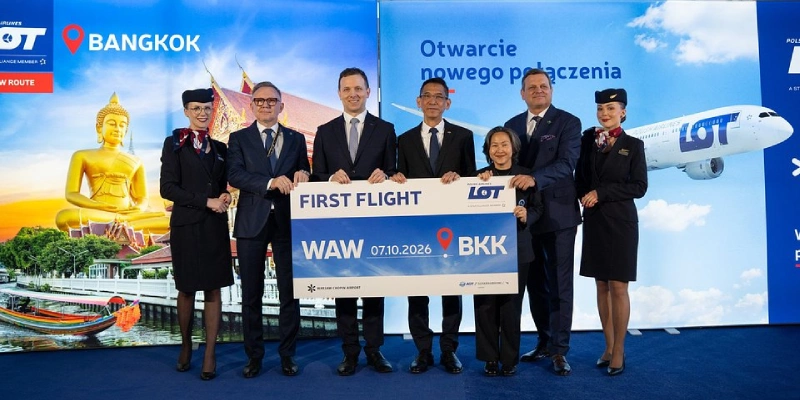
LOT Polish Airlines Launches Direct Flights Between Warsaw and Bangkok
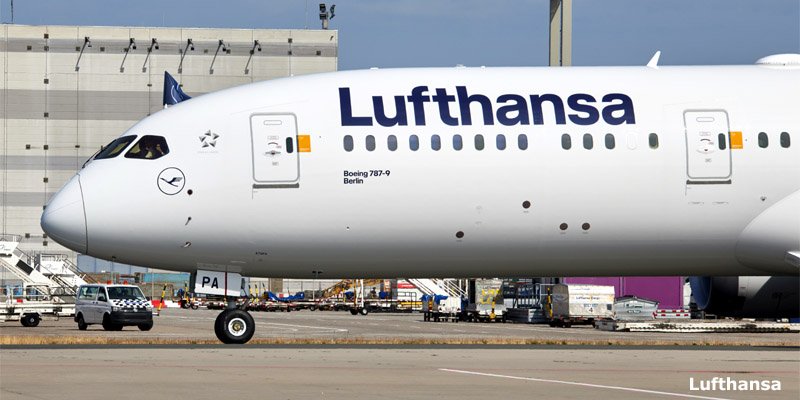
Lufthansa Group Boosts Connectivity to Japan, Reaching Up to 50 Weekly Flights in Summer 2027

Thai Airways Cuts Flights and Faces Baggage Handling Collapse Following Severe Bangkok Flooding

Akasa Air in Talks With Boeing for Over 200 737 MAX Jets


Plataforma Informativa de Aviación Comercial con 13 años de trayectoria.