
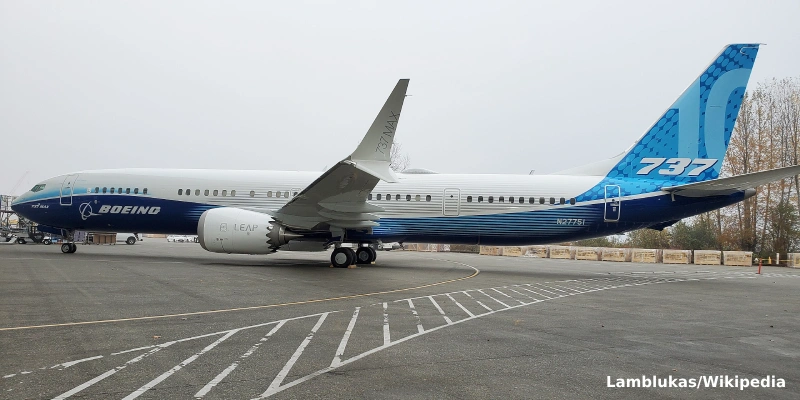
The U.S. Federal Aviation Administration (FAA) has authorized the Boeing 737 MAX 10, the largest variant of the 737 MAX family, to proceed to the second phase of its certification campaign. This is a significant milestone for a program that has accumulated years of delays. However, this advance comes with caveats: the main technical issues remain unresolved, and the path to full certification is still uncertain.
The information was confirmed to Reuters by a source familiar with the program, in a context where Boeing urgently needs to stabilize its product portfolio, restore cash flow, and halt the loss of market share to Airbus.
What the Phase 2 of 737 MAX 10 Testing Entails
The FAA’s second phase of flight testing focuses on the aircraft’s critical systems, including:
- Avionics
- Propulsion
- Other key design elements
This step validates that the program continues to progress from a regulatory standpoint but does not equate to imminent certification. In fact, one of the main delay factors remains open.
Engine Anti-Icing Problem Remains Unresolved
The most sensitive point of the program continues to be the issue with the engine anti-icing system, a technical problem that has impacted both the MAX 10 and the MAX 7, the smallest variant in the family.
→ Boeing Requests Emissions Exemption from FAA to Sell 35 777F Jets
According to the source, the FAA’s authorization does not apply to the MAX 7, confirming that both programs are advancing at different paces and that the technical issue still lacks a certified solution.
This same problem has been repeatedly cited as the main cause of the accumulated delays for both models, despite Boeing having previously stated its expectation to complete certification of the MAX 7 and MAX 10 within this year.
A Critical Aircraft for Boeing’s Finances
The start of 737 MAX 10 deliveries is considered by industry analysts as fundamental to improving Boeing’s revenue and cash flow. The model’s commercial importance is backed by concrete figures:
- More than 1,200 firm orders in Boeing’s backlog, according to data from consultancy Cirium.
- Direct competition with the dominant Airbus A321neo in the higher-capacity single-aisle segment.
Each additional month of delay exposes Boeing to the risk of continuing to lose market share, especially among airlines seeking growth with higher-density, longer-range aircraft.
Market Pressure and Customer Support
Despite the uncertainty, some customers maintain their confidence. Just this week, Alaska Airlines ordered 105 Boeing 737 MAX 10s, and its CEO, Ben Minicucci, stated that he is confident the aircraft will be certified this year.
The order reinforces the model’s strategic relevance but also increases pressure on Boeing and the FAA to close the pending technical issues without compromising safety standards.
A Program that Advances, But Still Without a Finish Line
The move of the 737 MAX 10 to Phase 2 of certification is undoubtedly a positive signal after years of delays and heightened regulatory scrutiny. However, the engine anti-icing problem remains unresolved, and the lack of a clear certification date prevents Boeing from fully activating its industrial and commercial strategy.
Final certification, more than just a formality, will be the true turning point. Until then, progress will continue to be measured, observed, and, above all, conditional.
Related Topics
Airbus Plans to Accelerate A350 Production Ramp-Up and Evaluates Higher-Capacity Variants
Global Aviation Services Market to Double, Surpassing $420 Billion by 2045, Says Airbus
Avolon Orders 250 Aircraft from Airbus and Boeing
Airbus A321XLR: Reshaping Transatlantic Routes and Replacing Boeing 757

Plataforma Informativa de Aviación Comercial con 13 años de trayectoria.