
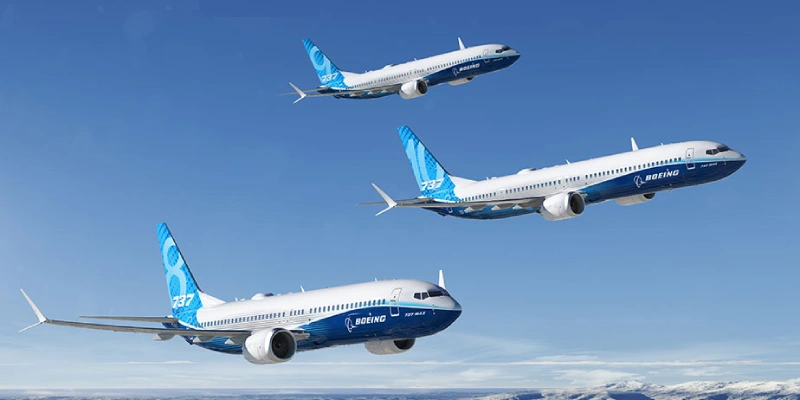
Commercial aviation in India and South Asia is poised for a large-scale structural transformation. According to Boeing’s latest Commercial Market Outlook (CMO), the region’s airlines will require nearly 3,300 new commercial aircraft by 2044. This demand is driven by a sustained 7% annual growth in passenger air traffic over the next 20 years.
This forecast does more than just quantify future deliveries; it illustrates a profound shift in the scale, complexity, and ambition of the Indian and South Asian aviation markets. The region is set to evolve from being predominantly domestic to establishing itself as a major player in international passenger and cargo networks.
A Fleet Quadrupling in Two Decades
The projected growth is substantial. The region’s commercial fleet, which currently totals 795 aircraft, is expected to reach 2,925 planes by 2044—effectively nearly quadrupling in size in just two decades.
This increase addresses both net demand growth and the need to replace aging aircraft. In this evolving landscape, operational efficiency and network flexibility have become critical factors for profitability. The primary engine of this expansion will remain India’s domestic traffic, supported by:
- Growth of the middle class.
- Economic expansion.
- Progressive migration from rail to air transport.
- Sustained investment in airport infrastructure and connectivity.
Absolute Dominance of Single-Aisle Aircraft
One of the report’s most significant findings is the clear hegemony of single-aisle aircraft, which will account for approximately 90% of all predicted deliveries for the region.
Projected Deliveries by Aircraft Type (2025–2044)
- Single-aisle: 2,875 aircraft
- Widebody: 395 aircraft
- Freighters: 20 aircraft
- Regional jets: Fewer than 10 units
- Total: 3,290 aircraft
The preference for the single-aisle segment stems from the need to maximize operational flexibility on short- and medium-haul routes, where growth is fastest and cost pressure is constant.
India as an International Hub: Long-Haul Renaissance
While single-aisle planes dominate in volume, the report highlights a strategic expansion in the widebody segment. Boeing projects that the South Asian widebody fleet will more than triple by 2044.
This growth is directly linked to India’s ambition to consolidate its position as:
- An international passenger hub, offering connections to the Middle East, Europe, and North America.
- A relevant air cargo node, leveraging its geographical positioning and industrial growth.
Diversifying long-haul networks will allow regional airlines to capture international traffic without relying exclusively on external hubs.
Air Cargo and E-commerce: A Silent Multiplier
The report also emphasizes the growing role of the freighter market, fueled by the growth of high-tech manufacturing in India and the accelerated expansion of e-commerce.
As a result, the regional fleet of new and converted freighter aircraft is expected to grow to five times its current size over the next 20 years. Although the absolute number of deliveries (20 aircraft) is limited, the strategic and operational impact is significant, particularly for high-value supply chains.
Parallel Challenges: Services and Human Talent
Fleet growth cannot happen in isolation. Boeing estimates the region will require more than $195 billion in aviation services, including:
- Maintenance, Repair, and Overhaul (MRO).
- Digital services.
- Training and technical education.
Simultaneously, the aviation ecosystem in India and South Asia must onboard approximately 141,000 new professionals. This breakdown includes:
- 45,000 pilots.
- 45,000 maintenance technicians.
- 51,000 cabin crew members.
The availability and training of this talent will be a critical factor in ensuring that growth projections materialize without operational bottlenecks.
As Ashwin Naidu, Boeing’s Managing Director of Commercial Marketing for Eurasia and the Indian Subcontinent, noted: “As air transport becomes more integral to the mobility of people and goods in India and South Asia, airlines will strengthen networks, scale fleets, and invest in services and technical personnel”.
Related Topics
Embraer Reports Record Third-Quarter Performance With 66 Aircraft Delivered
Embraer Nears Key Regional Jet Order from Japan Airlines
BermudAir Becomes Second Global Operator of Embraer E-Freighter

ANA Expands Regional Fleet with Additional Order for Eight Embraer E190-E2s


Plataforma Informativa de Aviación Comercial con 13 años de trayectoria.