
Southwest Airlines has officially entered a new chapter in its service model by introducing assigned seating and premium seat options, a historic decision that marks the definitive end of one of the most distinctive features of the US carrier. The change, implemented simultaneously across its entire network, directly responds to customer demand for greater variety and control over their onboard experience, the company stated.
Far from being an incremental adjustment, this move represents the culmination of an 18-month transformation process, with profound implications for operations, passenger experience, and Southwest’s brand identity.
Farewell to Open Seating: A Carefully Orchestrated Transition
The most potent symbol of this change was seen on the night of Monday, January 26th, when flight WN1791, between Honolulu and Los Angeles, became the last flight with open seating in the airline’s history. The farewell was neither casual nor discreet: Southwest organized a gate celebration and a traditional flight blessing, led by Senior Vice President and Chief Communications Officer, Whitney Eichinger, alongside corporate historian Richard West.
The gesture reflects the cultural weight of open seating within the company, a model that for decades was synonymous with operational simplicity and differentiation from its competitors.
→ Southwest Partners with Turkish Airlines to Offer Transatlantic Flights Starting in January
First Flights with Assigned Seating: A Debut in Two Time Zones
Tuesday morning marked the formal start of the new scheme, with two inaugural assigned seating flights, strategically scheduled to depart simultaneously from different time zones in the eastern United States.
WN3575: San Juan — Orlando
The first flight departed from San Juan, Puerto Rico, to Orlando, Florida, with commemorative events at both the departure airport and upon arrival. The event was led by Tony Roach, Executive Vice President and Chief Customer & Brand Officer, who symbolized the commercial and customer experience focus behind the decision.
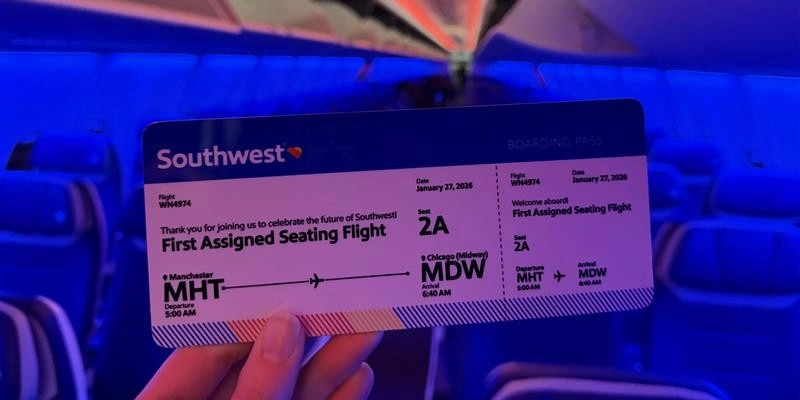
WN4974: Manchester — Chicago Midway
Simultaneously, flight WN4974 took off from Manchester, New Hampshire, bound for Chicago Midway, under the supervision of Justin Jones, Executive Vice President of Operations. His presence underscores the operational impact of the new model, which involves adjustments to boarding processes, cabin assignment, and ground coordination.
A New Cabin and a New Boarding Process: More Options for the Passenger
Southwest’s new scheme introduces three clearly differentiated seat categories:
- Extra Legroom seating, aimed at customers who prioritize additional space.
- Preferred seating, with preferential location within the cabin.
- Standard seating, which replaces the logic of “choose your seat when boarding.”
This redesign is accompanied by a group-based boarding process, leaving behind the classic open-row ordering. Although the announcement refers to a previous update for the complete details of the new “gate experience” and the enhanced cabin, the airline makes it clear that this is a comprehensive experience, not just a reassignment of seats.
Leadership Endorsement and the Magnitude of Change
The strategic importance of this milestone was reflected in the presence of the company’s top leadership at the Command Center of its corporate headquarters in Dallas. CEO and Vice Chairman Bob Jordan, alongside COO Andrew Watterson and CIO Lauren Woods, personally oversaw the implementation and acknowledged the work of the employees involved.
This level of executive involvement suggests that the transition to assigned seating is not a tactical concession, but a structural redefinition of the Southwest product.
In this way, Southwest abandons one of the last major elements that set it apart from its traditional competitors in the US domestic market. For an airline that built its identity on simplicity and differentiation, this step marks a clear turning point, the real impact of which will begin to be measured starting today, flight by flight.
Related Topics

Aeromexico Plans to Launch Flights to Caracas in Q1 2027 and Evaluates Making Santiago Seasonal Route Year-Round
Copa Airlines Ramps Up Americas-Wide Campaign for Margarita Island Ahead of Porlamar Route Launch
LATAM Airlines Strengthens Regional Leadership with Five Honors at the 2026 World Travel Awards

Copa Airlines Restores Operations Following Seismic Activity in Panama and Expands Commercial Flexibility Policies


Un apasionado por la aviación, Fundador y CEO de Aviación al Día.