

Air India faces a new operational challenge after one of its Airbus A350s suffered engine damage upon landing at New Delhi’s Indira Gandhi International Airport, an incident that could lead to disruptions on the airline’s strategic routes. The event, confirmed by both the company and the Indian aviation authority, once again brings into focus ground risk management and the operational resilience of the most modern fleets.
What Happened: Timeline and Confirmed Causes
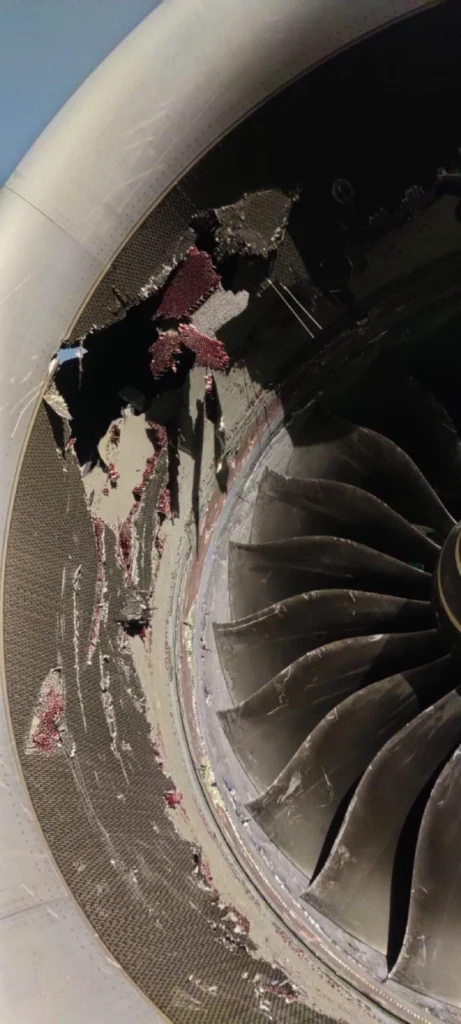
According to Air India, the aircraft came into contact with a “foreign object” while taxiing in dense fog conditions. Subsequently, India’s Directorate General of Civil Aviation (DGCA) clarified that the damage was caused by a loose cargo container, which fell from a vehicle and ended up on one of the airport’s taxiways.
The incident occurred at 5:25 a.m. local time this Thursday. The DGCA released images on social media showing a hole in the inner part of the engine air intake, damage that necessitates a thorough inspection before any return to service.

→ Air India Seeks New CEO Amid Intense Scrutiny Over Operational and Safety Failures
A Flight Affected by Regional Geopolitics
The A350 involved was bound for New York but was forced to return to its departure airport due to the temporary closure of Iranian airspace. This restriction, which lasted about five hours, was in response to concerns over a potential military escalation between the United States and Iran, a situation that led numerous airlines to cancel, divert, or delay flights in the region.
Although Iran has since reopened its airspace, the geopolitical context was a key factor in the aircraft being on the ground again in New Delhi at the time of the incident.
Operational Impact: A Small Fleet, Critical Routes
Air India currently operates six Airbus A350s, deployed on high-profitability routes connecting New Delhi with London, New York, and Newark. These services are also covered by Boeing aircraft, which could offer some degree of flexibility, though not without commercial and product impact.
The airline confirmed that the aircraft remains grounded for a thorough investigation and necessary repairs, warning that this could cause disruptions on some A350-operated routes. However, it has not specified which flights or frequencies might be affected—a key point for assessing the real impact on the long-haul network.
Beyond the specific damage, the episode underscores the importance of ground controls and the management of airport equipment, especially in congested airports and under adverse weather conditions. For an airline seeking to reposition itself globally with a modern fleet, every A350 counts, and any unavailability has effects that go beyond maintenance.
Related Topics
FAA Poised to Certify Boeing 737 MAX 10 Next Week Following Key Safety Review Clearance

Boeing Posts Best Month of 2026 With 57 Aircraft Delivered in September
Southwest Airlines Evaluates Widebody Aircraft, Eyes Boeing 787

Avolon Orders 250 Aircraft from Airbus and Boeing


Plataforma Informativa de Aviación Comercial con 13 años de trayectoria.