
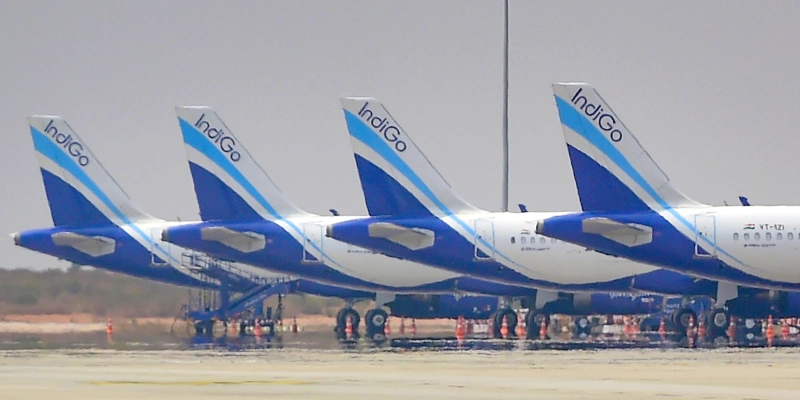
The Indian government has requested detailed average fare data from the country’s major airlines following the massive disruptions in December, as part of an antitrust investigation against IndiGo for alleged abuse of a dominant position in a highly concentrated market.
Disruptions, Capacity, and Market Power
The end of 2025 left the Indian air market in an uncomfortable situation for regulators and airlines alike. The combination of a pilot shortage, limited seat supply, and a seasonal rebound in demand exposed the structural tensions of a system dominated by a single player. IndiGo controls about 65% of the domestic market, a share that amplifies any operational problem and magnifies its impact on fares and national connectivity.
The mass cancellations recorded in December not only affected punctuality and passenger experience but also reopened the debate on dynamic pricing, demand elasticity, and the line between legitimate commercial management and possible market abuse in crisis contexts.
What Data the Regulator is Requesting and Why It Matters
Request for Average Fares by Route and Cabin
The Directorate General of Civil Aviation (DGCA), the sector’s safety and oversight authority, sent a formal request to IndiGo, Air India, Air India Express, SpiceJet, and Akasa Air asking for precise information on:
- Average fares per operated route
- Segmented by economy and premium economy
- For the period December 1 to 15
The request, reviewed by Reuters, responds to a direct petition from the Competition Commission of India (CCI), which seeks to identify fare patterns during the period of greatest operational disruption.
→ Air India Seeks New CEO Amid Intense Scrutiny Over Operational and Safety Failures
The Trigger: Cancellations and Fare Spikes
IndiGo was forced to cancel approximately 4,500 flights in a single month due to a lack of pilots, leaving thousands of passengers stranded and drastically reducing available capacity on multiple routes. In that context, fares on certain airlines soared, leading the government to impose temporary price caps to contain the political and social impact of the crisis.
One of the most sensitive points in the file is a complaint accusing IndiGo of canceling flights and then reselling seats on alternative services at significantly higher prices, a practice that, if proven, could be interpreted as abuse of a dominant position.
Scope of the Investigation
For now, there is no indication that the CCI is formally expanding the investigation to other airlines. However, the request for data from the entire ecosystem suggests a comparative approach: assessing whether the fare increases responded to homogeneous market dynamics or whether there were atypical behaviors attributable to the specific weight of a single operator.
Signals for Airlines and Regulators
For airlines, the message is clear: in concentrated markets, operational resilience and capacity management are as strategic as cost structure. An internal disruption—such as a lack of crews—can quickly turn into regulatory risks if it translates into abrupt fare increases.
For regulators, the case sets a relevant precedent in an expanding market. India is one of the countries with the highest RPK growth worldwide, and the balance between free market, consumer protection, and effective competition will be key to sustaining that growth without distortions.
From the passenger’s perspective, the episode reinforces the perception of vulnerability to mass cancellations and price hikes in high-demand contexts, a factor that can erode confidence if not managed with transparency.
A Case to Watch Closely
The investigation against IndiGo and the request for fare data open a stage of increased regulatory vigilance in Indian aviation. The outcome will depend on whether the CCI can demonstrate a direct correlation between operational disruptions and abusive commercial practices, or whether the data confirms market behavior aligned with supply and demand.
In any scenario, the case leaves a lesson for the global industry: in a tight capacity environment, the line between commercial efficiency and antitrust scrutiny is becoming increasingly thin. What happens in India could become a reference for other emerging markets with similar structures and accelerated growth.
Related Topics

Satena to Launch Direct Flights Between Montería and Panama City in October

LATAM Airlines Dismisses Rumors Regarding the Creation of a Venezuelan Subsidiary

Avianca Bolsters Argentina Connectivity: Daily Service to Cordoba and Revamped In-Flight Experience
British Airways Expands Network for Summer 2027: Touches Down in Tanzania and Boosts Latin American Capacity by 25%

Plataforma Informativa de Aviación Comercial con 13 años de trayectoria.