
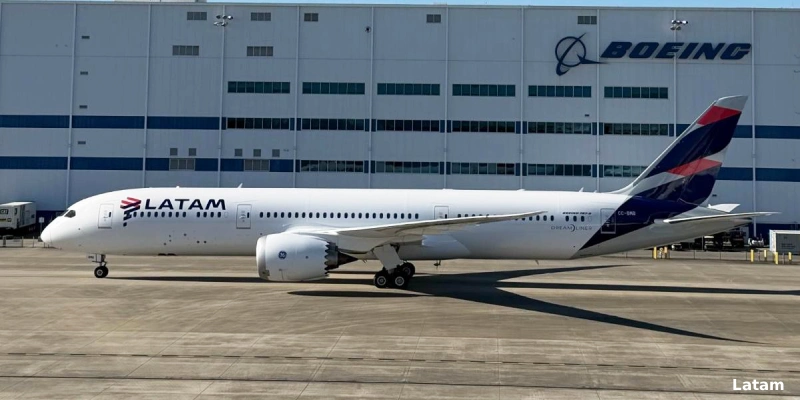
LATAM Airlines took a new step in its growth strategy by announcing the reception of its first Boeing 787-9 Dreamliner equipped with GEnx engines from GE Aerospace. With this delivery, the company becomes the first airline group to operate this specific model in South America, reinforcing its position within the regional market and its long-haul international network.
The aircraft completed its delivery flight from Charleston, South Carolina, in the United States, to Santiago, Chile. In the coming days, it will begin to be integrated into the group’s intercontinental route operations.
Operational Efficiency and Environmental Improvements
According to information provided by the manufacturer, the GEnx engines—an acronym for General Electric next-generation—offer up to a 15% reduction in fuel consumption compared to the previous generation. This performance also translates into lower CO₂ and NOx emissions, along with reduced noise and higher levels of reliability and durability.
These characteristics make the Boeing 787-9 with this engine a key component for airlines seeking to optimize operating costs while simultaneously advancing sustainability goals.
→ LATAM Inaugurates Direct Flight Between Recife and Buenos Aires
A Strategic Addition to the International Network
Sebastián Acuto, Director of Fleet and Projects at LATAM Airlines Group, highlighted the significance of this arrival within the group’s plan. As he explained, the combination of the Boeing 787-9 with GEnx engines represents a major step forward towards more efficient and sustainable operations by reducing fuel consumption and emissions, in addition to providing greater flexibility to adapt to different markets and routes.
Acuto stated that this addition is fundamental to strengthening the long-haul network and supporting the projected international growth for the coming years.
A Fleet Plan Looking Towards 2030
The arrival of this Dreamliner is part of an ambitious growth and modernization program. By the end of 2025, LATAM had a total fleet of 371 aircraft, having added 26 new aircraft during that year, all corresponding to latest-generation models.
For 2026, the group projects the addition of 41 more aircraft, including the first Embraer models that will become part of its fleet. In 2027, the arrival of another 27 units is expected, among which will be the company’s first Airbus A321XLR.
Over 130 New Aircraft by the End of the Decade
Looking at the long term, LATAM plans to add more than 130 aircraft from various manufacturers by 2030. This growth will allow the expansion of the destination network and improve efficiency in medium and long-haul operations.
With this sustained investment, the group estimates that over 50% of its fleet will be composed of latest-generation aircraft by the end of the decade, consolidating a strategy focused on operational efficiency, international expansion, and the continuous modernization of its operations.
Related Topics

Allegiant Air Orders Six Additional Boeing 737 MAX Jets
Airbus Projects Global Freighter Fleet to Reach 3,460 Aircraft by 2045

Airbus Projects Demand for 2,720 New Passenger Aircraft in Latin America Over Next 20 Years
End of an Era: Lufthansa Retires Airbus A340-600 Fleet After 23 Years of Service


Plataforma Informativa de Aviación Comercial con 13 años de trayectoria.