
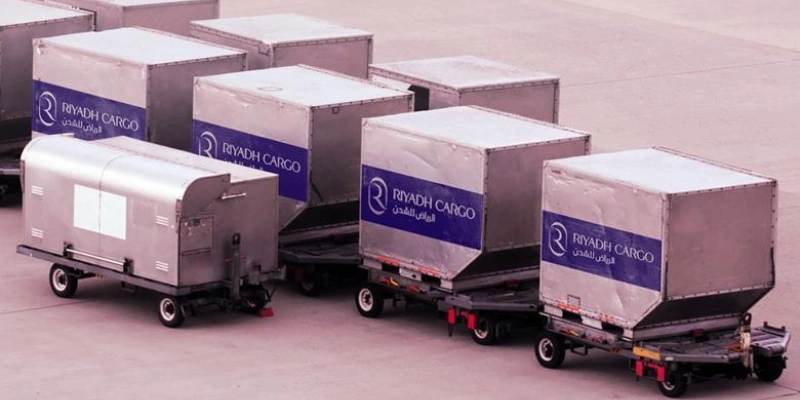
Riyadh Air, Saudi Arabia’s new national airline, took a key step in its growth strategy with the official launch of Riyadh Cargo, its dedicated brand for air freight operations. This announcement marks the company’s formal entry into the competitive global air cargo market and activates, from this initial phase, the utilization of belly-hold cargo capacity in its future long-haul fleet.
Far from being a complementary initiative, cargo is positioned as a structural pillar of Riyadh Air’s business model, aligned with the Kingdom’s strategy to transform Riyadh into an intercontinental logistics hub.
An Integrated Cargo Strategy from Day One
Riyadh Cargo relies on a key asset: over 120 wide-body aircraft currently on order, whose capacity will be used to connect global markets efficiently and reliably. The airline has defined a deliberately gradual approach, designed to scale the cargo business in parallel with network expansion and the operator’s operational maturity.
This vision avoids haphazard growth and aims to build an integrated cargo platform, anchored at the Riyadh hub, with standardized processes and long-term adaptability.
Initial Operations: London Heathrow as a Testing Ground
As part of an internal process called Pathway to Perfect, Riyadh Cargo has already begun live operations on the Riyadh-London Heathrow route, where it has demonstrated significant operational tempo. This corridor has seen relevant volumes of goods transported, including:
- Apparel and textiles
- Fresh flowers
- Seafood products
- Tea and coffee
The diversity of these commodities is significant. It reflects the operation’s ability to handle perishable, time-sensitive, and high-value cargo—an indispensable requirement for competing in major global air freight flows.
→ Riyadh Air Unveils “Hafawa Lounge,” Its First Premium Lounge at Riyadh Airport
Operational Discipline and Scalability as Core Principles
“Riyadh Cargo has been built with a clear focus on operational discipline, reliability, and long-term scalability,” explained Pravin Singh, Global Head of Cargo at Riyadh Air. According to the executive, operating from an early phase in a live environment allows for testing, adjusting, and refining processes while delivering tangible value to customers from the start.
Digitalization as a Competitive Edge
True to its digital DNA, Riyadh Cargo has integrated dedicated cargo management systems, centralized airway bill control, and higher levels of data visibility. These elements enable:
- Greater operational transparency
- Faster, better-informed decisions
- Consistent service levels
A particularly relevant point is the centralized management of airway bill inventory with 24/7 access, considered a critical operational advantage in highly complex environments.
CHAMP Cargo spot-neo and Smart ULDs
On the technological front, Riyadh Cargo has selected CHAMP’s Cargo spot-neo, a next-generation digital platform covering the complete air cargo cycle. The system enhances operational control and responsiveness as volumes and network complexity increase.
This is complemented by a strategic investment in lightweight and durable ULDs (Unit Load Devices) with digital tracking, managed in collaboration with Unilode. These devices enable real-time monitoring, inventory optimization, and greater operational efficiency, especially during irregular operations, while also contributing to sustainability benefits.
Infrastructure and Handling: Partnership with SATS Saudi Arabia
On the ground, cargo operations and hub management are carried out in partnership with SATS Saudi Arabia Company. Services are provided at the country’s major airports:
- King Khalid International Airport (Riyadh)
- King Fahd International Airport (Dammam)
- King Abdulaziz International Airport (Jeddah)
These facilities feature modern infrastructure, specialized handling zones, and centralized management, allowing for real-time oversight and smooth cargo connections. Riyadh Cargo also anticipates benefiting from dedicated facilities and expanded capabilities to enhance the customer experience.
A Key Component of a Much Larger Ambition
Riyadh Air projects a total fleet of over 180 aircraft and a network of more than 100 destinations by 2030. According to company estimates, this expansion could generate around USD 20 billion in contribution to Saudi Arabia’s non-oil GDP and support over 200,000 direct and indirect jobs globally.
In this context, Riyadh Cargo emerges as a strategic enabler, not only for the airline’s growth but also for consolidating the Kingdom’s position as a leading global aviation and logistics hub.
For now, no details were provided on whether Riyadh Cargo will consider adding dedicated freighter aircraft in the future, nor the specific timeline for cargo route expansion—aspects that will be key to measuring its positioning against established operators.
Related Topics
LATAM Airlines Strengthens Regional Leadership with Five Honors at the 2026 World Travel Awards

Copa Airlines Restores Operations Following Seismic Activity in Panama and Expands Commercial Flexibility Policies

Arajet Resumes Direct Flights Between Punta Cana and Guayaquil

LATAM Airlines Announces Nonstop Flights Between Santiago de Chile and Caracas Starting in January


Un apasionado por la aviación, Fundador y CEO de Aviación al Día.