Berlin Airport Suspends Operations for Second Consecutive Day Due to Persistent Freezing Rain
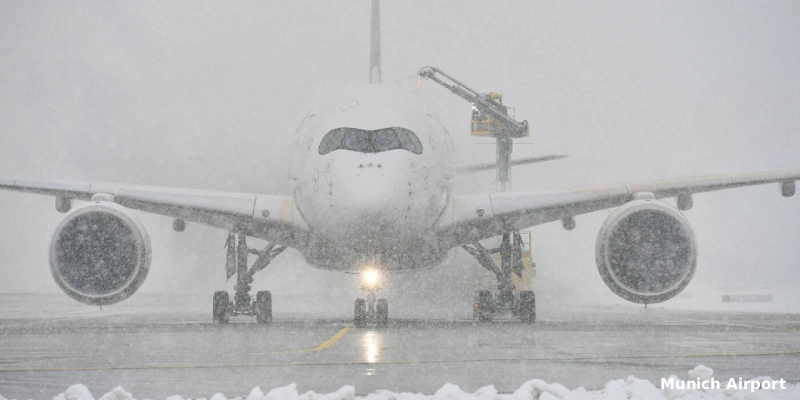




Berlin Brandenburg Airport (BER), Germany’s third busiest aviation hub, was forced to once again suspend takeoffs and landings on Friday morning. This move extended an operational crisis that began the previous day, triggered by severe weather conditions—primarily freezing rain and the formation of black ice.
The situation has once again highlighted the operational limits of major European airports when faced with persistent winter phenomena, emphasizing the delicate balance between safety, punctuality, and capacity.
Full Suspension of Operations: The Airport’s Decision
In an official statement published on its website, the airport was categorical: “Due to weather conditions, takeoffs and landings are currently not possible”.
The measure particularly impacted Friday morning operations, following dozens of cancellations already recorded on Thursday for the same reason.
→ Madrid-Barajas Airport’s T4 Celebrates Its 20th Anniversary
Unlike other adverse weather episodes that allow for limited or staggered operations, the freezing rain combined with near-zero temperatures left critical surfaces—runways, taxiways, and aprons—in conditions that did not meet the safety margins required for commercial aviation.
De-icing Under Pressure: Doubled Times and Compromised Efficiency
One of the most significant operational data points revealed by the airport was the substantial increase in de-icing times. According to a BER spokesperson cited by the DPA agency, the de-icing process was taking up to one hour per aircraft, more than double the usual time.
This factor, which is critical for any operations director or fleet planner, has a direct impact on:
- Aircraft rotation
- Slot utilization
- Crew management
- Network punctuality, especially at hub airports
Although airport staff worked through the night to clear the runways, their efforts were only partially successful, as the persistent freezing rain continued to regenerate ice layers and slippery surfaces at the start of Friday’s workday.
Resumption Without a Set Schedule: Operational Uncertainty
The airport spokesperson indicated that operations would resume on Friday afternoon, though without specifying an exact time, maintaining a scenario of high uncertainty for both airlines and passengers. Even during the early afternoon, delays and cancellations continued to be recorded.
The airport advised passengers to constantly check their flight status before traveling to the terminal—a standard instruction in these contexts that nevertheless underscores the fragility of operations when weather exceeds predicted margins.
Related Topics

Japan Airlines Selects Embraer E190-E2 to Renew J-AIR Regional Fleet

AirAsia in Talks with Malaysian Government Over Potential Financial Support Amid Economic Headwinds and Soaring Fuel Costs

LOT Polish Airlines Launches Direct Flights Between Warsaw and Bangkok

Lufthansa Group Boosts Connectivity to Japan, Reaching Up to 50 Weekly Flights in Summer 2027

Plataforma Informativa de Aviación Comercial con 13 años de trayectoria.