
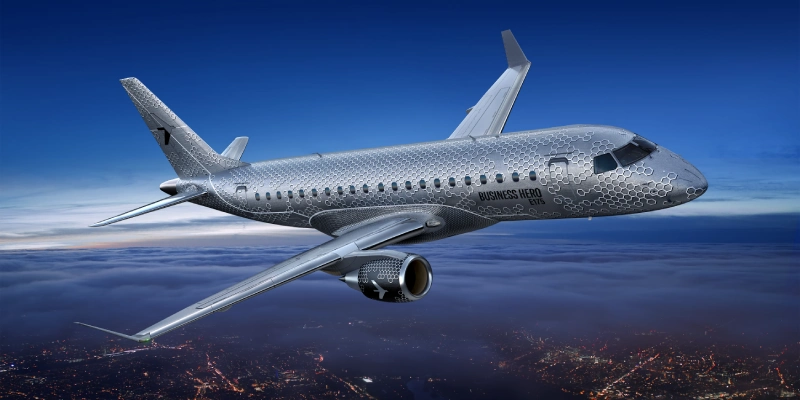
Adani Defence & Aerospace and Embraer have taken a decisive step in their industrial partnership by exchanging an enhanced Memorandum of Understanding (MoU) to establish an E175 Final Assembly Line (FAL) in India. This initiative is framed within the country’s Regional Transport Aircraft (RTA) program.
The agreement was formalized by Francisco Gomes Neto, President and CEO of Embraer, and Jeet Adani, Director of Adani Defence & Aerospace. The ceremony took place in the presence of the President of Brazil, Luiz Inácio Lula da Silva, and India’s Minister of Commerce and Industry, Piyush Goyal.
This advancement expands upon the initial MoU signed in January 2026. It integrates into a broader roadmap designed to develop an integrated RTA ecosystem in India while strengthening the strategic bilateral relations between India and Brazil.
A Comprehensive Industrial Ecosystem Around the E175
The industrial agreement extends beyond the mere installation of an assembly line. Both companies are working collaboratively across all aspects of the MoU, including:
- Aircraft manufacturing
- Supply chain development
- Aftermarket services
- Pilot training
- Order intake to support the proposed FAL
The objective is to build a holistic ecosystem for the E175, aligned with the Indian strategy to bolster domestic industrial capabilities in the aerospace sector.
Jeet Adani emphasized that regional aviation is the backbone of economic expansion, particularly as initiatives like UDAN transform air connectivity in Tier 2 and Tier 3 cities. According to the director, developing an indigenous regional ecosystem has become a critical necessity.
Similarly, Ashish Rajvanshi, President and CEO of Adani Defence & Aerospace, noted that this initiative is part of a commitment to “Aatmanirbhar” (self-reliant) aviation. He highlighted its direct impact on generating high-skilled employment and positioning India within the global aerospace industry.
→ Embraer Delivered 244 Aircraft in 2025
India: One of the Fastest-Growing Regional Aviation Markets
India is currently one of the world’s fastest-growing aviation markets in terms of passenger traffic. According to forecasts cited in the document, the country will require at least 500 aircraft in the 80-to-146-seat segment over the next 20 years.
This projection reflects a robust demand for regional and short-haul connectivity, driven by smaller, more efficient aircraft.
Francisco Gomes Neto pointed out that the E175 has a proven global track record in high-frequency, high-efficiency regional operations, and that India represents a key growth market for this segment. For Embraer, the progress of this MoU constitutes a critical milestone in the partnership and the joint effort to secure the orders necessary to sustain the future assembly line.
E175 as a Platform for the Indian Regional Market
With a capacity for up to 88 passengers, the E175 is positioned as a solution tailored to untapped market opportunities in India, specifically in Tier 2 and Tier 3 cities. These routes, traditionally underserved by larger aircraft, could benefit from:
- Opening of new connections
- Enhanced regional connectivity
- More reliable operations
- Accelerated expansion of regional air transport
Strategic Role of Adani Defence & Aerospace
Adani Defence & Aerospace stands as the largest integrated private player in India’s defense and aerospace sector. The company develops capabilities in aerospace and UAV (Unmanned Aerial Vehicle) manufacturing aligned with national security priorities and global requirements.
The group also possesses the country’s largest MRO (Maintenance, Repair, and Overhaul) ecosystem and a rapidly expanding pilot training platform, allowing it to cover the aeronautical value chain from end to end. Its portfolio spans aircraft, unmanned systems, avionics, weaponry, and sustainment services, with a sustained focus on long-term capability development and national self-reliance.
Should the E175 Final Assembly Line in India materialize, the country would not only advance its Regional Transport Aircraft program but also position itself as a new production hub within the Brazilian manufacturer’s global ecosystem.
The next step involves the consolidation of orders to support the industrial viability of the assembly line—a key element in turning this proposal into an operational reality.
Related Topics
FAA Mandates Inspections on Nearly 2,000 Boeing 737 NGs Over Horizontal Stabilizer Oscillations
GE Aerospace Ramps Up GEnx Deliveries, Outpacing Boeing 787 Handover Rate
FAA Certifies Boeing 737-10: Largest Member of MAX Family Is Cleared for Deliveries
Boeing Unveils Dataliner: Next-Gen AI-Powered Aircraft Data Platform


Un apasionado por la aviación, Fundador y CEO de Aviación al Día.