Ryanair Redefines Maintenance Strategy: Signs Multi-Billion Dollar Deal with CFM to Internalize Engine MRO Starting in 2029
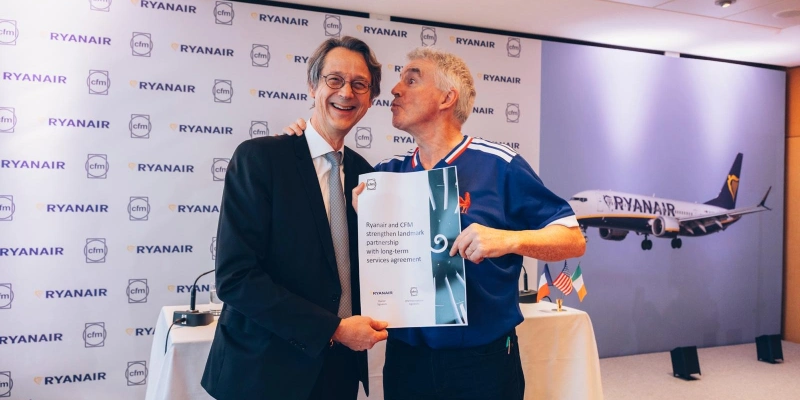




Ryanair has taken a major strategic step regarding its operational and cost model. The Irish airline and CFM International—the 50/50 joint venture between Safran Aircraft Engines and GE Aerospace—signed a Memorandum of Understanding (MoU) this Tuesday, laying the groundwork for a multi-year, multi-billion dollar engine spare parts support agreement.
This move not only consolidates a three-decade relationship but also anticipates a structural shift: Ryanair will internalize its engine maintenance starting in 2029, with the opening of two MRO (Maintenance, Repair, and Overhaul) shops in Europe.
The agreement is designed to support the group’s accelerated fleet growth, which projects reaching 800 Boeing 737 aircraft and more than 2,000 CFM engines in the coming years.
From “Power by the Hour” to In-House Maintenance
For the past 30 years, maintenance for Ryanair’s CFM56 engines was conducted under long-term “power by the hour” contracts, where CFM assumed comprehensive support management in exchange for a payment per flight hour. This model, common for young and expanding fleets, will begin to change toward the end of the decade.
According to the MoU, Ryanair commits to purchasing all of its engine spare parts directly from CFM International. This contract will cover both the CFM56-7B and the LEAP-1B engines, installed on current and future Boeing 737 NG and 737 MAX aircraft.
Starting in 2029, with the entry into operation of two proprietary engine MRO centers, the airline will take over tasks internally that were previously outsourced. To achieve this, it will place substantial orders for initial spare parts provisioning with CFM, specifically intended to support the opening and operation of these facilities.
→ Ryanair Eyes Free Wi-Fi Within 3 to 5 Years: A Promise Contingent on Tech Breakthroughs
Over $1 Billion a Year in Spare Parts
One of the most significant aspects of the agreement is its economic scale. Throughout its duration, Ryanair expects to commit to direct spare parts purchases from CFM International totaling more than $1 billion annually. According to the company, this figure is expected to be maintained even after maintenance is fully internalized, including the supply of replacement engines and parts.
In the words of Michael O’Leary, CEO of the Ryanair Group, the agreement extends a historic partnership and prepares the airline to operate:
“What will be one of the largest commercial aviation fleets in the world, as well as one of the largest sets of Boeing 737 engines in the world”.
The executive emphasized that the transition to in-house maintenance will be carried out with the direct support of CFM, Safran, and GE Aerospace—a key factor in mitigating technical and operational risks for a fleet of this magnitude.
CFM, Safran, and GE Strengthen the Open MRO Ecosystem
On the industrial side, the agreement aligns with the manufacturers’ strategy. Olivier Andriès, CEO of Safran, noted that the simultaneous growth of the CFM56—which still has a massive presence in the global fleet—and the rapid expansion of the LEAP, necessitates investment in a global MRO network based on an open and competitive ecosystem.
According to Safran, the goal is clear: to optimize fleet efficiency and control airline operating costs in a context of high maintenance demand and market capacity constraints.
For his part, H. Lawrence Culp, Jr., Chairman and CEO of GE Aerospace, focused on two critical variables for low-cost airlines: capacity and turnaround times. The MoU with Ryanair, he stated, seeks to respond to growing demand while reducing the total cost of engine ownership.
The decision to internalize engine MRO is a significant undertaking. It involves substantial investments, the development of proprietary technical capabilities, and complex inventory management; however, it also provides Ryanair with greater control over costs, planning, and fleet availability. For a group operating with tight margins and record volumes, every incremental improvement in efficiency has a direct impact on the bottom line.
Related Topics

Avianca to Permanently Resume Direct Flights Between Cali and Miami

U.S. Airlines Prioritize High Fares Over Load Factors to Counter Soaring Jet Fuel Costs

Record Revenue, Red Ink: Fuel Costs Take a Toll on American Airlines in Q3 2026

Southwest Posts Record Q3 2026 Operating Revenue, Accelerates Commercial Transformation

Plataforma Informativa de Aviación Comercial con 13 años de trayectoria.