Singapore to Establish World’s First Airport Testbed for Next Generation Propulsion Technologies
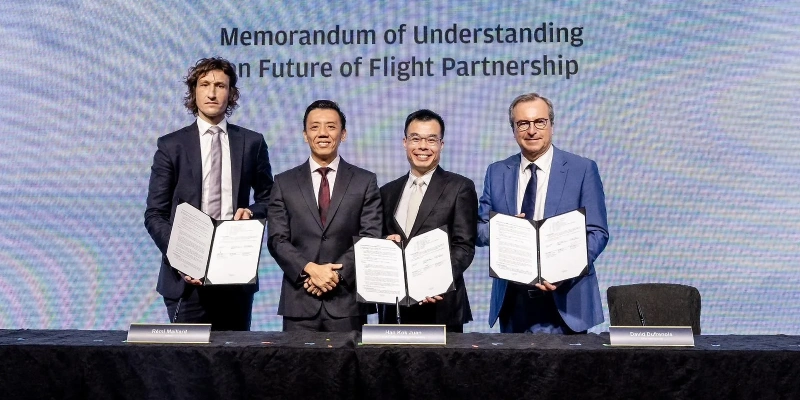




The Civil Aviation Authority of Singapore (CAAS), CFM International, and Airbus have signed a Memorandum of Understanding (MOU) to establish Singapore as the world’s first airport field laboratory dedicated to real-world testing of next generation propulsion technologies, specifically focusing on the Open Fan architecture of the RISE program.
The agreement was formalized on February 2, 2026, during the 3rd Changi Aviation Summit. It brings together three key players in the global aeronautical ecosystem with a shared objective: preparing airports, manufacturers, and airlines for a new era of engines that are more efficient, less polluting, and operationally viable.
An Unprecedented Testbed for Open Fan Technology
The core of the agreement is both ambitious and concrete. Singapore will become the world’s first “airport testbed” to evaluate how open-architecture engines, such as CFM’s Open Fan, interact with actual airport operations.
This initiative goes beyond testing an engine in flight; it involves analyzing the entire operational ecosystem:
- Ground operations.
- Maintenance procedures.
- Interaction with existing infrastructure.
- Safety and certification standards.
- Applicable regulatory frameworks.
The ultimate goal is to develop a comprehensive readiness framework that can serve as a global model for airports, manufacturers, and airlines that will operate aircraft equipped with this type of propulsion in the future.
RISE: More Than an Engine, a Technological Platform
The agreement centers on CFM International’s RISE (Revolutionary Innovation for Sustainable Engines) program, a technology demonstration initiative aimed at the next generation of commercial aircraft, particularly in the narrow-body segment.
What makes the Open Fan different? The Open Fan architecture removes the traditional engine cowling (nacelle), which allows for:
- A larger fan diameter.
- Reduced aerodynamic drag.
- Greater propulsive efficiency.
According to CFM, the RISE program targets a fuel efficiency improvement of more than 20% compared to commercial engines currently in service. However, the scope extends beyond consumption:
- Emission reduction.
- Lower noise levels.
- Future compatibility with hybrid-electric systems.
This positions the Open Fan as a key technology for commercial aviation in the coming decades.
Specifics of the Memorandum of Understanding
The MOU signed by CAAS, CFM International, and Airbus establishes three clear lines of work:
1. Development of a Global Readiness Framework: Work will focus on integrating Open Fan engines into existing airport operations, addressing aircraft design, infrastructure modifications, operational procedures, and safety regulations.
2. Leveraging Singapore’s Aviation Ecosystem: Singapore will contribute its expertise as an integrated air hub, facilitating knowledge exchange in airport design, safety protocols, regulatory frameworks, and operating procedures.
3. Operational Trials in Real Airports: The parties plan to conduct operational tests with RISE program Open Fan demonstrators at Changi Airport and Seletar Airport. These tests will validate the readiness framework and assess the real-world operational viability of the technology.
Perspectives from Key Players
For Han Kok Juan, Director-General of CAAS, the agreement reinforces Singapore’s strategic role: “The partnership of CFM International and Airbus with CAAS to establish the world’s first airport testbed for next-generation propulsion technologies in Singapore demonstrates Singapore’s strength as an integrated air hub with solid regulatory expertise”.
From the engine manufacturer’s perspective, Gaël Méheust, President and CEO of CFM International, emphasizes the practical value: “Having the ability to conduct real-world demonstrations—from ground handling and maintenance to airport operations—will give airlines and the public confidence in the safety, durability, and efficiency of the Open Fan”.
Rémi Maillard, Executive Vice President of Engineering and CTO of Airbus Commercial Aircraft, highlights the leap in technological maturity: “Testing new propulsion systems against future operational requirements is key. And there is no better place than Singapore, with its world-class aerospace ecosystem”.
Implications for Airlines and Airports
For airline executives, this project addresses one of the great unknowns of the technological transition: how to introduce radically new engines without operational disruptions. Creating a validated reference framework reduces future risks in:
- Fleet planning.
- Adaptation costs.
- Certification and regulatory compliance.
For airports, the program offers a concrete roadmap to prepare for aircraft with unconventional propulsion configurations.
With this agreement, Singapore positions itself not only as a testing center but as the architect of the global operating standard for the next generation of aircraft engines. At a time when the industry seeks efficiency, sustainability, and regulatory certainty, the RISE program testbed may become an essential benchmark for the future of commercial aviation.
Related Topics

Boeing Detects 737 MAX Software Glitch Affecting Automated Navigation Guidance During Landing

Akasa Air in Talks With Boeing for Over 200 737 MAX Jets

Alaska Air Targets Boeing 737 MAX 10 Certification by Late September
Biman Bangladesh Airlines Expands Fleet with Follow-on Order for 11 Boeing Jets

Un apasionado por la aviación, Fundador y CEO de Aviación al Día.