
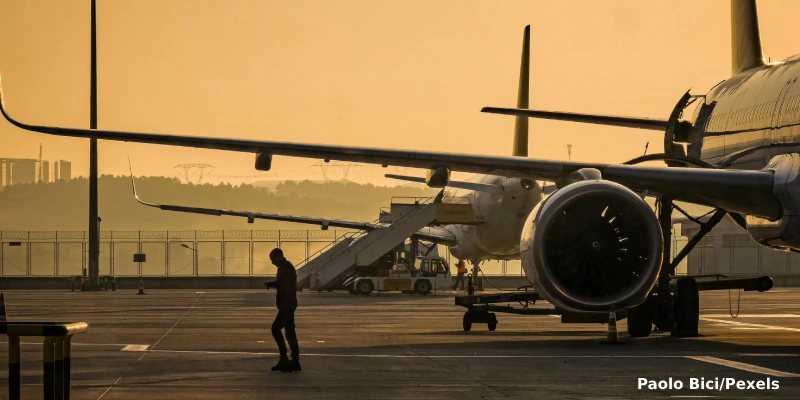
The sustained increase in oil prices is shaping up to be the most severe financial stress test for US carriers since the COVID-19 pandemic. While industry giants see opportunities for expansion, low-cost carriers (LCCs) face an imminent risk of contraction, increased debt, or, in critical cases, liquidation.
An “Opportunity” Scenario Amidst the Crisis
For airlines with robust balance sheets, the current price spike is more than just an operational challenge; it is a strategic turning point. Scott Kirby, CEO of United Airlines, has noted that if fuel prices remain elevated, opportunities will arise to acquire assets and absorb changes in route networks, suggesting that weaker competitors may be forced to yield ground.
United is preparing for worst-case scenarios, modeling costs based on Brent crude reaching $175 per barrel and remaining above $100 through 2027. Under this framework, the airline’s annual fuel bill would increase by approximately $11 billion—a figure that doubles its highest historical annual profit.
Vulnerability of Low-Cost Carriers
Fuel represents nearly a quarter of an airline’s operating costs. Because tickets are sold weeks or months in advance, companies are left exposed when crude prices rise faster than they can adjust their fares.
According to the rating agency Moody’s, low-cost carriers and ultra-low-cost carriers (ULCCs) will be the hardest hit. Companies such as JetBlue, Spirit Airlines, and Frontier Airlines already reported losses last year, prior to the current price rally.
- Spirit Airlines: Currently in bankruptcy proceedings, the airline warned that rising fuel costs have an “immediate and substantial” negative impact, which could derail negotiations with creditors and force a liquidation.
- Frontier Airlines: With $874 million in liquidity and net losses last year, the carrier has little room to maneuver within a business model predicated on low fares.
- JetBlue: Lacking fuel hedges and facing cash burn projections for this year, the airline appears highly vulnerable.
→ American Airlines Elevates Lounge Experience at Miami Hub
Strengths and Challenges Among Legacy Carriers
Delta Air Lines and United possess the greatest capacity to absorb this prolonged shock without abandoning their current strategies. Both generated the highest operating margins in the sector last year and boast a higher proportion of revenue from premium services.
Conversely, American Airlines faces a dual situation. While it projects ending the quarter with more than $10 billion in liquidity, it carries $25 billion in long-term debt. The airline’s CEO, Robert Isom, indicated that every one-cent increase in the price of a gallon of fuel adds $50 million to annual costs.
Other industry players are adjusting their structures:
- Southwest Airlines: Despite a solid balance sheet, the fuel shock could pressure earnings and force difficult decisions regarding cash allocation.
- Alaska Air Group: In the midst of integrating Hawaiian Airlines, the company has raised fares to offset costs, maintaining operational capacity while reviewing its expenditure structure.
Toward a New Industry Consolidation?
History suggests that these cost spikes often transform the market. The 2008 crisis triggered a wave of mergers that consolidated the industry into four major carriers.
However, J.P. Morgan analysts predict that this cycle will widen competitive gaps before leading to formal consolidation, favoring airlines with stronger brand loyalty after 2027.
The impact is already visible: jet fuel recently reached $4.24 per gallon, compared to $2.50 prior to the military tensions in the Middle East, according to Airlines for America (A4A). As Ed Bastian, CEO of Delta, warned, the impact of nearly doubling the primary operating cost overnight is significant for those companies lacking an absorption margin.
With information from Reuters
Related Topics
British Airways Expands Network for Summer 2027: Touches Down in Tanzania and Boosts Latin American Capacity by 25%

Copa Airlines Restores Second Daily Flight to Caracas, Venezuela

Avianca Strengthens Cross-Border Network: Launches Daily Flights Between Bogotá and Maracaibo, Venezuela

LATAM to Expand International Connectivity With New Direct Route Between Santiago de Chile and Salvador de Bahia


Plataforma Informativa de Aviación Comercial con 13 años de trayectoria.