
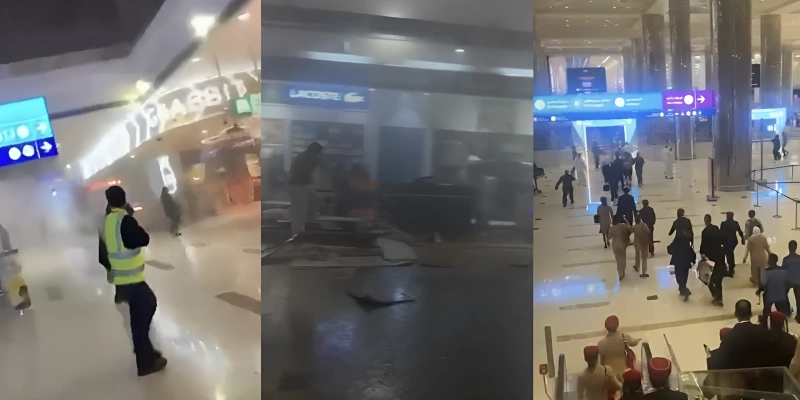
Operational safety in the Middle East has been severely compromised following recent strikes launched by the U.S. and Israel against Iran, and subsequent Iranian retaliations. This situation forced the immediate closure of airspace across multiple nations, including Israel, Qatar, Syria, Iran, Iraq, Kuwait, and Bahrain.
As a direct consequence of these restrictions:
- More than 3,400 flights were canceled during Sunday’s operations across seven of the region’s primary airports.
- Critical logistics hubs, such as Dubai International Airport, Zayed International Airport in Abu Dhabi, and Hamad International Airport in Doha, suspended operations.
- Emirates suspended all services to and from Dubai until at least Sunday afternoon.
- Qatar Airways reported that Doha’s airport would remain closed until at least Monday morning.
Direct Impact on Airport Infrastructure
Unlike other conflicts where closures are purely preemptive, direct attacks against civilian facilities were reported in this instance. Authorities in the United Arab Emirates condemned what they described as a “blatant attack with Iranian ballistic missiles”.
- Dubai International Airport (DXB): Four injuries were reported following the incidents.
- Zayed International Airport (AUH): A drone attack resulted in one fatality and seven injuries.
- Kuwait International Airport (KWI): Attacks were also recorded at its facilities.
Although Iran has not publicly claimed responsibility, Gulf governments attribute these actions to a retaliation that exceeded the military objectives initially intended.
Operational and Financial Consequences for Airlines
The economic and logistical impact on the industry is profound. The three major “Gulf Carriers”—Emirates, Qatar Airways, and Etihad Airways—typically move approximately 90,000 passengers daily through their respective hubs.
Rerouting and Costs
To maintain connectivity between Europe, Africa, and Asia, airlines must divert their flights, primarily overflying Saudi Arabian airspace. This entails:
- Increased Flight Time: Routes will add several additional hours of flight time.
- Higher Fuel Consumption: A direct increase in operating costs that could be passed on to ticket prices if the conflict persists.
- Air Traffic Control (ATC) Pressure: Controllers in Saudi Arabia will face airspace saturation, which could force a slowdown of traffic for safety reasons.
Recovery Outlook
Industry analysts warn that travelers should prepare for persistent delays and cancellations in the coming days. For its part, El Al is already preparing recovery efforts to repatriate Israeli citizens stranded abroad once the situation normalizes.
Experts suggest that airspace utilization will evolve over the next 24 to 36 hours as kinetic activity zones are defined and Iran’s remaining missile launch capacity is assessed. However, the precedent of June 2025, where a similar conflict lasted 12 days, creates uncertainty regarding the total duration of this crisis.
Passenger Note
Airlines urge all travelers to check their flight status online before heading to any terminal. Some carriers are issuing waivers to allow itinerary changes without additional fees.
Related Topics
LATAM Airlines Strengthens Regional Leadership with Five Honors at the 2026 World Travel Awards

Copa Airlines Restores Operations Following Seismic Activity in Panama and Expands Commercial Flexibility Policies

Arajet Resumes Direct Flights Between Punta Cana and Guayaquil

LATAM Airlines Announces Nonstop Flights Between Santiago de Chile and Caracas Starting in January


Plataforma Informativa de Aviación Comercial con 13 años de trayectoria.