RTX Achieves Key Hybrid-Electric Propulsion Milestone: Full-Power Testing Success
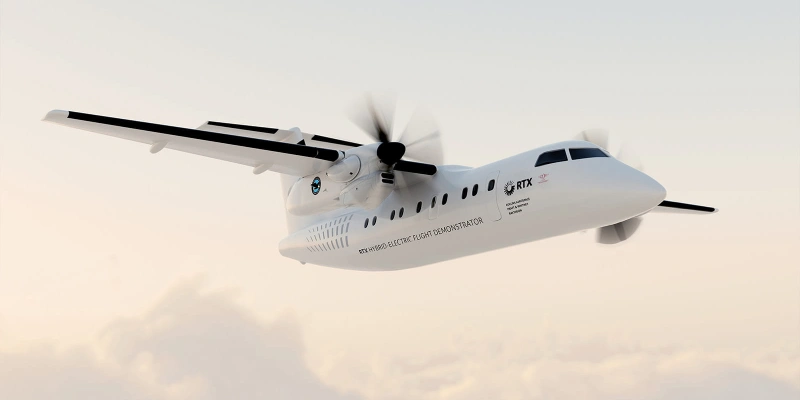




RTX has successfully completed full-power system testing of the propulsion and battery systems for its Hybrid-Electric Flight Demonstrator. This technological breakthrough, which promises to improve fuel efficiency by 30%, marks a turning point in the development of more sustainable regional aircraft.
A Cutting-Edge Propulsion Architecture
The project is a strategic collaboration within RTX that integrates the capabilities of its core business units and external partners. The system will be installed on a modified De Havilland Canada Dash 8-100 aircraft, specifically designed to demonstrate the potential of hybrid propulsion on short-haul and regional routes.
The demonstrator configuration combines:
- An advanced thermal engine from Pratt & Whitney Canada.
- A 1-megawatt (MW) electric motor developed by Collins Aerospace.
- A 200-kilowatt-hour (kWh) battery system from the startup H55, backed by RTX Ventures.
A specialized gearbox system connects both engines to drive the propeller, allowing power to be sourced from the thermal engine, the electric motor, or both simultaneously.
→ GE Aerospace to Invest Additional $1 Billion to Boost U.S. Production in 2026
Optimized Efficiency by Flight Phase
Unlike conventional thermal engines, which only convert between 30% and 40% of their fuel into useful energy, electric systems exceed 90% efficiency in mechanical power conversion. The RTX demonstrator seeks to capitalize on this advantage by assigning specific tasks to each energy source:
- Taxi, Takeoff, and Climb: The electric motor will handle the bulk of the workload during these high-energy demand phases.
- Cruise: The thermal engine will be responsible for powering the aircraft during level flight.
This load distribution not only optimizes consumption but also aims to minimize the energy required to transport a passenger from point A to point B, drastically reducing the carbon footprint per passenger-mile.
Technical Challenges: Weight and High Voltage
The transition of electric technology from automotive to aviation faces two critical obstacles: battery weight and the management of high voltage levels.
Managing Energy Density
In aviation, weight is a deciding factor; excess battery weight reduces payload capacity (passengers or cargo). To counteract this, the team from Collins Aerospace and the RTX Technology Research Center have implemented novel materials, wide-bandgap semiconductors, and magnet technologies that increase power density without adding significant weight.
Safety in High-Voltage Systems
The system operates at voltage levels that exceed any current standard in commercial aviation, creating risks of overheating and electric arcing (electricity jumping between components). To mitigate these risks, a modular and highly protected battery system has been designed, featuring:
- Fireproof enclosures with gas and flame venting capabilities.
- Modular weight distribution throughout the aircraft.
- Safety mechanisms tested by the European Union Aviation Safety Agency (EASA).
Next Steps: From the Control Room to Flight
Following six years of development and the recent validation of full power on the ground, the team is preparing for the physical integration phase. The hardware will be shipped to AeroTEC in Moses Lake, Washington, for installation on the Dash 8-100.
Over the next year, the team will continue ground testing before conducting the first flight. This milestone will not only validate the technology in real-world conditions but also help establish new certification standards for the future generation of hybrid-electric aircraft.
Related Topics

Boeing Pays $3.1 Million FAA Fine over Multiple Safety Violations

FAA Mandates Inspections for Select Boeing 787s Over Potential Structural Defects

Boeing Delivers 53 Jets in July, Down 11 From June

FAA Orders Inspection of Hundreds of Boeing 737 MAX Aircraft Over Potential Fuselage Cracking

Un apasionado por la aviación, Fundador y CEO de Aviación al Día.