Teruel Airport Once Again Becomes a “Refuge” for Airline Fleets Amid Middle East Conflict
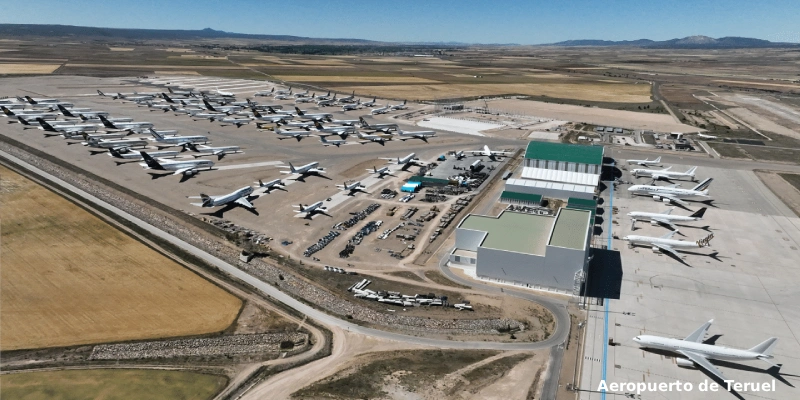




Teruel Airport is once again operating as a massive storage hub for commercial aircraft due to airspace closures and the reconfiguration of international routes caused by the conflict with Iran.
Impact of the Conflict on International Fleet Planning
The current military situation with Iran has forced several countries to close their airspace, compelling airlines to divert flights and restructure their operational schedules. This instability, coupled with potential risks to the aviation fuel supply chain (Jet Fuel), has led carriers to seek secure facilities to temporarily park their fleets.
Alejandro Ibrahim, the terminal’s General Director, explained that this is an exceptional situation: “Companies are reviewing their fleets and routes, looking for safer locations to park their aircraft, and Europe meets those requirements.” Ibrahim emphasized that Teruel is once again providing fundamental support for global air transport during a time of crisis.
Qatar Airways Leads the Arrival of Wide-Body Aircraft
According to the projected operational schedule, the airport is expected to receive approximately 20 aircraft by the end of this week. Of this total, 17 aircraft belong to Qatar Airways, which has actively sought refuge at the Spanish platform.
During Friday’s operations, several wide-body aircraft—the largest commercial planes in the world—were recorded landing at the facility:
- Airbus A380: A unit from the Qatari airline landed mid-morning arriving from London.
- Airbus A350 and Boeing 787: At least two A350 units and one 787 were already on-site by late Friday afternoon.
→ Madrid-Barajas Named “Best European Airport with over 40 Million Passengers”
Teruel: Technical Capacity and Climatological Advantages
Located in the province of Aragón—an area highlighted by the “Empty Spain” (España Vaciada) demographic phenomenon—Teruel Airport has established itself as one of the most significant maintenance and storage centers on the continent. Its facilities have the capacity to house up to 250 wide-body aircraft and up to 400 narrow-body aircraft.
Three determining factors make this enclave the preferred choice for international operators:
- Optimal Climate: Its dry environment, free of salt spray, is ideal for preserving metallic structures and electronic components, effectively preventing corrosion.
- Industrial Operability: As it is not a passenger airport, aircraft can remain parked on taxiways and aprons without interfering with conventional commercial traffic.
- Proven Track Record: During the COVID-19 pandemic, the terminal managed the simultaneous storage of approximately 140 aircraft.
Business Outlook and Aeronautical Maintenance
Despite the surge in storage demand, airport management emphasizes that its primary economic activity remains aircraft maintenance. Quick-cycle maintenance contracts are what generate the highest value and industrial activity for the region.
Currently, management is working on a week-to-week planning basis, as there is no clear horizon regarding the duration of the conflict in the Middle East or the evolution of airline needs. “What we would like is for the conflict to end, because our core business is maintenance. The more planes fly, the more activity our airport sees,” Ibrahim concluded.
Related Topics
LATAM Airlines Strengthens Regional Leadership with Five Honors at the 2026 World Travel Awards

Copa Airlines Restores Operations Following Seismic Activity in Panama and Expands Commercial Flexibility Policies

Arajet Resumes Direct Flights Between Punta Cana and Guayaquil

LATAM Airlines Announces Nonstop Flights Between Santiago de Chile and Caracas Starting in January

Plataforma Informativa de Aviación Comercial con 13 años de trayectoria.