
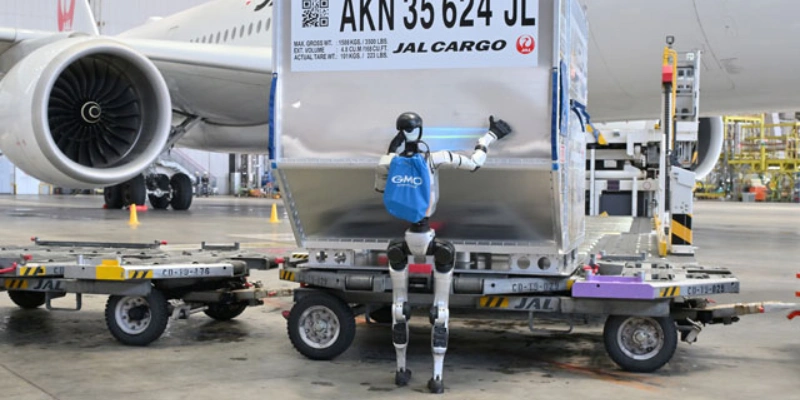
Japan is set to begin a pioneering experiment at Tokyo-Haneda Airport in May 2026, aimed at integrating humanoid robots into ground operations. This project, the first of its kind in the country, seeks to mitigate labor shortages and reduce the physical burden associated with critical airport support tasks.
Innovation in Ground Handling: The Leap Toward Humanoid Robotics
JAL Grand Service, the subsidiary responsible for ground handling operations for Japan Airlines, has formalized a strategic alliance with GMO AI & Robotics Trading, a company dedicated to the social implementation of artificial intelligence and robotics. The central objective is to evaluate how humanoid robots can complement human tasks in complex airport environments.
Unlike fixed automated installations or single-function robots, which often struggle to adapt to the variable workflows of an airport, humanoid robots offer a range of motion and adaptability comparable to that of a human operator. This characteristic is fundamental for interacting with various pieces of Ground Support Equipment (GSE) without requiring costly modifications to existing infrastructure or aircraft design.
Scope and Timeline of the Haneda Airport Experiment
The demonstration, which will take place at Haneda International Airport, is projected to run between May 2026 and 2028. The roadmap is divided into strategic phases to ensure safety and efficiency:
- Visualization and Analysis: Identifying operational areas where robots can perform safely.
- Operational Verification: Repetitive testing in environments that simulate real-world operations.
- Task Integration: Validating the robot’s ability to complement human labor in specific areas.
Future tasks envisioned for these robots include baggage and cargo loading/unloading, cabin cleaning, and eventually, the operation of ground support vehicles.
A Sector Facing Demographic Challenges
The aviation industry in Japan is currently facing a labor shortage crisis driven by two primary factors: the surge in inbound tourism and a declining working-age population. Ground handling operations not only require highly qualified personnel to ensure safety during maneuvers but also involve significant physical labor.
By combining cutting-edge AI technology with the flexibility of humanoid forms, the project seeks to establish a sustainable operational structure. The ultimate goal is to achieve significant labor savings and a reduction in personnel fatigue, ensuring the continuity of airport services at Japan’s major domestic and international terminals.
Related Topics
End of an Era: Lufthansa Retires Airbus A340-600 Fleet After 23 Years of Service

ITA Airways Celebrates Its Fifth Anniversary

Condor Launches Daily Flights Between Berlin and Abu Dhabi

Lufthansa in Talks to Acquire Remaining 50.1% Stake in TAP Air Portugal Following Initial Entry


Plataforma Informativa de Aviación Comercial con 13 años de trayectoria.