
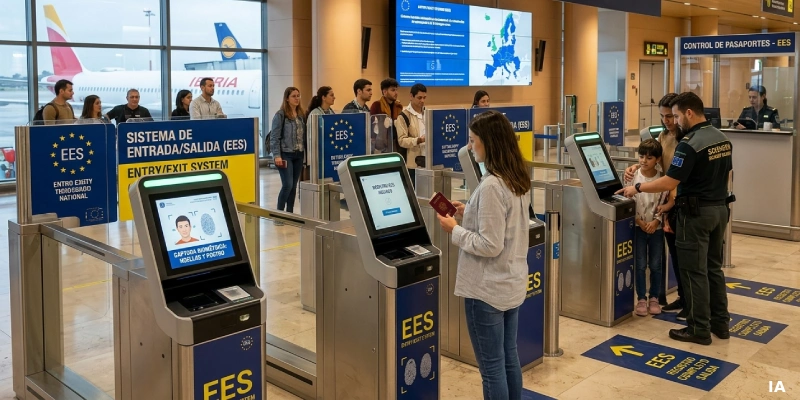
Ryanair has formally requested that the Spanish Government suspend the implementation of the European Union’s Entry/Exit System (EES) until the peak summer season concludes. According to the carrier, enforcing these new passport control measures at this time would result in unnecessary and prolonged delays for passengers traveling during the summer holidays.
Despite authorities having over three years’ notice that the EES would become fully operational on April 10, 2026, the airline claims that the minimum requirements for a seamless transition have not been met. Key deficiencies highlighted include:
- Inadequate staffing levels at border control checkpoints.
- A lack of necessary self-service kiosks for biometric data processing.
- IT system instability, characterized by recurring outages that disrupt passenger flow.
Critical Airports and Wait Times
The current situation is already impacting air connectivity across several strategic points within the Spanish network. Ryanair has reported that wait times currently exceed one to two hours at key airports, resulting in missed flights for some travelers.
→ Ryanair to Close Berlin Base Amid Rising Airport Fees and Declining Competitiveness in Germany
The airports most affected by staffing shortages and systemic failures include:
- Málaga (AGP)
- Alicante (ALC)
- Lanzarote (ACE)
- Tenerife South (TFS)
- Gran Canaria (LPA)
- Reus (REU)
- Fuerteventura (FUE)
Greek Precedent and EU Legal Framework
The airline argues that there is both a legal basis and a clear precedent for this suspension. Neal McMahon, Ryanair’s Chief Operations Officer, noted that other EU member states are adopting a more pragmatic approach. Greece, for instance, has already decided to suspend EES implementation until September to effectively manage peak summer demand.
From a regulatory standpoint, the airline points out that Regulation (EU) 2025/1534 allows governments to suspend implementation if conditions are suboptimal.
“Governments across Europe are attempting to implement a half-baked IT system during the busiest travel season of the year, and passengers are paying the price,” McMahon stated.
Formal Petitions to the Ministry of the Interior
In an effort to mitigate the impact on the industry, Ryanair has sent official communications to the governments of the 29 countries within the EES zone, including a specific letter addressed to the Spanish Minister of the Interior, Fernando Grande-Marlaska.
The solution, according to the airline, lies in postponing the system’s rollout until summer traffic pressure eases in September. This would allow Spanish authorities to finalize the installation of the required infrastructure and ensure smooth airport operations for international tourism.
Related Topics

Copa Airlines Restores Operations Following Seismic Activity in Panama and Expands Commercial Flexibility Policies

Arajet Resumes Direct Flights Between Punta Cana and Guayaquil

LATAM Airlines Announces Nonstop Flights Between Santiago de Chile and Caracas Starting in January

Satena to Launch Direct Flights Between Montería and Panama City in October


Un apasionado por la aviación, Fundador y CEO de Aviación al Día.